

You’ve invested in the latest console or a powerful gaming PC, but your display feels like it’s holding you back. That split-second delay between your controller input and the on-screen action can be the difference between victory and defeat in competitive gaming. Similarly, washed-out colors and poor contrast can rob you of the immersive experience developers intended. This guide is for gamers who demand both performance and picture quality, focusing on projectors that deliver exceptionally low input lag for responsive control and High Dynamic Range (HDR) for breathtaking visuals.
We have assessed nine leading models from trusted brands like BenQ, Optoma, ViewSonic, and XGIMI to find the best gaming projectors with low input lag and HDR. Our methodology prioritizes verified technical specifications that impact your gaming experience directly. For a broader look at high-performance displays, explore our parent category on Gaming Projectors.
Pros
- Bright 3200-lumen laser output works well in ambient light, not just dark rooms
- Low input lag and high refresh rate make it genuinely gaming-friendly for PS5, Xbox, and PC
- Laser light source offers long-term durability and consistent color performance
- Quieter operation compared to previous lamp-based models
- Flexible setup options with lens shift and keystone correction
Cons
- Software-based keystone correction can be limiting compared to true optical correction
- As a renewed unit, some buyers have reported occasional boot-up issues
- Outdated menu interface feels dated compared to newer projector UIs
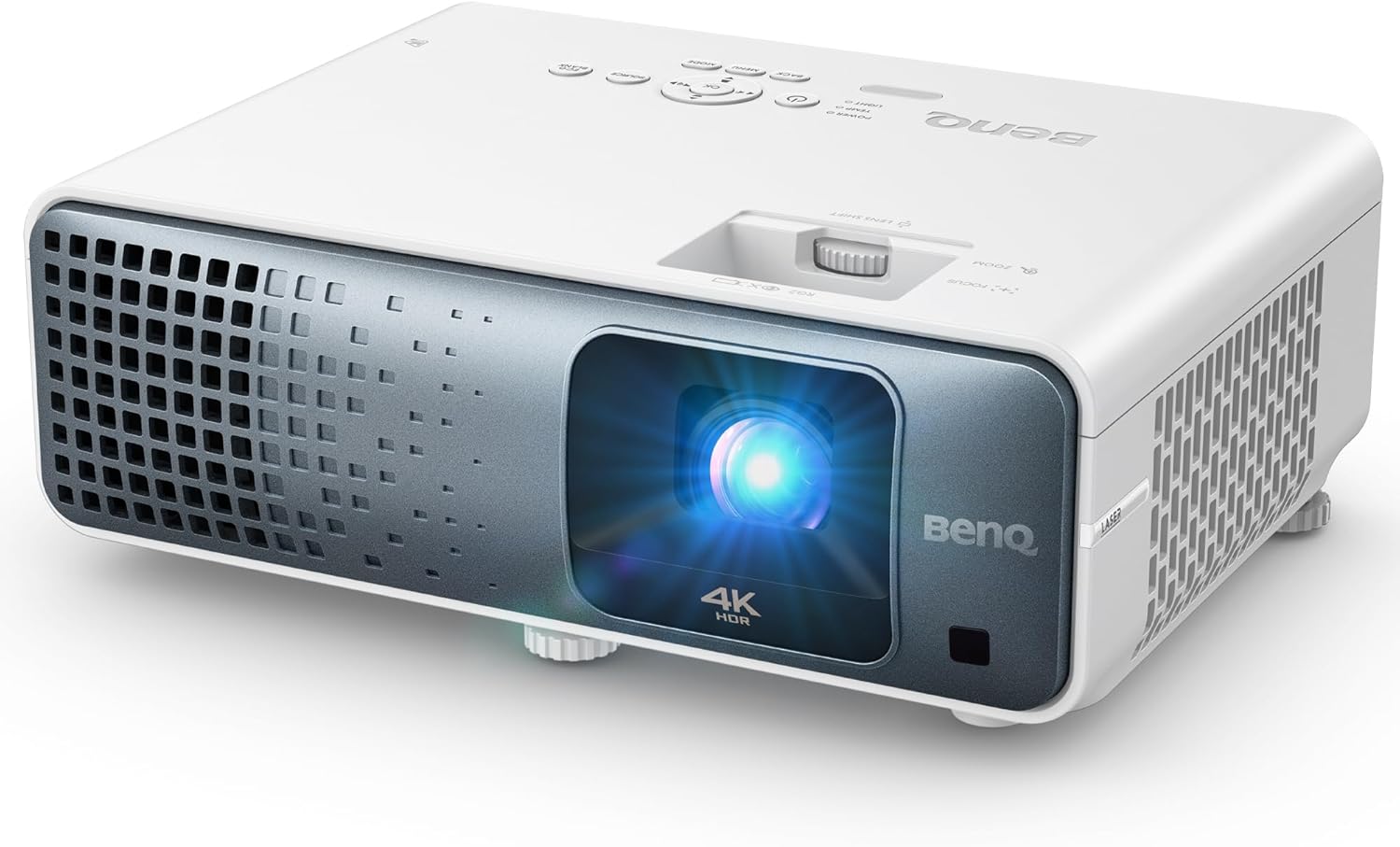
The BenQ TK710 is a 4K UHD laser projector built for home theater enthusiasts and gamers who want a bright, versatile display solution. With 3200 ANSI lumens, it stands out from typical home projectors by remaining watchable even in rooms with ambient light, making it a practical choice for living rooms rather than dedicated blackout theaters.
What really sets this projector apart is its gaming performance. A 4ms response time paired with a 240Hz refresh rate at 1080p, plus low input lag at 4K/60Hz, means it handles fast-paced titles on PS5, Xbox, and PC without noticeable lag. Combined with HDR10 and HLG support and 95% Rec.709 color coverage, both gaming and movie content look vibrant and detailed.
Build-wise, the laser light source is a major advantage over traditional lamp-based projectors, offering better color saturation and removing the hassle of periodic lamp swaps. Features like 10% vertical lens shift and ±30° 3D keystone correction add flexibility for placement, though the keystone adjustment relies on software rather than optical correction, which can introduce minor image quality trade-offs on larger or stretched screens.
On the downside, this being a renewed unit means some quality variance is possible. At least one user reported intermittent boot-up issues, a reminder to test the unit thoroughly during the return window. The menu interface also feels dated and could use a modern refresh.
Overall, the BenQ TK710 is a compelling choice for gamers and movie fans who want strong brightness, 4K clarity, and low-latency performance without spending on a brand-new unit. It's best suited to buyers comfortable with the minor risks of a refurbished laser projector in exchange for solid performance at a reduced price.

Pros
- Exceptional short-throw capability allows large 100-inch displays in rooms where traditional projectors won't fit
- Low input lag and high refresh rate support make it one of the best gaming projectors for console players
- Bright 3000-lumen output ensures clear images in various lighting conditions without blackout requirements
- Automatic keystone correction and vertical adjustment simplify setup from non-ideal mounting positions
- Award-winning design recognized by High Ground Gaming as best projector for gaming in 2019
Cons
- Lamp replacement costs can add up over time despite extended life options, requiring budget planning for long-term ownership
- Native 1080p resolution may feel limiting for users wanting 4K detail on very large projection surfaces
- Built-in 5W speaker provides basic audio but most users will want external speakers for immersive gaming sound
The BenQ TH671ST is a purpose-built gaming projector designed for console gamers and home entertainment enthusiasts who want cinematic experiences without sacrificing performance. With its ultra-low 16ms input lag and DLP technology, this projector targets serious gamers on PS4, Xbox One X, Nintendo Switch, and other platforms who demand responsive gameplay on the big screen.
The standout feature is its short-throw capability, projecting 100-inch images from just 5 feet away thanks to a 0.69-0.83 throw ratio. Combined with 1.2x zoom flexibility, the TH671ST works in compact living rooms where traditional projectors fail. Its 3000-lumen brightness with 92% Rec.709 color accuracy ensures vibrant visuals even in well-lit spaces, while the Game Mode fine-tunes shadow detail and clarity for competitive play. The automatic LumiExpert detection actively adjusts image quality based on ambient light, reducing eye strain during extended gaming sessions.
Build quality reflects BenQ's reputation with a compact 2.7kg design, dual HDMI inputs for console connectivity, and vertical keystone adjustment for flexible mounting. The projector supports up to 1080p 60Hz 3D content and includes comprehensive connectivity options. Performance is solid across picture modes, though the native 1080p resolution shows limitations on very large screens, and the 5W speaker requires supplemental audio for immersive gaming soundscapes.
Minor drawbacks include lamp replacement costs despite the extended 15,000-hour LampSave mode, and the absence of 4K support limits future-proofing for next-generation consoles. However, the 3-year warranty and US-based support provide confidence in long-term ownership and service reliability.
The BenQ TH671ST delivers excellent value for console gamers seeking big-screen action in space-constrained homes. Its combination of low input lag, short-throw projection, and bright image quality makes it a top choice for PS4 and Xbox players, though 4K enthusiasts should consider higher-end models for future content compatibility.
This projector excels in gaming environments with its 16ms input lag and microsecond DMD response time, eliminating the motion blur and lag that plague casual gaming setups. The Game Mode picture preset specifically enhances shadow detail and visual precision, giving competitive players an advantage in dark scenes and fast-paced action sequences.
Console compatibility is comprehensive, supporting PS4 Pro, Xbox One X, Nintendo Switch, and Google Stadia with dual HDMI 1.4a inputs. The refresh rate matches console output specifications, ensuring smooth frame delivery without stuttering or tearing. For esports titles and fast-action games, the low input lag maintains the responsiveness players expect from dedicated gaming monitors.
The 1080p resolution is sufficient for console gaming on screens up to 100 inches, though competitive players in larger rooms may notice some pixelation. The projector's 10,000:1 native contrast ratio delivers punchy blacks and bright highlights, enhancing visual impact during intense gaming moments.
Display Technology: DLP projection with 1.07 billion color support and RGBYCM color wheel at 2X speed (50Hz/60Hz)
Resolution: Native 1080p (1920x1080) with support up to WUXGA-RB (1920x1200), 92% Rec.709 color accuracy
Brightness and Contrast: 3000 ANSI lumens, 10,000:1 native contrast ratio for vibrant images in any lighting condition
Throw Ratio: 0.69-0.83 with 1.2x zoom, projects 100-inch image from 5 feet, up to 300-inch maximum
Keystone Adjustment: Vertical keystone correction plus/minus 40 degrees for flexible mounting angles
Connectivity: Dual HDMI 1.4a, VGA input, USB Type-A and mini-B, 3.5mm audio in/out, RS232 control
Lamp Life: 4000 hours normal, 10,000 hours eco mode, 15,000 hours LampSave mode for extended operation
Audio: Built-in 5W mono speaker, supports external audio via 3.5mm output
Dimensions: 296 x 120 x 224mm, 2.7kg weight for portable setup
Power: 320W typical consumption, AC 100-240V, 50/60Hz compatible
Warranty: 3-year limited parts and labor coverage with US-based customer support
Pros
- Excellent brightness for a short throw laser projector, usable with some ambient light
- Very low input lag makes it genuinely competitive for gaming, not just marketed as such
- Laser light source eliminates recurring lamp costs and offers instant on/off
- Compact footprint and short throw lens make placement easy in small rooms or golf sim bays
- Strong warranty coverage with 5-year or 12,000-hour light source protection
Cons
- Native resolution is 1080p, not true 4K, despite accepting 4K input signals
- Connectivity leans on HDMI and RCA, lacking newer wireless casting or smart platform integration
- At this price point, buyers expecting native 4K sharpness may be disappointed
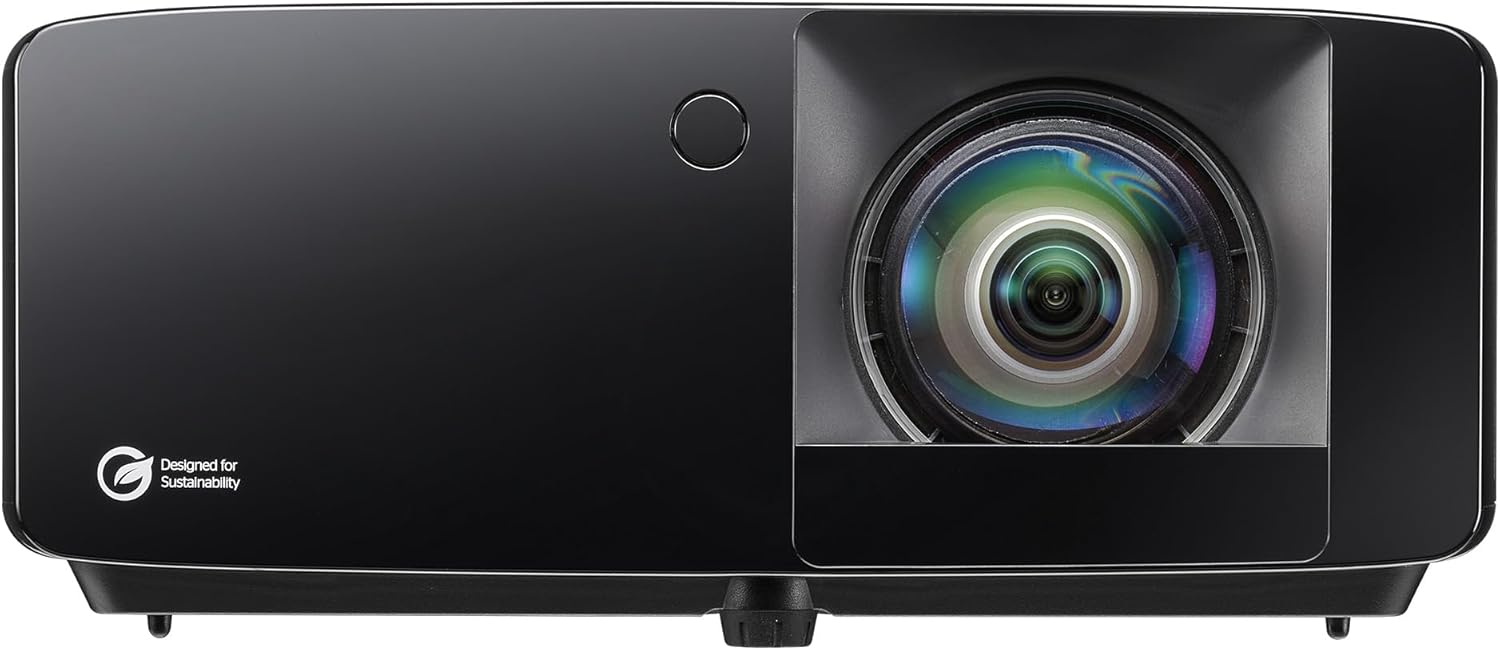
The Optoma GT2400HDR is a short throw laser projector aimed at two very specific buyers: home theater fans working with limited space, and golf simulator enthusiasts who need a big, bright image from a short distance. Its 0.496:1 throw ratio lets it fill a large screen while sitting just a few feet away, making it a practical fit for garages, basements, and media rooms where a traditional long-throw projector wouldn't work.
Brightness is the standout spec here. At 4,200 ISO lumens, the GT2400HDR holds up better than most home projectors when there's some ambient light in the room, which matters for golf sims and daytime viewing. Gamers get a real functional benefit too, with an 8.4ms input lag at 1080p120Hz in Enhanced Gaming Mode, a number that competes with dedicated gaming monitors rather than typical projectors.
Build quality centers around Optoma's DuraCore laser light source, rated for 30,000 hours in eco mode. This translates to years of use without swapping lamps, plus instant on/off and consistent brightness over time. The compact desktop form factor, at just under 9.5 pounds, supports flexible tabletop, wall, or ceiling mounting.
The main tradeoff is resolution. While the projector accepts 4K HDR10 and HLG signals, its native panel is Full HD 1080p, so it's not delivering true 4K sharpness. Connectivity is also fairly basic, relying on dual HDMI and RCA rather than modern wireless streaming options, so users will likely pair it with an external streaming device.
Overall, the GT2400HDR earns its place as a specialized tool rather than an all-purpose projector. It's a smart buy for anyone prioritizing brightness, low latency gaming, and short throw flexibility, particularly golf sim builders and space-constrained home theater setups, but 4K purists may want to look elsewhere.
Pros
- Exceptional gaming performance with industry-leading 4.2ms input lag and 240Hz refresh rate
- True 4K resolution with HDR support produces sharp, detailed, and dynamic images
- High 3200 ANSI lumen output allows use in ambient light without washing out the picture
- Versatile setup options including optical zoom, auto keystone, and 4-corner adjustment
- Long lamp life of up to 20,000 hours in SuperEco+ mode reduces long-term running costs
Cons
- At nearly $1000, it sits at a premium price point that may stretch budgets compared to entry-level 4K projectors
- The 1.1x optical zoom range is relatively narrow, which may limit placement flexibility in some room layouts
- No built-in smart TV platform means you need an external streaming device such as a Chromecast or Fire Stick
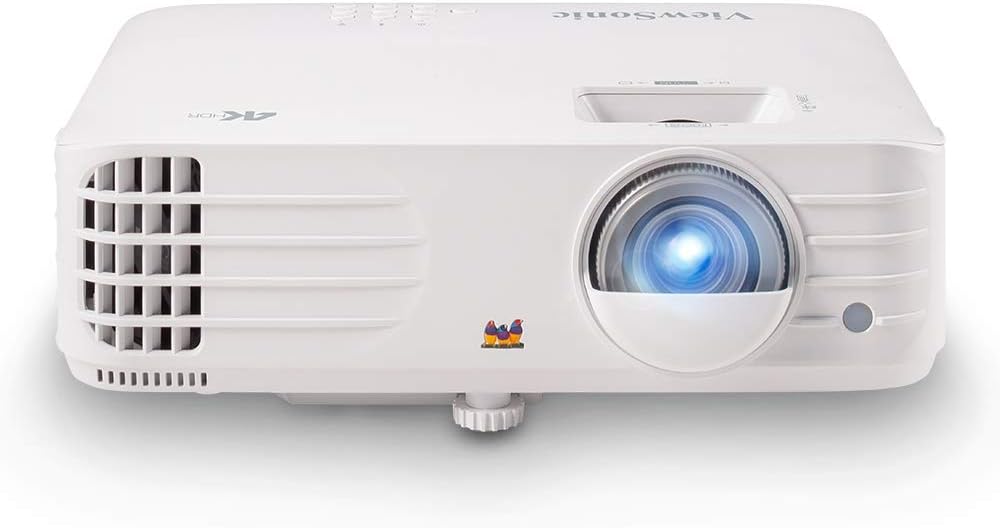
The ViewSonic PX701-4K is a true 4K UHD DLP projector designed for home theater enthusiasts and serious gamers who want a large-screen experience without investing in an oversized television. With a native 3840x2160 resolution, 3200 ANSI lumens, and support for both HDR10 and HLG, it positions itself as a versatile all-rounder that performs well in both darkened home theaters and moderately lit living rooms.
Where this projector truly stands out is in its gaming credentials. The 4.2ms input lag combined with a 240Hz refresh rate is genuinely impressive for a 4K projector at this price, putting it ahead of many competing models. Motion is smooth, fast-moving scenes remain sharp, and competitive gamers will notice a real difference compared to slower projectors. ViewSonic's SuperColor technology further enhances the experience by delivering a wide, accurate color gamut that makes both games and films look vivid and true to life.
Setup is made straightforward thanks to automatic horizontal and vertical keystone correction, 4-corner adjustment, and a built-in warping tool for curved surfaces. The 1.1x optical zoom offers some placement flexibility, though the range is modest. The projector supports ceiling mounting and can throw images from 30 inches up to a room-filling 300 inches, with a recommended maximum throw distance of 36 feet for a clear 300-inch image. Connectivity is practical, with dual HDMI ports, a powered USB-A output, and compatibility with most consoles, PCs, and streaming dongles.
On the downside, the absence of a built-in smart TV operating system means users must supply their own streaming device. The optical zoom range could be wider for greater installation flexibility, and the price point, while competitive for a true 4K gaming projector, is still a significant investment. Lamp-based projectors also require eventual bulb replacement, though the 20,000-hour SuperEco+ lifespan does mitigate this concern considerably.
Overall, the ViewSonic PX701-4K delivers a compelling combination of 4K image quality, gaming-grade responsiveness, and flexible setup features at a price that undercuts comparable large-screen TV alternatives. It is an excellent pick for anyone who wants the immersive thrill of a massive display for both movies and gaming, and is willing to add an external streaming stick to complete the setup.
Resolution: True 4K UHD (3840 x 2160p) with DLP display technology for sharp, pixel-dense imagery across all screen sizes.
Brightness and Color: 3200 ANSI lumens output with SuperColor technology, HDR10 and HLG support for enhanced contrast and a wide color gamut in varied lighting conditions.
Gaming Performance: 4.2ms input lag with a 240Hz refresh rate. Input lag activation requires enabling via advanced settings with the refresh rate set to 240Hz. Response time is based on the DMD chip.
Projection Size and Distance: Supports image sizes from 30 to 300 inches. Recommended throw distance for a 300-inch image is 36 feet. Projects an 80 to 150-inch image at a throw distance of 8.7 to 16.3 feet, with a 100-inch image achievable from 10.9 feet.
Zoom and Adjustment: 1.1x optical zoom, 0.8x to 2.0x digital zoom, automatic horizontal and vertical keystone, 4-corner adjustment, and curved surface warping tool. Throw ratio is 1.5 to 1.6.
Connectivity: Dual HDMI inputs, powered USB-A output (5V/1.5A) for wireless dongles such as Chromecast or Amazon Fire TV Stick. Compatible with gaming consoles, PCs, Macs, and mobile devices.
Lamp Life: Up to 15,000 hours in standard mode, extended to 20,000 hours in SuperEco+ mode, equivalent to approximately 13 years at 4 hours of daily use.
Mounting: Ceiling mountable, compatible with ViewSonic mount PJ-WMK-007.
Is this projector right for you? The ViewSonic PX701-4K is best suited to buyers who want a dual-purpose display for both home cinema and gaming. If you primarily watch films and sports, the true 4K resolution, HDR support, and high brightness will deliver a genuinely impressive picture. If you are a gamer, the 4.2ms input lag and 240Hz refresh rate are standout specs that rival dedicated gaming monitors on a much larger screen.
Room considerations: With 3200 lumens, this projector can handle rooms with some ambient light, but a darkened or dim environment will always produce the best contrast and color accuracy. Consider your room size carefully. The throw ratio of 1.5 to 1.6 means you will need roughly 11 feet of distance to project a 100-inch image, so measure your space before purchasing.
What you will need to add: This projector does not include a built-in smart TV platform, so plan to pair it with a streaming device such as a Chromecast, Amazon Fire TV Stick, or Apple TV. The built-in USB-A port conveniently powers these dongles without needing an extra wall adapter. A dedicated projection screen is recommended for the best image quality, though a flat white wall can work in a pinch.
Comparing alternatives: At this price tier, the PX701-4K competes with projectors like the BenQ TK700STi and Optoma UHD50X. Its 240Hz refresh rate and 4.2ms input lag give it a clear edge for gaming, while its SuperColor technology and HDR support keep it competitive for movie watching. If budget is the primary concern, entry-level 4K projectors are available at lower prices but typically sacrifice brightness, refresh rate, or input lag performance.

Pros
- Exceptional brightness and contrast from the X-Master RGB triple laser engine suits both dark and ambient-light environments
- All-in-one design with Google TV, Harman Kardon audio, and an integrated stand reduces setup complexity significantly
- Industry-leading gaming specs including 240Hz, 1ms response, VRR, and ALLM make it a rare projector for competitive and casual gaming
- Multiple HDR certifications including Dolby Vision and IMAX Enhanced ensure the highest fidelity across streaming and physical media
- Optical zoom and lens shift provide flexible placement options without image degradation
Cons
- The premium price point places it out of reach for budget-conscious buyers seeking a casual big-screen solution
- As a newly listed product with no user reviews yet, real-world long-term reliability and lamp longevity remain unverified
- Large all-in-one form factor and integrated stand may limit portability compared to compact or portable projector alternatives
The XGIMI HORIZON 20 is a flagship 4K home projector designed for users who refuse to compromise between cinema quality and gaming performance. Powered by an X-Master RGB triple laser engine, it targets home theater enthusiasts, avid streamers, and dedicated gamers who want one device to do everything exceptionally well.
The standout feature is undoubtedly the RGB triple laser light source, which produces 3200 ISO lumens and a 1,000,000:1 contrast ratio. This combination ensures colors remain accurate and punchy even in rooms with some ambient light, and the certifications for IMAX Enhanced, Dolby Vision, HDR10+, and Filmmaker Mode mean content is displayed exactly as creators intended.
From a design and usability standpoint, XGIMI has engineered the HORIZON 20 as a true all-in-one solution. The integrated Harman Kardon speaker system, built-in Google TV with licensed Netflix, and an included stand mean you can be up and running without sourcing additional hardware. The optical zoom and motorized lens shift further simplify room placement, allowing precise image alignment without physically repositioning the unit.
For gamers, the HORIZON 20 is remarkably capable, offering a 240Hz refresh rate, 1ms input lag, and full support for VRR and ALLM. These specs rival dedicated gaming monitors and place this projector in a very small category of display devices that can serve both cinephiles and competitive players equally well. The Black Equalizer and Virtual Crosshairs features add further gaming-specific utility.
The primary drawback is the significant investment required, which will not suit every buyer. Additionally, with no published user reviews at launch, prospective buyers are relying on spec sheets and brand reputation alone. That said, for those who can budget for it, the HORIZON 20 represents one of the most comprehensively equipped home projectors available today, backed by a reassuring 2-year warranty.
Display Technology: RGB Triple Laser (X-Master Engine)
Resolution: 4K Ultra HD
Brightness: 3200 ISO Lumens
Contrast Ratio: 1,000,000:1
Maximum Display Size: 300 inches
Refresh Rate: 240Hz
Input Lag: 1ms
Gaming Features: VRR, ALLM, Black Equalizer, Virtual Crosshairs
HDR Support: Dolby Vision, HDR10+, IMAX Enhanced, Filmmaker Mode
Operating System: Google TV (with licensed Netflix)
Audio: Harman Kardon integrated speakers
Optics: Optical Zoom, Motorized Lens Shift
Smart Features: ISA 5.0 (Intelligent Screen Adaptation)
Warranty: 2 Years
If you are considering the XGIMI HORIZON 20, it helps to first clarify what type of viewer you are. This projector is best suited for dedicated home theater setups, living rooms with moderate light control, and gaming dens where screen size and responsiveness are priorities. It is not designed for ultra-portable or outdoor casual use.
Room size matters when evaluating this projector. The HORIZON 20 can project up to 300 inches, but its optical zoom and lens shift give you flexibility to scale down comfortably for smaller spaces. A room between 12 and 25 feet in depth will allow you to take full advantage of the display range without compromising image sharpness.
Consider your ecosystem needs before purchasing. The built-in Google TV covers the major streaming platforms including Netflix, YouTube, and Disney+, so if you primarily stream content, no additional media player is needed. For physical media enthusiasts, pairing it with a 4K Blu-ray player via HDMI will unlock the full benefit of the Dolby Vision and IMAX Enhanced certifications.
For gamers, verify that your console supports VRR and ALLM output, as these features require compatible hardware to activate. The PS5, Xbox Series X, and recent gaming PCs all support these protocols, making the HORIZON 20 an excellent pairing for next-generation gaming setups at a scale no TV can match.

Pros
- Very bright image that holds up well in rooms with ambient light
- Compact, lightweight footprint that's easy to set up or transport
- Long-lasting laser light source backed by a 5-year/12,000-hour warranty
- Sharp 1080p picture with 4K HDR input compatibility for richer colors
- Low power consumption compared to traditional lamp projectors
Cons
- Native resolution is 1080p, not true 4K, despite accepting 4K HDR input
- Short throw distance still requires careful measurement, some buyers found it doesn't fill screens as close as expected
- Limited connectivity options with no built-in smart streaming features
The Optoma GT2100HDR is a compact short throw laser projector built for home theater enthusiasts and gamers who need big-screen visuals in tight spaces. Its ability to cast a 120-inch image from roughly four feet away makes it especially appealing for smaller living rooms, dorms, or dedicated gaming setups where a long throw projector simply won't fit.

Pros
- Excellent low input lag makes it a top choice for competitive and casual gamers alike
- Bright 3500-lumen output performs well even with ambient light
- Built-in speaker delivers surprisingly good audio without external speakers
- Long lamp life (up to 15,000+ hours per user reports) and durable build
- Easy setup with auto keystone correction and flexible placement
Cons
- Automatically switches HDMI input when a connected device powers off, which can be inconvenient during gaming sessions
- Native 1080p resolution rather than true 4K, so detail lags behind laser projectors like the Epson EF12
- Focus can be finicky and overly sensitive, especially in ceiling-mounted setups
The BenQ TH685P is a 1080p DLP projector purpose-built for gamers who want a big-screen experience without sacrificing responsiveness. With 4K signal support, HDR10 compatibility, and a native 1080p/120Hz mode boasting just 8.3ms of input lag, it's designed to keep fast-paced titles feeling sharp and immediate. It's an excellent fit for gamers, casual movie watchers, and anyone tired of staring directly into a screen for hours.
In real-world use, the projector shines brightest in its gaming performance. Reviewers consistently praise its low latency for twitchy, competitive games, along with dedicated Game Mode and Game Sound Mode presets that fine-tune visuals and audio on the fly. At 3500 ANSI lumens, it holds up well even with some ambient light in the room, a rarity among projectors in this price range.
Build quality feels solid and long-lasting, with several long-term users reporting lamp life well beyond BenQ's stated hours and multiple TH685P/BenQ units lasting years without failure. The built-in 5W treVolo speaker with equalizer is a nice bonus, delivering usable audio without needing an external sound system for casual setups.
That said, it isn't without quirks. Several users note that the projector automatically switches HDMI inputs when a connected device powers down, causing brief blank screens or unwanted source switching mid-session. It also lacks true 4K resolution and laser-grade color accuracy, so detail-oriented movie watchers might find competitors like the Epson EF12 sharper for cinematic content.
Overall, the TH685P is a strong pick for gamers prioritizing responsiveness and brightness over ultimate picture fidelity. It's less ideal for videophiles chasing 4K detail, but for living room gaming, casual movie nights, or even office presentations, it offers excellent value and dependable performance backed by a solid 3-year warranty.

Pros
- Extremely low input lag and high refresh rate ideal for gaming
- Bright enough to use with some ambient light in the room
- Long-lasting laser light source with minimal maintenance
- Versatile mounting and adjustment options including 360-degree projection
- Strong warranty coverage with three years on parts and labor
Cons
- Higher price point compared to standard home theater projectors
- USB connectivity limited to USB-A 2.0, lacking newer USB-C options
- Gaming-focused feature set may be overkill for buyers wanting a pure cinema projector
The ViewSonic LX700-4K is a 4K laser projector purpose-built for gamers, developed in partnership with Microsoft as an officially "Designed for Xbox" device. It's aimed squarely at console and PC gamers who want a massive screen without giving up the responsiveness expected from a proper gaming display, while still doubling as a capable home theater unit.
Pros
- True 4K UHD resolution with HDR support for sharp, vibrant visuals
- Short throw lens saves space and suits golf simulator installations
- Bright 4,000 lumen output performs well in rooms with ambient light
- Low input lag and high refresh rate support make it gaming-friendly
- Laser light source eliminates the need for lamp replacements
Cons
- Premium price point compared to standard throw or lamp-based projectors
- Short throw lens placement requires precise setup for optimal image alignment
- No user reviews yet, so real-world reliability and performance feedback is limited
The Optoma GT3900UHD is a True 4K UHD laser projector designed specifically for golf simulators, home theaters, and gaming setups where space is limited. Its short throw lens allows it to sit close to the screen while still producing a large image, making it a practical choice for enthusiasts who want a big-screen experience without dedicating a large room to a traditional long-throw setup.
The standout feature here is the combination of True 4K UHD resolution, HDR compatibility, and 4,000 lumens of brightness. This trio means the projector can produce sharp, colorful images even in rooms that aren't fully darkened, which is a common requirement for golf simulator bays and multi-use entertainment spaces. Gamers will also appreciate the low input lag specs, supporting 1080p at 240Hz and 4K at 60Hz for smooth, responsive gameplay on consoles and PCs.
Build quality centers around Optoma's DuraCore laser light engine, rated for up to 30,000 hours of use. This effectively removes the recurring cost and hassle of lamp replacements, making the projector a lower-maintenance long-term investment compared to bulb-based alternatives. The 0.496:1 short throw ratio is engineered to keep the unit out of the swing path in golf simulator setups, minimizing shadow interference during play.
On the downside, short throw projectors generally demand more careful mounting and calibration to achieve a perfectly aligned image, so setup may take longer than with standard throw models. The price also sits at a premium tier, and since this listing currently has no customer reviews, buyers are relying on spec sheets and brand reputation rather than field-tested feedback.
Overall, the GT3900UHD looks like a well-specced choice for anyone building a golf simulator room, a compact home theater, or a gaming space where a long throw distance simply isn't available. Buyers who prioritize 4K sharpness, brightness in lit rooms, and low-maintenance laser technology should find this projector a compelling fit, provided they're comfortable with the setup precision short throw units require.
Buying Guide: Choosing Your Gaming Projector
Input Lag and Refresh Rate: The Need for Speed
Input lag is the single most critical spec for gaming. Measured in milliseconds (ms), it’s the delay between your controller input and the corresponding action on screen. For competitive play, aim for under 20ms. Refresh rate, measured in Hertz (Hz), dictates how many frames per second the projector can display. A high refresh rate, like 120Hz or 240Hz, paired with low lag, creates an incredibly smooth and responsive feel, essential for first-person shooters and racing games. Many models offer different lag times depending on the resolution and refresh rate you select.
For example, a projector might offer a blistering 4ms response at 1080p and 240Hz, perfect for high-frame-rate competitive gaming, while maintaining a still-excellent 16ms at 4K 60Hz for cinematic single-player adventures. If your priority is pure speed, our guide on the best gaming projectors with low input lag and 4K resolution dives deeper into this balance.
HDR Compatibility and Color Performance
High Dynamic Range (HDR) is not just a buzzword; it’s a transformative technology for visual depth. HDR expands the range of contrast and color, delivering brighter whites, deeper blacks, and a wider spectrum of hues. This results in more realistic lighting, detailed shadows, and vibrant, lifelike images. Look for projectors supporting HDR10, the most common standard, or advanced formats like HDR10+ and Dolby Vision for dynamic metadata that adjusts the picture scene-by-scene.
A projector’s color gamut, often expressed as a percentage of Rec.709 or DCI-P3 color spaces, indicates how much of that rich HDR palette it can actually display. Models with high color accuracy ensure that the stunning HDR content from your games and movies is rendered faithfully on your screen.
Lumen Brightness and Light Source
Brightness, measured in ANSI or ISO lumens, determines how well your projector performs in rooms with ambient light. For gaming in a living room with some light control, 3,000 lumens or more is a solid target. This allows for a vivid image without needing complete darkness. The light source technology is equally important. Traditional lamp-based projectors are common but require eventual replacement.
Laser light sources, found in many premium models, offer superior longevity, often rated for 20,000 to 30,000 hours. They also provide consistent brightness and color output over their lifespan and typically turn on instantly. This makes laser projectors a fantastic, maintenance-free choice for dedicated gaming spaces. For a focused look at this technology, check out our reviews of top laser gaming projectors with low input lag.
Throw Distance and Setup Flexibility
Where you place your projector matters. Standard-throw models need several feet of distance from the screen or wall to create a large image. Short-throw projectors can create a 100-inch image from just a few feet away, making them ideal for smaller rooms and helping to minimize shadows and glare. Consider your room layout before choosing. Features like optical zoom, lens shift, and keystone correction (both vertical and horizontal) provide crucial flexibility for achieving a perfectly rectangular, aligned image without physically moving the projector.
This is especially valuable if you cannot mount the projector dead-center on your screen. Short-throw designs are also popular for golf simulators and immersive setups. Our expert guide on top short throw gaming projectors with low input lag highlights excellent options for space-conscious gamers.
Final Thoughts
Upgrading to a dedicated gaming projector can fundamentally transform your play sessions, merging cinematic scale with competitive-grade responsiveness. After reviewing the field, two models stand out for different priorities. For gamers seeking the ultimate combination of 4K clarity, laser longevity, and ultra-high refresh rates, the BenQ TK710 3200-Lumen XPR UHD 4K Gaming Projector is a phenomenal choice. If your setup demands a powerful, bright image from a very short distance, perhaps for a simulator or compact room, the feature-packed Optoma GT2400HDR – Full HD 1080p, 4,200 Lumens short-throw laser projector delivers exceptional value and performance. Whichever path you choose, prioritizing verified low input lag and true HDR support will ensure your new projector is a gateway to countless hours of immersive, lag-free gaming.
Frequently Asked Questions
What is considered a good input lag for gaming on a projector?
For casual gaming, anything under 50ms is acceptable. For serious or competitive gaming, you should aim for 20ms or lower. Many dedicated gaming projectors now achieve between 4ms and 16ms, which provides an experience comparable to high-end gaming monitors. This ensures your actions feel instantaneous, giving you a tangible edge in fast-paced titles.
Do I need a 4K projector for gaming, or is 1080p sufficient?
This depends on your hardware and preferences. Modern consoles and PCs can output 4K, and a 4K projector will deliver incredible detail and sharpness, especially on large screens. However, a high-quality 1080p projector with low input lag and high refresh rate can offer a smoother, more responsive experience, often at a more accessible price point. Many 1080p models also accept a 4K signal and downscale it, preserving some benefits.
Can I use these projectors in a room with some ambient light?
Yes, but the level of brightness is key. Projectors rated at 3,000 ANSI lumens or higher, like many in this guide, are capable of producing a vibrant, watchable image in a room with controlled lighting, such as dimmed overhead lights or curtains drawn. For the best HDR performance and contrast, a darker environment is still ideal. To explore models specifically built for high brightness, see our list of the top high refresh rate gaming projectors available in 2026.
What is the advantage of a laser light source over a traditional lamp?
Laser projectors offer several major advantages. They have a vastly longer lifespan, often exceeding 20,000 hours, which means you may never need to replace the light source. They provide instant on/off functionality and maintain consistent brightness and color output throughout their life. Lamp-based projectors gradually dim over time and require periodic, often costly, replacements. For a long-term gaming setup, a laser model is a very compelling investment.


Write Your Review
No reviews yet. Be the first to share your experience!