

You’ve invested in a powerful gaming rig or the latest console, but your display feels like a bottleneck. That cinematic immersion you crave, the split-second advantage in competitive play, is lost on a small screen. The solution lies in projecting your games onto a massive canvas, but not just any projector will do. You need one engineered for speed, with minimal input lag and a high refresh rate to keep up with every frame.
This guide is dedicated to gamers seeking that theater-scale experience without sacrificing performance. We’ve assessed several premium models from leading brands like BenQ, Hisense, and Optoma, all priced under $2500. Our focus is squarely on the specs that matter most for gaming: input lag measured in milliseconds and refresh rates that push beyond 120Hz. Whether you’re navigating sprawling RPGs or engaged in fast-paced multiplayer battles, the right projector can transform your play.
Top Gaming Projectors Under $2500: Quick Comparison

Pros
- Exceptional brightness at 3200 lumens allows comfortable daytime and well-lit room viewing
- Industry-leading 4ms input lag at 240Hz is a major advantage for console and PC gamers
- Short throw ratio reduces shadows and eye strain, making it practical for typical living room distances
- All-in-one Android TV integration eliminates the need for external media players or streaming sticks
- Laser light source offers superior longevity and color consistency compared to traditional lamp projectors
Cons
- At nearly $1900, the price point is a significant investment compared to entry-level 4K projectors
- Native 4K laser projectors at this brightness level can produce noticeable fan noise in quiet environments
- Short throw lenses can be more sensitive to placement precision, requiring careful initial setup
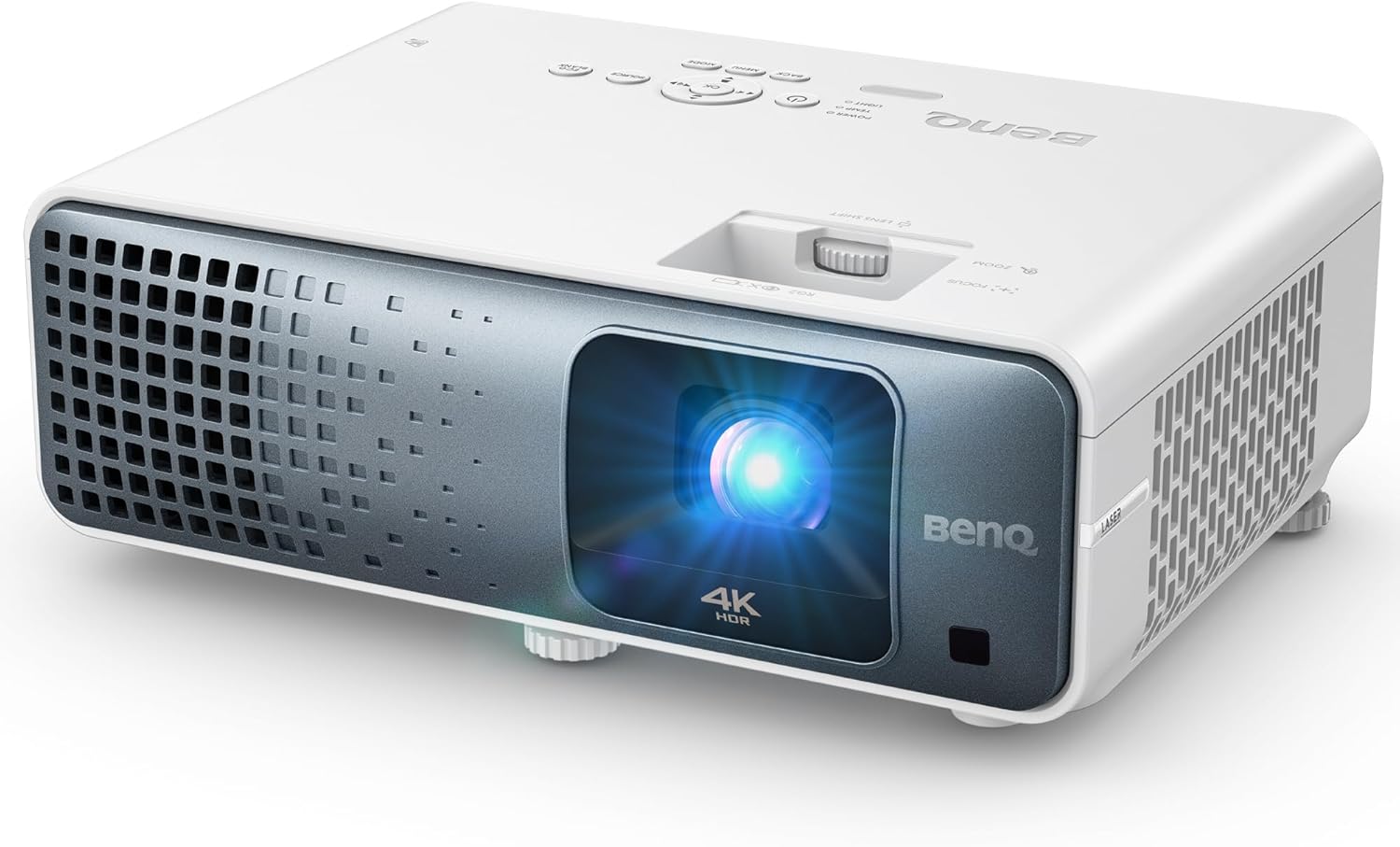
The BenQ TK710STi is a feature-packed 4K short throw laser projector designed for home entertainment enthusiasts and serious gamers alike. It occupies a compelling middle ground between a dedicated home theater projector and a gaming display, making it a strong option for anyone who wants one device to handle both roles without compromise.
The standout feature is undoubtedly its combination of 3200 ANSI lumens brightness and a laser light source, which together ensure the image remains vivid and color-accurate even when the lights are on. The 95% Rec.709 color coverage delivers natural, cinema-grade tones, while HDR10 and HLG support adds depth and contrast to compatible content. For gaming, the 4ms input lag at 1080p and 240Hz refresh rate is genuinely impressive for a projector, putting it on par with many dedicated gaming monitors.
The short throw design is a practical highlight, allowing a 100-inch image to be projected from just 6 feet away. This makes it far more suitable for typical living rooms than standard throw projectors. The addition of 3D Keystone correction and 1.2x optical zoom further simplifies the setup process, reducing the frustration of precise physical alignment.
On the software side, the built-in Google-certified Android TV platform is a genuine convenience, offering direct access to Netflix, Prime Video, YouTube, and the broader Google Play ecosystem without requiring an external streaming device. AirPlay support also makes it easy to mirror content from Apple devices. The laser light source, while adding to the upfront cost, removes the recurring expense and hassle of lamp replacements over time.
The primary drawback is the price, which places it firmly in the premium category and may give budget-conscious buyers pause. Some users may also find that short throw optics demand more careful initial placement than a standard lens projector. Overall, the TK710STi is a well-rounded, future-proof projector that delivers exceptional value for those who prioritize both gaming performance and cinematic picture quality in a single device.
Resolution: Native 4K (3840 x 2160) with HDR10 and HLG support for wide compatibility with modern content sources.
Brightness and Light Source: 3200 ANSI lumens from a laser light source, offering long-term reliability and consistent color output without lamp degradation over time.
Gaming Performance: 4ms input lag at 1080p resolution with a 240Hz refresh rate, plus dedicated HDR game modes optimized for console and PC gaming.
Throw Distance and Optics: Short throw design projects a 100-inch image from approximately 6 feet. Includes 1.2x optical zoom and 3D Keystone correction for flexible room placement.
Smart Platform and Connectivity: Google-certified Android TV with built-in Netflix, AirPlay, and access to the Google Play Store. Color coverage is 95% Rec.709, ensuring accurate and natural color reproduction across a wide range of content.
If you are considering the BenQ TK710STi, it helps to understand where it fits in the projector market. This model is best suited for buyers who want a single device that can serve as both a home theater projector and a high-performance gaming display, without the need to switch between multiple pieces of equipment.
The short throw design is a key selling point for urban apartments or living rooms where wall distance is limited. If your seating area is roughly 6 to 10 feet from the wall, this projector is an ideal fit. However, if you have a dedicated home theater room with a controlled lighting environment, a standard throw projector at a lower price point might deliver comparable image quality.
Gamers should pay close attention to the 4ms input lag and 240Hz support at 1080p. While 4K gaming is available, competitive players will benefit most from dropping to 1080p for the fastest possible response. Console gamers playing at 4K 60Hz will still enjoy a premium experience with HDR support and low latency.
The built-in Android TV platform is a genuine convenience for cord-cutters and streaming households. Before purchasing, verify that your preferred streaming apps are available on the Google Play Store version supported by this device, as app availability can occasionally differ from mobile versions. Overall, this projector rewards buyers who value versatility, brightness, and long-term reliability over a budget-first approach.

Pros
- Exceptional brightness and color accuracy praised across multiple verified reviews
- Versatile placement with 360 degree rotation and strong all-metal build quality
- Smooth 4K upscaling and 240Hz support make it great for both movies and gaming
- Auto focus and keystone correction simplify setup
- Strong built-in audio reduces need for a separate sound system
Cons
- Only a 1 year warranty compared to some competitors offering 3 years
- Requires more throw distance than some smaller projectors, which may limit setups in tight spaces
- Some users note black levels can weaken in daylight conditions
The Hisense C2 Ultra is a 4K triple-laser smart projector designed for home theater fans and gamers who want a big-screen experience without a permanent installation. With support for Dolby Vision, IMAX Enhanced, and up to 300 inch projection, it's built for those who take picture quality seriously.
In real-world use, reviewers consistently highlight the projector's brightness and color precision. The 3000 ANSI lumen output combined with the triple laser light source produces vivid, true-to-life images even in moderately lit rooms, while HDR content and dark scenes retain strong detail thanks to the 2000:1 contrast ratio.
Build quality is solid, with an all-metal body and a flexible angle adjuster offering 360 degree rotation plus wide vertical tilt, making it easy to mount on a wall, ceiling, or simply place on a table. Setup is aided by auto focus and keystone correction, which reviewers describe as fast and reliable.
The main tradeoffs are a shorter one year warranty compared to some premium competitors, a throw distance that may not suit very small rooms, and slightly reduced black levels in daylight. Gamers will appreciate the 240Hz refresh rate and Designed for Xbox optimization for smooth, low-latency play.
Overall, the C2 Ultra delivers a genuinely premium projection experience with excellent brightness, color, and gaming performance. It's a strong choice for anyone wanting a portable, high-end home cinema and gaming projector, provided they have adequate room for throw distance.

Pros
- Exceptional brightness for daytime and ambient-light viewing
- Highly flexible installation thanks to lens shift, zoom, and motorized gimbal
- Strong built-in audio that rivals standalone soundbars
- Excellent gaming performance with low latency and high refresh rate
- Fast, lag-free Google TV interface with plenty of RAM and storage
Cons
- Fan noise can be noticeable, even occasionally kicking on during sleep mode
- Some Google TV apps don't fully support 4K Dolby Vision, requiring an external streaming device
- Rainbow effect and minor light bleed reported by some users, typical of laser/DLP projectors
The JMGO N3 Ultimate is a premium 4K triple laser projector aimed at home theater enthusiasts, gamers, and anyone who wants a flexible, high-brightness alternative to a traditional TV setup. Its combination of portability and professional-grade optics makes it equally suited for a dedicated media room or a casual living space setup.
What truly sets this projector apart is its 5800 ISO Lumen output from the triple laser engine, which keeps images bright and colorful even with some ambient light in the room, a common weak point for projectors in this class. Reviewers consistently praise the color accuracy, Dolby Vision performance, and deep black levels, while gamers benefit from the 240Hz refresh rate and 1ms input lag that make fast-paced titles feel responsive on PS5, Xbox, or PC.
Physically, the N3 Ultimate impresses with its four-way lens shift, wide optical zoom range, and a 360-degree motorized AI gimbal, giving users true physical image placement rather than digital cropping. Setup is further simplified by real-time auto keystone and focus correction, making it easy to get a clean picture even in awkward room layouts.
On the downside, some users have reported fan noise during standby mode and a visible rainbow effect typical of single-chip DLP laser projectors. Additionally, while it runs on Google TV with native Netflix and Chromecast, a few third-party apps don't yet support full 4K Dolby Vision playback, so pairing it with an external streaming device may be necessary for the best results.
Overall, the JMGO N3 Ultimate delivers an impressive blend of brightness, color accuracy, and gaming performance that outperforms many pricier competitors. It's a strong choice for anyone wanting a versatile, big-screen home cinema experience, provided they can look past a few minor quirks in noise and app compatibility.

Pros
- Exceptional brightness that holds up well in normal room lighting
- Low input lag and high refresh rate ideal for gaming
- Sharp 4K image quality with strong HDR performance
- Flexible setup options including 360-degree projection and ceiling mount compatibility
- Strong value compared to pricier competitors in similar performance tiers
Cons
- Limited third-party reviews and testing data available online
- Requires more effort to set up and calibrate than plug-and-play projectors
- Color accuracy dips slightly when using the brightest picture mode
The ViewSonic LS901-4K is a 4K UHD laser projector aimed at home theater enthusiasts, gamers, and even golf simulator setups that need serious brightness and clarity. With 5,500 ANSI lumens, it's designed to perform well in larger rooms or spaces with some ambient light, making it more versatile than typical home theater projectors that require full darkness.
Performance-wise, the standout features are its 240Hz refresh rate and 4.2ms input lag, which reviewers confirm translate into smooth, responsive visuals for fast-paced gaming. The native 21:9 aspect ratio and HDR/HLG support also give movies a distinctly cinematic feel, with one reviewer comparing its image quality favorably to a $3,500 Epson model.
Setup flexibility is another strong point, thanks to 1.7x optical zoom, horizontal and vertical keystone correction, and support for 360-degree projection. This makes it easier to fit into rooms with unconventional layouts, and its compatibility with ViewSonic's ceiling mount adds to its installation versatility.
On the downside, buyers note that calibration takes more effort than simpler projectors, and the brightest picture mode sacrifices some color accuracy for maximum lumens. Independent testing and long-term reliability data are also still fairly limited online, which may give cautious buyers pause.
Overall, the LS901-4K earns its reputation as a high-value pick for anyone wanting a bright, 4K-capable laser projector that can double as a gaming display or golf simulator screen. It's best suited to users willing to spend a bit more time dialing in settings in exchange for excellent brightness, low lag, and long-term laser reliability.

Pros
- Exceptionally bright, sharp 4K picture that outperforms older 3LCD and lamp projectors
- Works well even with some ambient light, no need to fully darken the room
- Long-life laser light source eliminates the hassle of sourcing replacement lamps
- Quiet fan operation during movie and video playback
- Big, immersive screen experience praised by multiple reviewers for family and living room use
Cons
- Some users report brightness and color shifts in Vivid mode when transitioning between light and dark scenes
- At least one reported unit arrived with a factory defect (startup error), suggesting inconsistent quality control
- Limited connectivity options with primarily HDMI and RCA, no built-in smart streaming platform
The Optoma UHZ58LV is a 4K UHD dual-laser projector aimed at home theater users who want premium picture quality without stepping up to ultra-high-end models. It's designed for movie nights, gaming, and everyday streaming, with support for HDR10+ and a wide 95% DCI-P3 color gamut that brings noticeably richer, more lifelike color than typical lamp-based projectors.
In real-world use, the standout feature is brightness. At 3000 lumens, the UHZ58LV can throw a large, vivid image even with some ambient light in the room, a claim backed up by reviewers who watch daytime news and movies without blacking out windows. Filmmaker Mode and PureEngine Ultra work together to keep detail and color accurate, though a few users noted that the Vivid picture mode causes visible brightness and color shifts between light and dark scenes, an issue reportedly resolved by switching to another color mode.
Build quality is solid and the desktop form factor is straightforward to set up, with a throw distance range that accommodates various room sizes for screens up to 14 feet or larger. Fan noise stays low during playback, which is a common pain point in this projector class, and reviewers switching from older 3LCD units describe the upgrade as immediately noticeable in sharpness and clarity.
On the downside, connectivity is fairly basic, relying mainly on HDMI and RCA rather than built-in smart streaming apps, so a streaming stick or external source is recommended. There's also at least one reported case of a unit arriving with a startup error, a reminder that occasional quality control issues can happen and buyers should test the unit promptly after purchase.
Overall, the Optoma UHZ58LV delivers genuinely premium 4K laser performance at a more accessible price point, making it a strong pick for home theater enthusiasts and families wanting a big, bright, colorful picture. Just be prepared to pair it with a solid sound system and streaming device to get the most out of it.
The UHZ58LV features true 4K UHD native resolution at 3840 x 2160 using DLP display technology, paired with a dual laser light source rated at 3000 ANSI lumens for bright, punchy visuals in a variety of lighting conditions.
It supports HDR10+ for enhanced contrast and color depth, along with a 95% DCI-P3 color gamut for cinema-accurate tones. Connectivity is handled through HDMI and RCA inputs, and the projector is compatible with gaming consoles, laptops, smartphones, and external speakers.
Throw distance ranges up to 32.8 feet, giving flexibility for different room layouts, and the unit weighs 10.8 pounds in a compact desktop, tabletop-mount design. Optoma backs the projector with a 1-year limited parts and labor warranty, plus a 1-year or 20,000 hour warranty on the laser light source, whichever comes first.

Pros
- Exceptional short-throw ratio eliminates shadows and allows installation in tight spaces where traditional projectors fail
- Laser light source provides consistent brightness and color accuracy while minimizing maintenance compared to lamp-based projectors
- Minimal input lag creates responsive gameplay experience critical for golf simulation accuracy and player enjoyment
- Comprehensive installation tools and intuitive remote control make setup accessible even for first-time users
- Extremely long laser lifespan reduces total cost of ownership over the product lifetime
Cons
- Limited to Full HD native resolution, which may feel dated compared to 4K projectors despite excellent color accuracy
- Wired connectivity only means you cannot use wireless projection features available on some competitor models
The BenQ AH500ST is a purpose-built laser projector engineered specifically for home golf simulation enthusiasts who lack dedicated large rooms. Unlike general-purpose projectors, this device prioritizes the unique demands of golf simulators, including compact space requirements, responsive gameplay, and realistic visual presentation. It targets serious golfers and simulation hobbyists willing to invest in authentic practice technology.
What sets this projector apart is its innovative TR 0.5 short-throw lens combined with ultra-low input lag of 16.7ms at 1080P 120Hz. The short-throw ratio means you can mount the projector just 0.5 meters from your screen, eliminating shadows from the golfer and allowing installation in spaces where traditional projectors simply won't work. The minimal input lag ensures smooth, responsive ball tracking and club detection, which is absolutely critical for golf simulation accuracy and immersion.
Build quality reflects its premium positioning with a durable laser light source rated for 20,000 hours in normal mode or up to 38,000 hours in ECO mode. This laser technology delivers consistent brightness and vibrant colors throughout the projector's lifetime without the maintenance headaches of traditional lamp-based systems. The Full HD 1920x1080 resolution with 3,000,000:1 contrast ratio produces crisp, detailed visuals that bring golf courses to life with impressive clarity and depth.
The main limitation is that Full HD resolution feels somewhat dated in an era of 4K projectors, and the premium price point makes this inaccessible for casual users or those just exploring golf simulation. Additionally, wired-only connectivity means you cannot leverage wireless projection if that feature matters for your setup. The learning curve for initial setup, while simplified by BenQ's planning tools and remote hotkeys, still requires some technical comfort.
The BenQ AH500ST delivers exceptional value for dedicated golf simulation enthusiasts who prioritize performance and space efficiency over general versatility. Its specialized design, responsive gameplay technology, and long-lasting laser source justify the investment for serious users, though casual buyers should consider more general-purpose projectors.
Display Technology: DLP laser projector with Full HD native resolution (1920x1080)
Brightness and Contrast: 3,000,000:1 contrast ratio for exceptional image depth
Input Lag: 16.7ms at 1080P 120Hz, 33.4ms at 1080P 60Hz for responsive gameplay
Throw Ratio: 0.499 (TR 0.5) short-throw with 2D keystone adjustment (Vertical and Horizontal +/- 30 degrees)
Light Source: Laser with 20,000 hours normal mode / 38,000 hours ECO mode lifespan
Connectivity: VGA, supports devices from 640x480 to 4K UHD input
Compatible Devices: Gaming consoles, laptops, smartphones, tablets
Mounting: Floor mount, ceiling mount compatible
Weight: 18.2 pounds
Warranty: 1 Year Limited Warranty
Is this projector right for you? The AH500ST is ideal if you have a dedicated golf simulation setup in a small to medium-sized room and prioritize responsive, accurate gameplay over general entertainment use. It works best when paired with quality golf simulation software and a hitting mat setup that complements the projector's immersive capabilities.
Space Requirements: This projector requires only 0.5 meters of throw distance, making it suitable for rooms as small as 10x12 feet. The short-throw design eliminates the casting shadows that plague traditional projectors when golfers swing, a critical advantage for realistic simulation.
Installation Considerations: Use BenQ's Golf-Sim 3D Planner tool before purchasing to verify your space layout and mounting options. The dedicated remote control hotkeys simplify alignment and focus adjustments, but you should still allocate 1-2 hours for initial setup. Consider professional installation if you are uncomfortable with ceiling or floor mounting hardware.
Long-term Value: The laser light source dramatically reduces maintenance costs compared to lamp-based projectors. With 20,000 to 38,000 hours of lifespan depending on mode, this projector can serve your golf simulation hobby for 10+ years of regular use without bulb replacements.
Alternative Considerations: If you need 4K resolution or wireless connectivity, explore other projectors in a higher price range. If you use the projector for general entertainment beyond golf simulation, consider a more versatile general-purpose projector instead.
What to Look For in a Gaming Projector
Input Lag: The Non-Negotiable Metric
Input lag is the delay between your controller input and the action appearing on screen. For gaming, this is the most critical specification. A lag of 16ms or lower is ideal for competitive play, while under 30ms is generally acceptable for most genres. The projectors reviewed here, like the best DLP models for low latency, prioritize this metric to ensure your reactions are translated instantly.
Refresh Rate: Beyond 120Hz
While 60Hz is standard, a 120Hz or 240Hz refresh rate delivers dramatically smoother motion, crucial for racing sims and first-person shooters. This higher rate reduces motion blur and makes fast-paced action clearer. Many modern consoles and PCs support these high frame rates, so pairing them with a capable projector unlocks their full potential. Explore more options in our guide to projectors with 240Hz support.
Resolution and HDR Support
<!–4K resolution is now common in this price range, providing incredible detail for expansive game worlds. Equally important is High Dynamic Range (HDR) support, such as HDR10 or Dolby Vision. HDR expands the range of color and contrast, making bright highlights pop and dark shadows reveal more detail, which is essential for creating a visually immersive experience. For the pinnacle of clarity, consider native 4K gaming projectors.
Brightness and Throw Flexibility
<!–Brightness, measured in lumens, determines if you can game with ambient light present. A projector with 3000+ lumens holds up well in a living room. Also, consider your room layout. Short-throw models can create a large image from just a few feet away, saving space. Standard-throw projectors offer more placement flexibility but require more distance from the screen or wall.
Final Thoughts
Choosing the right gaming projector under $2500 comes down to balancing raw performance with your specific setup needs. For the ultimate competitive edge with incredibly low latency and a blistering 240Hz refresh rate, the JMGO N3 Ultimate 4K Triple Laser Projector is a formidable choice. If your space is limited and you need a brilliant, large image from a short distance, the BenQ TK710STi 3200 Lumens 4K HDR Short Throw Home delivers exceptional gaming specs in a compact form. Both represent the cutting edge of what’s possible for large-screen gaming at this price point.
Frequently Asked Questions
Is a gaming projector better than a gaming monitor?
<!–It depends on your priority. Monitors typically offer the absolute lowest input lag and fastest refresh rates for esports. Projectors provide an immersive, large-screen experience that monitors can’t match, perfect for single-player adventures, sports games, and group play. Modern gaming projectors have closed the performance gap significantly, making them a viable option for many serious gamers.
What is a good input lag for projector gaming?
<!–For fast-paced or competitive gaming, aim for an input lag of 16 milliseconds or lower. For general gameplay, including action-adventure and RPG titles, anything under 30ms is considered good and often imperceptible. All models featured in our low input lag category are selected with this threshold in mind.
Do I need a 120Hz projector for console gaming?
<!–Many current-gen consoles, like the PlayStation 5 and Xbox Series X, support 120Hz output in compatible games. Using a 120Hz projector with these consoles allows you to experience smoother, more responsive gameplay in those supported titles. If you’re a PC gamer with a capable graphics card, a high refresh rate projector is even more beneficial.
How long do laser projectors last for gaming?
<!–Laser light sources, found in most premium projectors today, are far more durable than traditional lamp-based models. They often boast lifespans of 20,000 hours or more. This means you can game for several hours daily for many years without worrying about a costly bulb replacement, making them a reliable long-term investment for your setup.



Write Your Review
No reviews yet. Be the first to share your experience!