

You know the feeling. You’re coming into the final chicane, fighting for the lead, and every millisecond of input lag or visual blur can cost you the race. For serious racing game enthusiasts, a standard display simply won’t cut it. You need the immersive scale and fluid motion that only a high-refresh-rate gaming projector can provide. This guide is designed for sim racers and gaming enthusiasts who demand the fastest response and smoothest visuals. We have evaluated eight top projectors to help you find the best 120Hz gaming projector for racing games that turns your room into a victory lane. For a broader look at performance-focused displays, explore our category on Low Input Lag / 120Hz+ projectors.

Pros
- Exceptional short-throw capability allows large 100-inch displays in rooms where traditional projectors won't fit
- Low input lag and high refresh rate support make it one of the best gaming projectors for console players
- Bright 3000-lumen output ensures clear images in various lighting conditions without blackout requirements
- Automatic keystone correction and vertical adjustment simplify setup from non-ideal mounting positions
- Award-winning design recognized by High Ground Gaming as best projector for gaming in 2019
Cons
- Lamp replacement costs can add up over time despite extended life options, requiring budget planning for long-term ownership
- Native 1080p resolution may feel limiting for users wanting 4K detail on very large projection surfaces
- Built-in 5W speaker provides basic audio but most users will want external speakers for immersive gaming sound
The BenQ TH671ST is a purpose-built gaming projector designed for console gamers and home entertainment enthusiasts who want cinematic experiences without sacrificing performance. With its ultra-low 16ms input lag and DLP technology, this projector targets serious gamers on PS4, Xbox One X, Nintendo Switch, and other platforms who demand responsive gameplay on the big screen.
The standout feature is its short-throw capability, projecting 100-inch images from just 5 feet away thanks to a 0.69-0.83 throw ratio. Combined with 1.2x zoom flexibility, the TH671ST works in compact living rooms where traditional projectors fail. Its 3000-lumen brightness with 92% Rec.709 color accuracy ensures vibrant visuals even in well-lit spaces, while the Game Mode fine-tunes shadow detail and clarity for competitive play. The automatic LumiExpert detection actively adjusts image quality based on ambient light, reducing eye strain during extended gaming sessions.
Build quality reflects BenQ's reputation with a compact 2.7kg design, dual HDMI inputs for console connectivity, and vertical keystone adjustment for flexible mounting. The projector supports up to 1080p 60Hz 3D content and includes comprehensive connectivity options. Performance is solid across picture modes, though the native 1080p resolution shows limitations on very large screens, and the 5W speaker requires supplemental audio for immersive gaming soundscapes.
Minor drawbacks include lamp replacement costs despite the extended 15,000-hour LampSave mode, and the absence of 4K support limits future-proofing for next-generation consoles. However, the 3-year warranty and US-based support provide confidence in long-term ownership and service reliability.
The BenQ TH671ST delivers excellent value for console gamers seeking big-screen action in space-constrained homes. Its combination of low input lag, short-throw projection, and bright image quality makes it a top choice for PS4 and Xbox players, though 4K enthusiasts should consider higher-end models for future content compatibility.
This projector excels in gaming environments with its 16ms input lag and microsecond DMD response time, eliminating the motion blur and lag that plague casual gaming setups. The Game Mode picture preset specifically enhances shadow detail and visual precision, giving competitive players an advantage in dark scenes and fast-paced action sequences.
Console compatibility is comprehensive, supporting PS4 Pro, Xbox One X, Nintendo Switch, and Google Stadia with dual HDMI 1.4a inputs. The refresh rate matches console output specifications, ensuring smooth frame delivery without stuttering or tearing. For esports titles and fast-action games, the low input lag maintains the responsiveness players expect from dedicated gaming monitors.
The 1080p resolution is sufficient for console gaming on screens up to 100 inches, though competitive players in larger rooms may notice some pixelation. The projector's 10,000:1 native contrast ratio delivers punchy blacks and bright highlights, enhancing visual impact during intense gaming moments.
Display Technology: DLP projection with 1.07 billion color support and RGBYCM color wheel at 2X speed (50Hz/60Hz)
Resolution: Native 1080p (1920x1080) with support up to WUXGA-RB (1920x1200), 92% Rec.709 color accuracy
Brightness and Contrast: 3000 ANSI lumens, 10,000:1 native contrast ratio for vibrant images in any lighting condition
Throw Ratio: 0.69-0.83 with 1.2x zoom, projects 100-inch image from 5 feet, up to 300-inch maximum
Keystone Adjustment: Vertical keystone correction plus/minus 40 degrees for flexible mounting angles
Connectivity: Dual HDMI 1.4a, VGA input, USB Type-A and mini-B, 3.5mm audio in/out, RS232 control
Lamp Life: 4000 hours normal, 10,000 hours eco mode, 15,000 hours LampSave mode for extended operation
Audio: Built-in 5W mono speaker, supports external audio via 3.5mm output
Dimensions: 296 x 120 x 224mm, 2.7kg weight for portable setup
Power: 320W typical consumption, AC 100-240V, 50/60Hz compatible
Warranty: 3-year limited parts and labor coverage with US-based customer support
Pros
- Exceptional brightness at 3200 lumens allows use in rooms that are not fully darkened
- Dual-purpose design excels at both cinematic movie watching and high-refresh-rate gaming
- Laser light source ensures consistent color performance and eliminates costly lamp replacements
- Flexible installation thanks to 1.3x zoom and vertical lens shift with 3D keystone correction
- eARC connectivity future-proofs the setup for premium audio systems
Cons
- Premium price point places it out of reach for budget-conscious buyers
- 240Hz refresh rate is limited to 1080p resolution, not full 4K, which may disappoint some users
- No built-in smart TV platform mentioned, which may require an external streaming device for app access
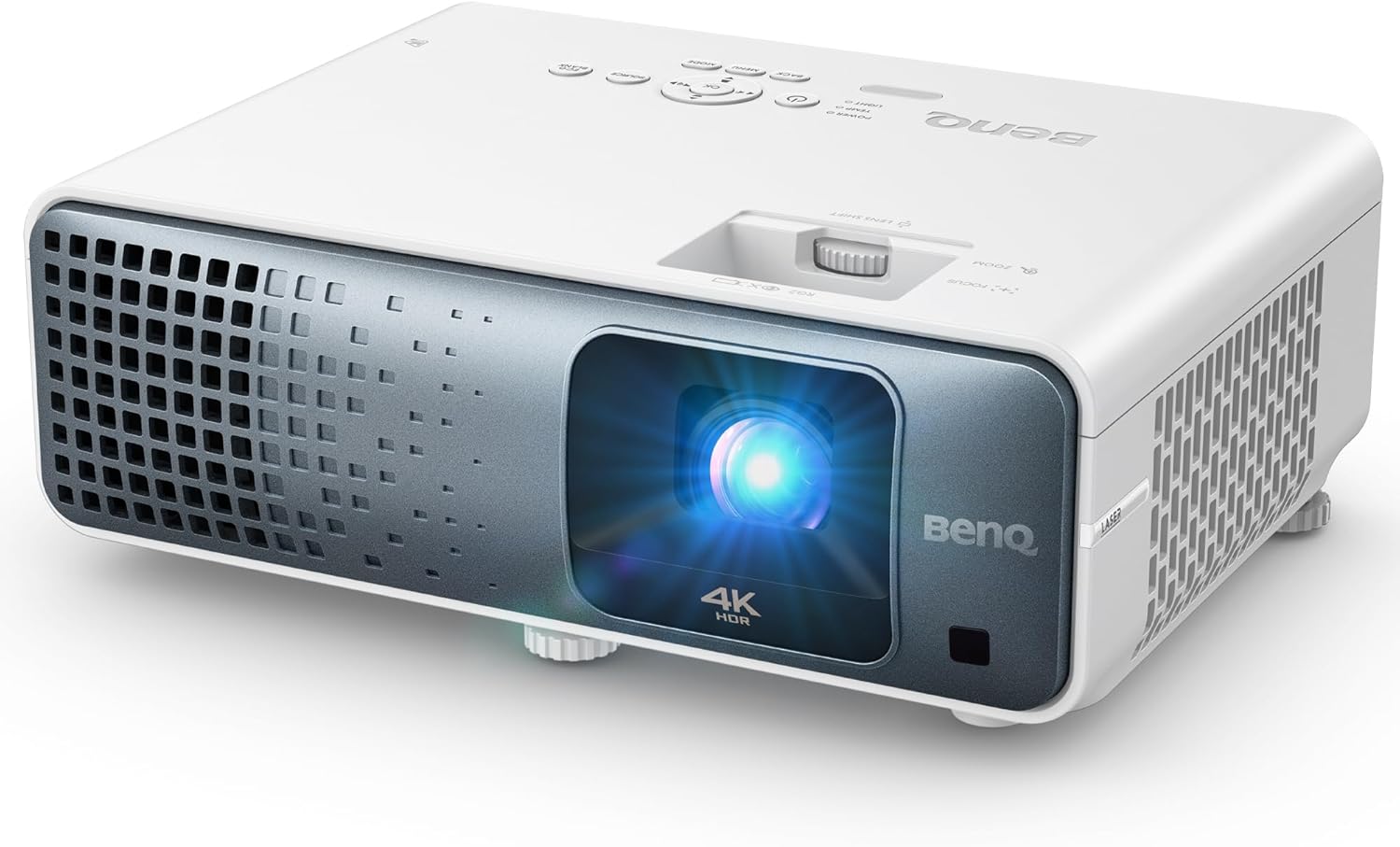
The BenQ TK710 is a 4K HDR laser projector designed to serve double duty as a premium home theater display and a high-performance gaming projector. Priced at the upper end of the consumer market, it targets enthusiasts who refuse to compromise between cinematic quality and gaming responsiveness. Whether you are setting up a dedicated home cinema or a versatile living room entertainment hub, the TK710 is built to handle both with confidence.
The headline feature is its 3200 ANSI lumen laser light source, which sets it apart from many competitors that struggle in anything but a pitch-dark room. Colors remain vibrant and contrast stays strong even with lights on, backed by 95% Rec.709 color coverage and HDR10 plus HLG support. The Dynamic Function actively adjusts the light source in real time to optimize contrast scene by scene, adding a layer of picture intelligence that benefits both film and gaming content.
For gamers, the TK710 delivers some of the most impressive specs in its class. At 1080p, it achieves a 240Hz refresh rate with just 4ms input lag, making fast-paced competitive titles feel genuinely responsive on a massive screen. At native 4K 60Hz, input lag drops to 16ms, which is well within the acceptable range for console gaming on PS5 and Xbox Series X. The eARC port adds audio flexibility, allowing lossless audio formats to pass through to a connected soundbar or AV receiver without extra cables.
On the installation side, the 1.3x optical zoom and vertical lens shift give users meaningful flexibility in placing the projector without resorting to digital correction that degrades image quality. The 3D keystone adjustment further assists in rooms where perfect alignment is not possible. One limitation worth noting is that the 240Hz high-refresh mode is capped at 1080p rather than 4K, so users expecting native 4K at ultra-high frame rates will need to manage expectations accordingly.
Overall, the BenQ TK710 is a compelling and well-rounded projector for buyers who want the best of both worlds. It earns its price through a durable laser light source, versatile connectivity including eARC, and genuinely impressive gaming performance. If you are serious about upgrading your home entertainment setup and need a projector that handles movie nights and gaming sessions with equal skill, the TK710 deserves serious consideration.
Resolution: True 4K UHD (3840 x 2160) with HDR10 and HLG support for rich, high-dynamic-range visuals across movies, sports, and gaming content.
Brightness and Light Source: 3200 ANSI lumens powered by a long-life laser light source. Laser technology delivers consistent brightness and color accuracy over thousands of hours without bulb replacements.
Gaming Performance: 4ms input lag at 1080p 240Hz for competitive gaming. 16ms input lag at 4K 60Hz for console gaming on PS5, Xbox Series X, and PC. Dedicated HDR Game Modes enhance in-game visuals.
Color Coverage: 95% Rec.709 color gamut coverage ensures accurate, cinema-grade color reproduction for both film and gaming content.
Connectivity: eARC support for high-quality audio passthrough. Compatible with major gaming consoles and streaming devices. Throw distance of approximately 6 feet for a 120-inch image at 10 feet.
Installation Flexibility: 1.3x optical zoom, vertical lens shift, and 3D keystone correction for versatile room placement. Backed by a 3-year manufacturer warranty for added peace of mind.
Who should buy the BenQ TK710? This projector is ideal for home theater enthusiasts who also game regularly and want a single display solution that excels at both. It is particularly well-suited for living rooms where full light control is not always possible, thanks to its 3200 lumen output.
Gaming Considerations: If you primarily play competitive titles at high frame rates, the 240Hz mode at 1080p will feel smooth and responsive on a large screen. Console gamers on PS5 or Xbox Series X will benefit most from the 4K 60Hz mode with 16ms lag, which is imperceptible during normal gameplay. PC gamers with high-refresh monitors will appreciate the flexibility to scale up to a big-screen format.
Home Theater Use: For movie watching, the laser light source and HDR10 support produce excellent contrast and color depth. The 95% Rec.709 coverage means skin tones, landscapes, and cinematic color grading look accurate and natural. Pairing this projector with a quality 4K screen and a good soundbar or AV receiver via eARC will deliver a genuinely cinematic experience.
Installation Tips: The 1.3x zoom and vertical lens shift make the TK710 easier to install than many fixed-lens projectors. At 120 inches, you only need about 6 feet of throw distance, making it suitable for smaller rooms. Plan your cable management around the eARC port if you intend to use an external audio system, as this will simplify your setup considerably.
Budget Note: At this price tier, buyers should also consider whether they need a built-in smart TV platform or are comfortable using an external streaming stick. Confirming smart platform availability before purchase will help avoid any surprises after setup.

Pros
- Exceptional brightness and color accuracy that hold up in rooms with ambient light
- Strong gaming performance with low latency, VRR, and multiple HDMI 2.1a plus DisplayPort inputs
- Simple ultra-short-throw setup with auto-focus, no ceiling mount needed
- Noticeably better dark scene detail and contrast compared to typical UST projectors
- Reviewers consistently praise picture clarity and color even without a dedicated screen
Cons
- Premium price puts it well above entry-level UST projectors and most flat-panel TVs
- Best image quality still benefits from pairing with an ALR or matte white screen, adding to overall cost
- 3D playback requires manual toggling, which some users find inconvenient
The AWOL VISION Aetherion Max is a 4K triple-laser ultra-short-throw projector positioned as a full laser TV replacement for the living room. It targets buyers who want a screen far larger than any flat-panel TV can offer, without sacrificing usability in rooms that get regular daylight or lamp light.
What stands out most is its 3300 ISO lumen output paired with a 110% Rec.2020 color gamut, which lets it hold color accuracy and contrast even with the lights on. Combined with 6,000:1 native contrast and a 7-level IRIS system, dark scenes retain shadow detail rather than washing out, a common weak point for UST projectors in bright settings.
Build quality reflects its premium positioning, with a compact desktop form factor, a 0.2:1 throw ratio that lets it sit just inches from the wall, and auto-focus that simplifies setup considerably. Gamers benefit from 1ms-class latency, 240Hz support, VRR, ALLM, and triple HDMI 2.1a plus DisplayPort inputs, allowing multiple consoles and a PC to stay connected without swapping cables.
The main drawbacks are cost-related: getting the absolute best image often means adding an ALR or matte white screen, and the projector itself sits at a premium price point compared to standard projectors or TVs. Minor quirks like manual 3D toggling also show up in user feedback.
Overall, the Aetherion Max earns its strong reviews by delivering genuinely bright, color-accurate, low-latency 4K performance in a UST form factor that fits real living rooms. It's a strong pick for home theater enthusiasts and gamers who want big-screen impact without a dedicated blackout room.
Pros
- Excellent brightness for a short throw laser projector, usable with some ambient light
- Very low input lag makes it genuinely competitive for gaming, not just marketed as such
- Laser light source eliminates recurring lamp costs and offers instant on/off
- Compact footprint and short throw lens make placement easy in small rooms or golf sim bays
- Strong warranty coverage with 5-year or 12,000-hour light source protection
Cons
- Native resolution is 1080p, not true 4K, despite accepting 4K input signals
- Connectivity leans on HDMI and RCA, lacking newer wireless casting or smart platform integration
- At this price point, buyers expecting native 4K sharpness may be disappointed
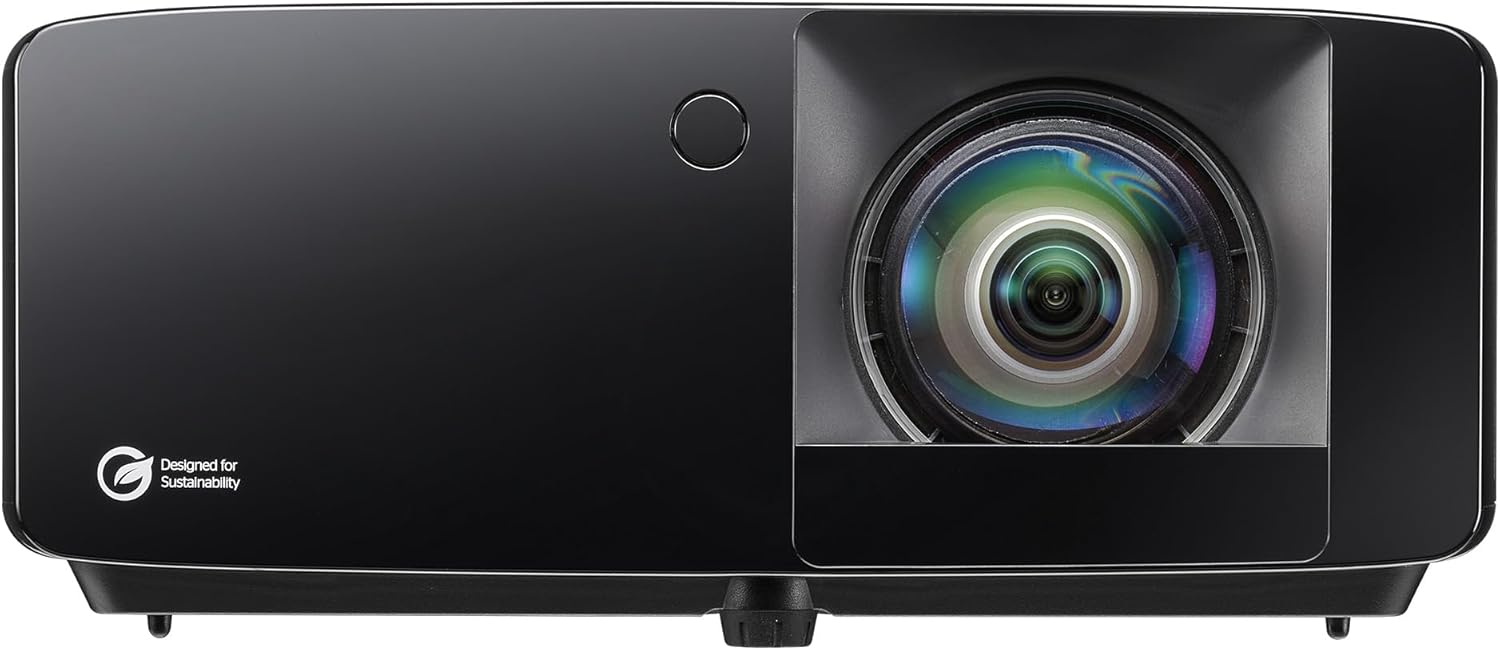
The Optoma GT2400HDR is a short throw laser projector aimed at two very specific buyers: home theater fans working with limited space, and golf simulator enthusiasts who need a big, bright image from a short distance. Its 0.496:1 throw ratio lets it fill a large screen while sitting just a few feet away, making it a practical fit for garages, basements, and media rooms where a traditional long-throw projector wouldn't work.
Brightness is the standout spec here. At 4,200 ISO lumens, the GT2400HDR holds up better than most home projectors when there's some ambient light in the room, which matters for golf sims and daytime viewing. Gamers get a real functional benefit too, with an 8.4ms input lag at 1080p120Hz in Enhanced Gaming Mode, a number that competes with dedicated gaming monitors rather than typical projectors.
Build quality centers around Optoma's DuraCore laser light source, rated for 30,000 hours in eco mode. This translates to years of use without swapping lamps, plus instant on/off and consistent brightness over time. The compact desktop form factor, at just under 9.5 pounds, supports flexible tabletop, wall, or ceiling mounting.
The main tradeoff is resolution. While the projector accepts 4K HDR10 and HLG signals, its native panel is Full HD 1080p, so it's not delivering true 4K sharpness. Connectivity is also fairly basic, relying on dual HDMI and RCA rather than modern wireless streaming options, so users will likely pair it with an external streaming device.
Overall, the GT2400HDR earns its place as a specialized tool rather than an all-purpose projector. It's a smart buy for anyone prioritizing brightness, low latency gaming, and short throw flexibility, particularly golf sim builders and space-constrained home theater setups, but 4K purists may want to look elsewhere.

Pros
- Exceptional color accuracy with a Delta E of approximately 0.9, producing near-perfect natural colors
- Massive 80 to 150 inch image from a compact, furniture-friendly ultra short throw placement
- Comprehensive HDR support including Dolby Vision, HDR10+, and IMAX Enhanced for premium content compatibility
- 240Hz refresh rate makes it one of the most capable UST projectors for gaming
- Google TV smart platform provides a polished, app-rich interface without needing an external streaming device
Cons
- At nearly $2,800, the price point is a significant investment that may not suit budget-conscious buyers
- 3,000:1 native contrast, while solid, may not fully satisfy videophiles who prefer the infinite contrast of OLED displays
- Ultra short throw projectors require a very flat, smooth wall or dedicated screen for the best image quality, adding potential extra cost
The Hisense PX3-PRO is a flagship ultra short throw laser projector aimed at home theater enthusiasts, gamers, and anyone looking to replace a large-screen TV with something far more cinematic. Supporting screen sizes from 80 to 150 inches and sitting just inches from the wall, it transforms any living room into a full-scale home cinema without the installation headaches of a traditional long-throw projector.
The standout feature here is Hisense's proprietary TriChroma triple laser engine, which uses dedicated red, blue, and green laser sources to achieve 110% of the BT.2020 color gamut and a color accuracy rating of Delta E approximately 0.9. In practical terms, this means colors are remarkably natural and vivid, with subtle gradations in skin tones and landscapes that cheaper projectors simply cannot reproduce. Combined with Dolby Vision, HDR10+, and IMAX Enhanced certification, supported content looks genuinely reference-grade.
For gamers, the PX3-PRO is a serious proposition. As the world's first UST projector officially designed for Xbox, it supports a 240Hz high refresh rate and is optimized to deliver responsive, fluid gameplay on a screen that dwarfs any conventional television. The Google TV platform adds a polished smart interface, giving users access to Netflix, Disney+, YouTube, and thousands of other apps without any external hardware.
On the downside, the premium price is a real barrier for many buyers. The native contrast ratio of 3,000:1, while respectable for a projector, still falls short of the deep blacks achievable on a high-end OLED TV. Additionally, getting the best image quality requires either a dedicated UST screen or a perfectly smooth, matte white wall, which can add to the overall cost of the setup.
Overall, the Hisense PX3-PRO is one of the most well-rounded ultra short throw projectors on the market today. It excels in color performance, gaming capability, and smart features, making it a compelling choice for buyers who want the biggest possible screen with the least installation complexity. For those who can stretch to the price, it delivers a genuinely impressive home cinema experience.
Resolution: Native 4K UHD with AI upscaling for lower-resolution content, powered by a DLP system with 2.07 million micromirrors for sharp detail up to 150 inches.
Brightness and Contrast: 3,000 lumens of brightness combined with a 3,000:1 native contrast ratio. Real-time Pro AI Algorithms continuously adjust brightness and contrast for optimal picture quality in varying room conditions.
Color Performance: TriChroma triple laser light source covering 110% of the BT.2020 color gamut. Color accuracy rated at Delta E approximately 0.9, supporting over 1.07 billion colors for natural, lifelike reproduction.
HDR and Audio: Dolby Vision, HDR10+, HLG, and IMAX Enhanced support. Dolby Atmos audio decoding for immersive, three-dimensional sound from compatible content.
Gaming and Refresh Rate: 240Hz high refresh rate with Xbox optimization for next-generation gaming performance. Ultra short throw lens projects up to 150 inches from just inches away from the wall.
Smart Platform and Longevity: Google TV built in with voice search and full app ecosystem access. Laser light source rated for up to 25,000 hours of use, reducing long-term maintenance costs significantly.
Is an Ultra Short Throw Projector Right for You? UST projectors like the PX3-PRO are ideal if you want a very large screen but cannot install a ceiling-mounted projector. They sit on a TV stand or low cabinet just inches from the wall, making them practical for apartments, living rooms, and dedicated home theaters alike. If you have a fixed, flat wall surface available, this format is extremely convenient.
Screen or Wall? For the best results, pair the PX3-PRO with a dedicated ambient light rejecting (ALR) or ultra short throw screen. While a smooth white wall works, a proper UST screen will significantly improve contrast, reject ambient light, and sharpen the overall image. Budget for this addition if you want truly reference-quality performance.
Room Lighting Considerations: With 3,000 lumens, the PX3-PRO performs well in moderately lit rooms, but like all projectors, it looks best in a darkened environment. If your viewing room receives heavy direct sunlight, consider blackout curtains or an ALR screen to maintain picture quality during daytime viewing.
Who Should Buy This: This projector is best suited to home theater enthusiasts who want premium color performance, gamers looking for a massive Xbox-optimized display, and households replacing a large TV with something more cinematic. It is a premium product and rewards buyers who are serious about their viewing and gaming experience.
Pros
- Exceptional gaming performance with industry-leading 4.2ms input lag and 240Hz refresh rate
- True 4K resolution with HDR support produces sharp, detailed, and dynamic images
- High 3200 ANSI lumen output allows use in ambient light without washing out the picture
- Versatile setup options including optical zoom, auto keystone, and 4-corner adjustment
- Long lamp life of up to 20,000 hours in SuperEco+ mode reduces long-term running costs
Cons
- At nearly $1000, it sits at a premium price point that may stretch budgets compared to entry-level 4K projectors
- The 1.1x optical zoom range is relatively narrow, which may limit placement flexibility in some room layouts
- No built-in smart TV platform means you need an external streaming device such as a Chromecast or Fire Stick
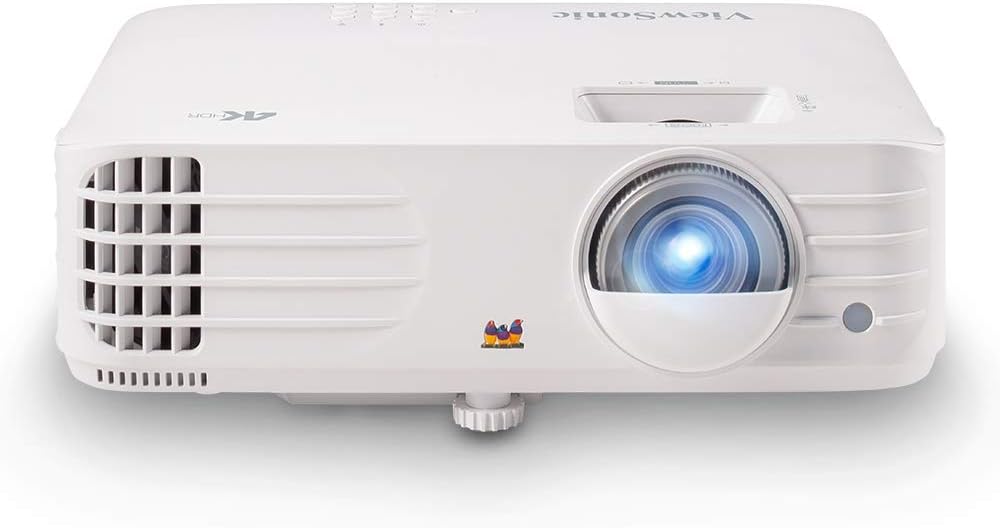
The ViewSonic PX701-4K is a true 4K UHD DLP projector designed for home theater enthusiasts and serious gamers who want a large-screen experience without investing in an oversized television. With a native 3840x2160 resolution, 3200 ANSI lumens, and support for both HDR10 and HLG, it positions itself as a versatile all-rounder that performs well in both darkened home theaters and moderately lit living rooms.
Where this projector truly stands out is in its gaming credentials. The 4.2ms input lag combined with a 240Hz refresh rate is genuinely impressive for a 4K projector at this price, putting it ahead of many competing models. Motion is smooth, fast-moving scenes remain sharp, and competitive gamers will notice a real difference compared to slower projectors. ViewSonic's SuperColor technology further enhances the experience by delivering a wide, accurate color gamut that makes both games and films look vivid and true to life.
Setup is made straightforward thanks to automatic horizontal and vertical keystone correction, 4-corner adjustment, and a built-in warping tool for curved surfaces. The 1.1x optical zoom offers some placement flexibility, though the range is modest. The projector supports ceiling mounting and can throw images from 30 inches up to a room-filling 300 inches, with a recommended maximum throw distance of 36 feet for a clear 300-inch image. Connectivity is practical, with dual HDMI ports, a powered USB-A output, and compatibility with most consoles, PCs, and streaming dongles.
On the downside, the absence of a built-in smart TV operating system means users must supply their own streaming device. The optical zoom range could be wider for greater installation flexibility, and the price point, while competitive for a true 4K gaming projector, is still a significant investment. Lamp-based projectors also require eventual bulb replacement, though the 20,000-hour SuperEco+ lifespan does mitigate this concern considerably.
Overall, the ViewSonic PX701-4K delivers a compelling combination of 4K image quality, gaming-grade responsiveness, and flexible setup features at a price that undercuts comparable large-screen TV alternatives. It is an excellent pick for anyone who wants the immersive thrill of a massive display for both movies and gaming, and is willing to add an external streaming stick to complete the setup.
Resolution: True 4K UHD (3840 x 2160p) with DLP display technology for sharp, pixel-dense imagery across all screen sizes.
Brightness and Color: 3200 ANSI lumens output with SuperColor technology, HDR10 and HLG support for enhanced contrast and a wide color gamut in varied lighting conditions.
Gaming Performance: 4.2ms input lag with a 240Hz refresh rate. Input lag activation requires enabling via advanced settings with the refresh rate set to 240Hz. Response time is based on the DMD chip.
Projection Size and Distance: Supports image sizes from 30 to 300 inches. Recommended throw distance for a 300-inch image is 36 feet. Projects an 80 to 150-inch image at a throw distance of 8.7 to 16.3 feet, with a 100-inch image achievable from 10.9 feet.
Zoom and Adjustment: 1.1x optical zoom, 0.8x to 2.0x digital zoom, automatic horizontal and vertical keystone, 4-corner adjustment, and curved surface warping tool. Throw ratio is 1.5 to 1.6.
Connectivity: Dual HDMI inputs, powered USB-A output (5V/1.5A) for wireless dongles such as Chromecast or Amazon Fire TV Stick. Compatible with gaming consoles, PCs, Macs, and mobile devices.
Lamp Life: Up to 15,000 hours in standard mode, extended to 20,000 hours in SuperEco+ mode, equivalent to approximately 13 years at 4 hours of daily use.
Mounting: Ceiling mountable, compatible with ViewSonic mount PJ-WMK-007.
Is this projector right for you? The ViewSonic PX701-4K is best suited to buyers who want a dual-purpose display for both home cinema and gaming. If you primarily watch films and sports, the true 4K resolution, HDR support, and high brightness will deliver a genuinely impressive picture. If you are a gamer, the 4.2ms input lag and 240Hz refresh rate are standout specs that rival dedicated gaming monitors on a much larger screen.
Room considerations: With 3200 lumens, this projector can handle rooms with some ambient light, but a darkened or dim environment will always produce the best contrast and color accuracy. Consider your room size carefully. The throw ratio of 1.5 to 1.6 means you will need roughly 11 feet of distance to project a 100-inch image, so measure your space before purchasing.
What you will need to add: This projector does not include a built-in smart TV platform, so plan to pair it with a streaming device such as a Chromecast, Amazon Fire TV Stick, or Apple TV. The built-in USB-A port conveniently powers these dongles without needing an extra wall adapter. A dedicated projection screen is recommended for the best image quality, though a flat white wall can work in a pinch.
Comparing alternatives: At this price tier, the PX701-4K competes with projectors like the BenQ TK700STi and Optoma UHD50X. Its 240Hz refresh rate and 4.2ms input lag give it a clear edge for gaming, while its SuperColor technology and HDR support keep it competitive for movie watching. If budget is the primary concern, entry-level 4K projectors are available at lower prices but typically sacrifice brightness, refresh rate, or input lag performance.

Pros
- Exceptionally bright 4,000-lumen output performs well even in rooms that are not fully darkened
- Full HD resolution ensures crisp, legible visuals for both detailed presentations and cinematic content
- Low 16ms input latency and 120Hz refresh rate make it genuinely suitable for gaming alongside business use
- Large 300-inch projection capability offers tremendous screen size for auditoriums or home theaters
- USB firmware update support keeps the projector current without requiring service visits
Cons
- Lamp-based technology means eventual bulb replacement costs and a shorter lifespan compared to laser projectors
- The 1.1x optical zoom range is relatively limited, requiring careful placement to achieve the desired screen size
The ViewSonic PA503HD is a full HD DLP lamp projector designed to serve a wide audience, from corporate presenters and classroom educators to home theater enthusiasts and casual gamers. With 4,000 ANSI lumens of brightness and a 1920x1080 native resolution, it positions itself as a versatile, high-performance option in the mid-range projector market.
The standout feature here is undeniably the brightness. At 4,000 lumens, the PA503HD holds its own in moderately lit rooms, making it practical for daytime presentations without requiring blackout curtains. Paired with a 22,000:1 dynamic contrast ratio and Texas Instruments 0.65-inch DMD chip, colors appear vivid and blacks look genuinely deep, which is impressive for a lamp-based unit at this price point.
For gamers and sports viewers, the 120Hz refresh rate and 16ms input latency are welcome additions that go beyond what most business projectors offer. Motion appears smooth and responsive, and fast-action scenes are rendered with minimal blur. The dual HDMI inputs and USB-A port add practical connectivity, and the auto vertical keystone correction simplifies setup considerably when ceiling mounting or placing on an uneven surface.
On the downside, the 1.1x optical zoom is narrower than competing models, which limits placement flexibility. Being a lamp-based projector, users should also factor in eventual bulb replacement costs and the fact that brightness will diminish gradually over the lamp's lifespan. Laser alternatives may offer longer-term value for heavy daily use.
Overall, the ViewSonic PA503HD delivers a compelling combination of brightness, image quality, and gaming-capable performance that justifies its position in the lineup. It is best suited for users who need a dependable, bright projector for mixed use across work, entertainment, and gaming, and who are comfortable with standard lamp maintenance over time.
Resolution: Full HD 1920x1080 (1080p)
Brightness: 4,000 ANSI Lumens
Contrast Ratio: 22,000:1 Dynamic
Technology: DLP with Texas Instruments 0.65-inch DMD Chip
Throw Ratio: 1.4 to 1.6
Optical Zoom: 1.1x
Digital Zoom: 0.8x to 2.0x
Screen Size Range: 80 inches to 150 inches (standard); up to 300 inches maximum
Throw Distance for 100-inch Image: 10.8 feet
Refresh Rate: 120Hz
Input Latency: 16ms
Connectivity: 2x HDMI, 1x USB-A
Keystone Correction: Auto Vertical Keystone
Firmware Updates: Via USB connection
Mounting: Ceiling mountable, compatible with ViewSonic PJ-WMK-007
If you are considering the ViewSonic PA503HD, the first question to ask is how much ambient light your space typically has. This projector shines brightest, literally, in environments where full blackout is not always possible, such as classrooms, conference rooms, or open living areas. Its 4,000-lumen output gives it a clear advantage over budget 2,000 to 3,000 lumen models in these settings.
For home theater purists who watch exclusively in a dark room, a projector with deeper native contrast or laser light source might be worth considering. However, if your usage spans presentations during the day and movies or gaming at night, the PA503HD handles both scenarios competently without requiring a second device.
Gamers should note that the 120Hz refresh rate and 16ms latency are genuine performance specs, not marketing additions. If you plan to connect a gaming console or PC, this projector delivers a noticeably smoother experience than standard 60Hz business projectors. Just ensure your source device supports 1080p at 120Hz to take full advantage.
Finally, consider placement before purchasing. The 1.1x optical zoom means you have limited room to adjust the image size without physically moving the projector. Measure your intended throw distance against the specification chart to confirm it fits your space before committing to a ceiling mount installation.

Pros
- Extremely low input lag and high refresh rate ideal for gaming
- Bright enough to use with some ambient light in the room
- Long-lasting laser light source with minimal maintenance
- Versatile mounting and adjustment options including 360-degree projection
- Strong warranty coverage with three years on parts and labor
Cons
- Higher price point compared to standard home theater projectors
- USB connectivity limited to USB-A 2.0, lacking newer USB-C options
- Gaming-focused feature set may be overkill for buyers wanting a pure cinema projector
The ViewSonic LX700-4K is a 4K laser projector purpose-built for gamers, developed in partnership with Microsoft as an officially "Designed for Xbox" device. It's aimed squarely at console and PC gamers who want a massive screen without giving up the responsiveness expected from a proper gaming display, while still doubling as a capable home theater unit.
How to Choose Your Racing Game Projector
Refresh Rate and Input Lag: The Non-Negotiables
For racing games, these two specs are paramount. A 120Hz or 240Hz refresh rate ensures that fast-moving scenery and other cars render smoothly, eliminating stutter and motion blur. Input lag, measured in milliseconds, is the delay between your controller input and the on-screen action. Look for projectors with dedicated gaming modes that minimize this lag. A projector like the ViewSonic PX701-4K, with its 240Hz and 4.2ms specs, is engineered for this precise need.
Resolution and HDR for Visual Fidelity
<!–While speed is critical, visual clarity enhances immersion. Native 4K resolution provides incredible detail, letting you spot braking markers and track textures from a distance. Support for HDR10, HLG, or Dolby Vision expands the dynamic range, delivering deeper shadows and brighter highlights for more realistic daytime and night racing conditions. The BenQ TK710 4K HDR Laser excels here, offering true 4K UHD with HDR10 support.
Brightness and Setup Flexibility
<!–Consider your room environment. High lumens (3000+) allow you to game with some ambient light without washing out the image. Also, think about placement. Short-throw models like the BenQ TH671ST can project a large image from just a few feet away, saving space. Ultra-short-throw (UST) projectors, such as the Hisense PX3-PRO, sit right against your wall for a clean, TV-like setup without ceiling mounts.
Connectivity and Future-Proofing
<!–Ensure the projector has the right ports for your gear. Multiple HDMI 2.1 inputs are ideal for connecting a gaming PC, PlayStation 5, and Xbox Series X simultaneously. Features like VRR (Variable Refresh Rate) and ALLM (Auto Low Latency Mode) help synchronize the display with your console’s output for tear-free gameplay. The premium AWOL VISION Aetherion Max is built with these advanced gaming features in mind. For more options tailored to competitive play, check out our guide to the best 120Hz gaming projectors for competitive gaming.
Final Thoughts
Selecting the right projector can transform your racing simulator from a hobby into a truly immersive experience. For gamers seeking exceptional value and proven performance in a traditional setup, the BenQ TH671ST 3000 Lumens 1080p Short Throw Home is a standout choice with its low input lag and short-throw convenience. If your goal is a premium, future-proof home theater that doubles as a breathtaking racing rig, the cutting-edge AWOL VISION Aetherion Max 4K Projector with its 1ms latency and triple-laser clarity is in a class of its own. Whichever model you choose, you are on track for a smoother, more responsive, and visually stunning ride.
Frequently Asked Questions
<!–Is 120Hz enough for racing games, or do I need 240Hz?
A 120Hz refresh rate provides a significant and very smooth upgrade over standard 60Hz displays, effectively eliminating motion blur for most players. A 240Hz refresh rate, offered by models like the ViewSonic LX700-4K, provides an even higher ceiling of fluidity, which can be beneficial for professional sim racers or those using high-frame-rate PCs. The difference becomes more noticeable at the very top tier of play.
What is more important for racing, input lag or resolution?
Input lag is fundamentally more critical for performance and reaction times. A fast 16ms or lower input lag ensures your steering and braking inputs feel instantaneous. Once you have a low-lag projector, you can then consider resolution for enhanced visual detail and immersion. Many modern projectors, like those reviewed here, successfully deliver both low latency and high resolution.
Can I use these projectors in a room with normal lighting?
Yes, but the results depend on the projector’s brightness (lumens). Models with high brightness ratings, such as the Optoma GT2400HDR at 4200 lumens, are specifically designed to maintain a vivid image in rooms with ambient light. For the best contrast and color, a darkened room is always ideal, but high-lumen projectors offer much more flexibility for daytime or living room use. Discover more models built for versatile environments in our parent category for Gaming Projectors.
Do I need a special screen for a 120Hz gaming projector?
While you can project onto a plain wall, a proper screen will significantly improve image quality, contrast, and color accuracy. For the best results with high-refresh-rate content, look for a screen with a smooth, low-gain surface that doesn’t interfere with motion clarity. An ambient light rejecting (ALR) screen is a fantastic pairing for ultra-short-throw projectors used in brighter rooms.


Write Your Review
No reviews yet. Be the first to share your experience!