

Imagine transforming a blank wall in your dedicated media room into a gateway to another world. That is the promise of a quality long throw projector, designed to deliver a massive, immersive picture from a distance. Finding the right model within a specific budget requires careful consideration of technology, brightness, and connectivity. This guide provides a focused review of five excellent long throw home theater projectors, each verified for performance and value, to help you build your dream setup.
For those exploring different budget tiers, our site offers detailed guides on options for various investment levels. You can discover more possibilities in our roundup of the best long throw projectors under $1500 for a wider range of features.
| Pick | Product | AI Score | Buy |
|---|---|---|---|
 Epson Home Cinema 1080 3-Chip 3LCD 1080p
|
9.7/10 | Buy on Amazon | |
 Acmejm 120" Motorized Floor Rising Projector
|
9.5/10 | Buy on Amazon | |
| Prime |
 Epson Home Cinema 1100 Full HD 1080p 3LCD
|
9.5/10 | Buy on Amazon |
| Prime |
 ViewSonic PX701-4K UHD Projector 3200 Lumens 240Hz
|
9.5/10 | Buy on Amazon |
| Prime |
 LG PF1000UW Ultra Short Throw Full HD Smart Home
|
9.5/10 | Buy on Amazon |
Pros
- Exceptionally bright picture that holds up well even with ambient light
- Accurate, vibrant colors thanks to 3LCD technology
- Simple setup with automatic keystone correction
- Strong warranty and customer support reputation
- Great value for a large-screen home theater experience
Cons
- Built-in speaker is weak and better suited as a backup than a primary audio source
- Auto keystone correction may need to be reset each time the projector is powered off
- No smart streaming platform built in, so you'll need an external device for apps
The Epson Home Cinema 1080 is a 1080p home theater projector designed for movie lovers, sports fans, and casual gamers who want a big-screen experience without the cost of a large TV. It's especially appealing to those who watch content during the day or in rooms with ambient light, thanks to its high brightness rating.
At the core of this projector is Epson's 3-chip 3LCD technology, which produces 3,400 lumens of both color and white brightness. Unlike single-chip DLP projectors that can suffer from rainbow artifacts, this model displays full RGB color in every frame, resulting in richer, more natural-looking images. Reviewers consistently praise the picture quality, noting it remains sharp and vibrant even with shades open or lights on.
Setup is straightforward thanks to the built-in picture skew sensor, which automatically corrects keystone distortion for a square image. Dual HDMI 2.0 ports make it easy to hook up streaming boxes, gaming consoles, or Blu-ray players, and the compact tabletop form factor keeps things simple for casual use. That said, some users have found the auto keystone feature inconsistent, sometimes requiring readjustment after powering the unit off and on.
Build quality feels solid for the price, though the built-in speaker is a known weak point. Most owners recommend pairing the projector with an external soundbar or speaker system for a more immersive experience, especially for movies and gaming. The lack of native smart TV apps means you'll need to bring your own streaming device, but this also keeps the unit simple and reliable.
Overall, the Epson Home Cinema 1080 delivers excellent picture quality and brightness for the price, making it a strong choice for anyone building a flexible home theater setup. It's best suited for buyers who prioritize image quality and ease of use over built-in smart features or premium audio.
Pros
- Disappears completely into the floor housing, maximizing room flexibility
- Matte white finish provides accurate color and wide 160-degree viewing angle
- Tensioned surface stays flat and wrinkle-free for consistent image quality
- Zero-gap design protects the screen material and looks seamless when retracted
- Works with both long-throw UST and standard projectors, offering flexible compatibility
Cons
- Premium price point compared to fixed-frame or manual pull-down screens
- Very limited customer review history makes long-term reliability hard to verify
- Floor housing placement requires careful planning around furniture and walking paths
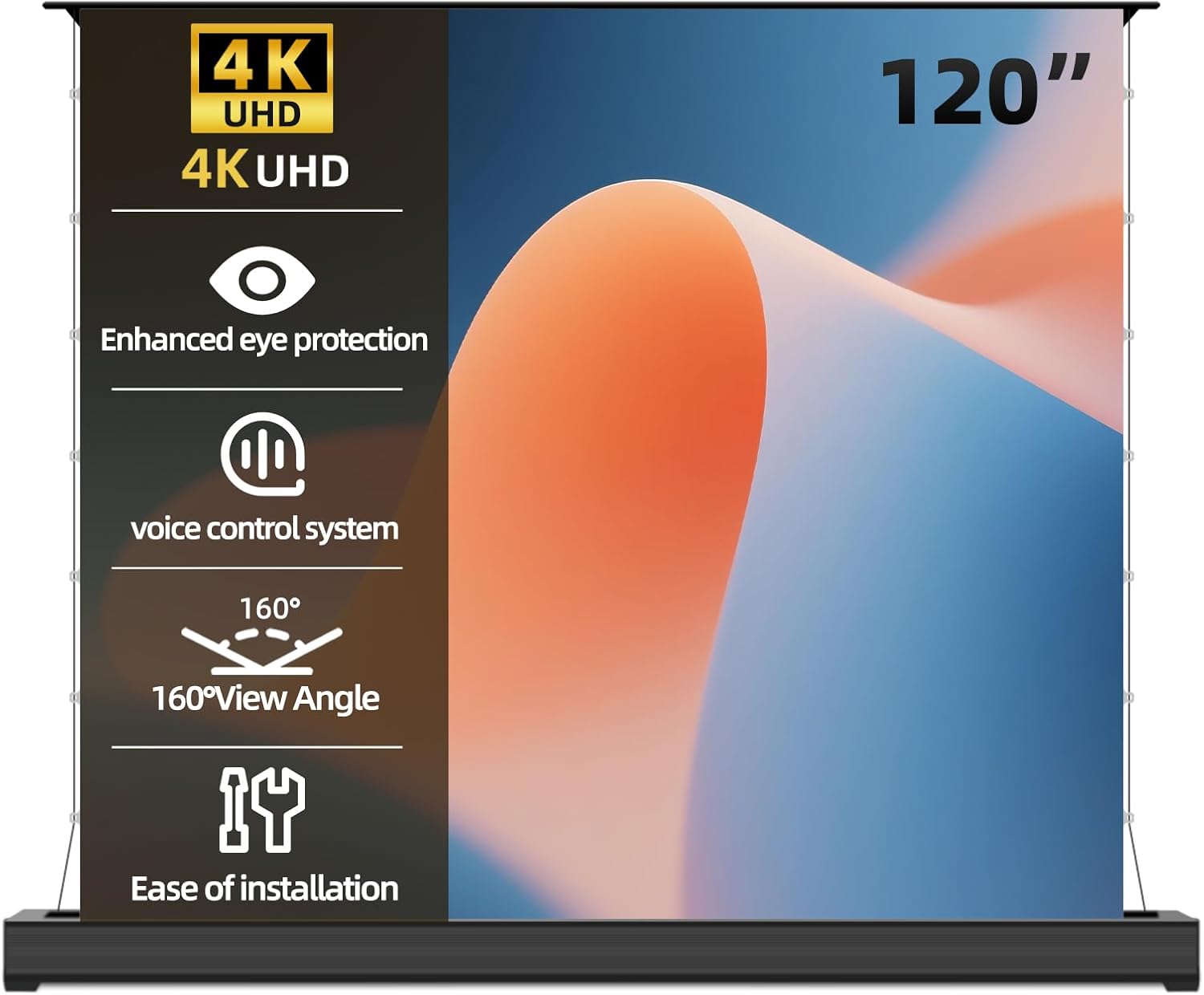
The Acmejm 120-inch Motorized Floor Rising Projector Screen is built for homeowners who want a big-screen home theater experience without committing to permanent wall or ceiling hardware. It's specifically tailored for long-throw UST projectors, though it also works with standard projectors, making it a flexible choice for a variety of setups.
The standout feature is the matte white surface, which is engineered for color accuracy, wide viewing angles, and a hotspot-free image in rooms with controlled lighting. Combined with the robust tensioning system, the screen stays flat and wrinkle-free, so image sharpness holds up across the entire viewing area rather than degrading at the edges.
Build quality centers around the floor-rising mechanism itself. The low-profile housing uses a quiet motor to raise and lower the screen, and the zero-gap, flush-fit design means it retracts level with the floor rather than leaving a visible lip or gap. This not only looks cleaner but also protects the screen material from dust and damage when stored.
On the downside, this is a premium-priced screen, and with only a handful of customer reviews available, it's difficult to gauge long-term motor reliability or durability under frequent daily use. Buyers will also need to plan floor space carefully, since the housing sits directly on the ground and needs a clear path to rise and retract.
Overall, this screen is a strong pick for anyone building a flexible home theater in a room where mounting isn't an option, especially if you're pairing it with a long-throw UST projector. Just go in with realistic expectations about the limited review data and the investment required.
The screen measures 87 inches wide by 48.8 inches high, delivering a 120-inch diagonal viewing area in a 16:9 aspect ratio, suited for both movies and general content viewing.
It features a matte white fabric/vinyl material with a 160-degree viewing angle, automatic motorized operation, and floor mount installation. The unit ships as a single count item and is backed by a 1-year manufacturer warranty.
Pros
- Bright, color-accurate 1080p image suitable for daytime or evening viewing
- Wireless streaming via AirPlay and Miracast simplifies setup
- Portable and lightweight at just over 6 lbs
- Two HDMI ports plus USB power for streaming devices
- Above-average 2-year warranty coverage
Cons
- Only a modest 2W built-in speaker, so external audio is recommended for serious movie nights
- 1080p Full HD resolution rather than native 4K, which some buyers may expect at this price
- Lamp-based light source means eventual bulb replacement instead of long-life laser
The Epson Home Cinema 1100 is a Full HD 1080p projector built for casual home theater use, gaming, and even outdoor movie nights. It targets buyers who want a big-screen experience without the complexity or cost of 4K laser projectors, making it a great fit for families, dorm rooms, or anyone setting up a flexible entertainment space.
Its standout feature is brightness: 3,400 lumens of both color and white output mean images stay punchy and watchable even with some room light present, a common weak point for budget projectors. The true 3-chip 3LCD engine also avoids the rainbow artifacts sometimes seen on single-chip DLP units, and built-in AirPlay and Miracast support let you cast content directly from an iPhone, Mac, or Windows laptop without a streaming stick.
Build quality follows Epson's familiar compact, portable design, weighing just over 6 lbs and measuring under 12 inches wide, so it's easy to relocate or pack away. Dual HDMI ports and a USB power port add welcome flexibility for connecting Fire TV, Roku, or gaming consoles directly.
The main compromises are the modest 2W internal speaker, which will likely need a soundbar or AV receiver for serious viewing, and the 1080p resolution ceiling, which won't satisfy buyers chasing native 4K detail. The lamp-based light source also means periodic bulb replacement rather than a maintenance-free laser engine.
Overall, the Home Cinema 1100 is a well-rounded, competitively bright 1080p projector that punches above its price point thanks to wireless streaming convenience and strong color accuracy. It's an easy recommendation for anyone prioritizing image brightness and portability over 4K resolution.
Native resolution is 1920 x 1080 (Full HD) with a maximum image size up to 305 inches and a minimum image size of 31 inches, giving flexibility for both small rooms and large open spaces.
Brightness is rated at 3,400 lumens for both color (IDMS) and white (ISO) output, paired with a 16,000:1 contrast ratio for solid depth in both bright and dark scenes.
Connectivity includes two HDMI ports, one USB port capable of powering streaming devices, and built-in Wi-Fi supporting Apple AirPlay and Miracast for cable-free streaming.
The lamp light source has a rated life of up to 6,000 hours, and the unit weighs 6.1 lbs with dimensions of 11.9 x 9.9 x 3.6 inches, backed by a 2-year limited projector warranty.
Pros
- Exceptional gaming performance with industry-leading 4.2ms input lag and 240Hz refresh rate
- True 4K resolution with HDR support produces sharp, detailed, and dynamic images
- High 3200 ANSI lumen output allows use in ambient light without washing out the picture
- Versatile setup options including optical zoom, auto keystone, and 4-corner adjustment
- Long lamp life of up to 20,000 hours in SuperEco+ mode reduces long-term running costs
Cons
- At nearly $1000, it sits at a premium price point that may stretch budgets compared to entry-level 4K projectors
- The 1.1x optical zoom range is relatively narrow, which may limit placement flexibility in some room layouts
- No built-in smart TV platform means you need an external streaming device such as a Chromecast or Fire Stick
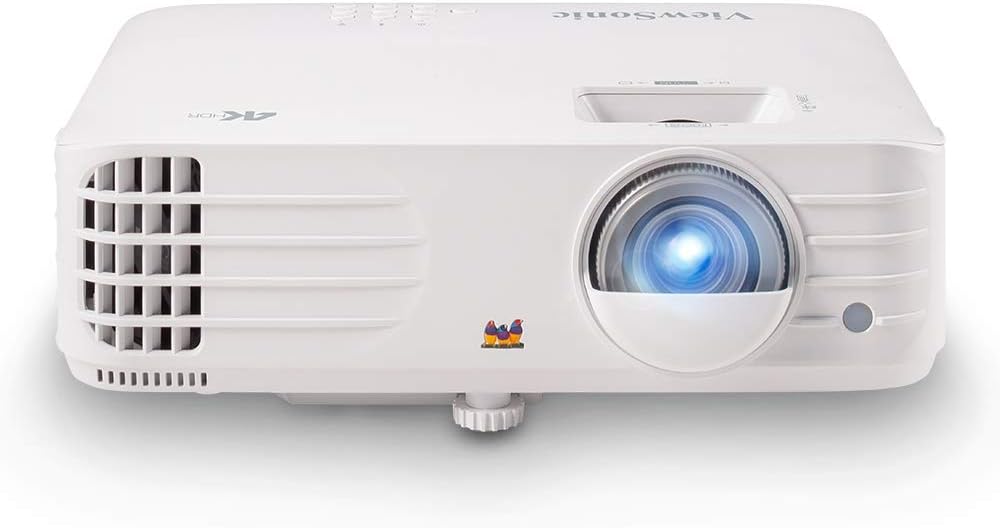
The ViewSonic PX701-4K is a true 4K UHD DLP projector designed for home theater enthusiasts and serious gamers who want a large-screen experience without investing in an oversized television. With a native 3840x2160 resolution, 3200 ANSI lumens, and support for both HDR10 and HLG, it positions itself as a versatile all-rounder that performs well in both darkened home theaters and moderately lit living rooms.
Where this projector truly stands out is in its gaming credentials. The 4.2ms input lag combined with a 240Hz refresh rate is genuinely impressive for a 4K projector at this price, putting it ahead of many competing models. Motion is smooth, fast-moving scenes remain sharp, and competitive gamers will notice a real difference compared to slower projectors. ViewSonic's SuperColor technology further enhances the experience by delivering a wide, accurate color gamut that makes both games and films look vivid and true to life.
Setup is made straightforward thanks to automatic horizontal and vertical keystone correction, 4-corner adjustment, and a built-in warping tool for curved surfaces. The 1.1x optical zoom offers some placement flexibility, though the range is modest. The projector supports ceiling mounting and can throw images from 30 inches up to a room-filling 300 inches, with a recommended maximum throw distance of 36 feet for a clear 300-inch image. Connectivity is practical, with dual HDMI ports, a powered USB-A output, and compatibility with most consoles, PCs, and streaming dongles.
On the downside, the absence of a built-in smart TV operating system means users must supply their own streaming device. The optical zoom range could be wider for greater installation flexibility, and the price point, while competitive for a true 4K gaming projector, is still a significant investment. Lamp-based projectors also require eventual bulb replacement, though the 20,000-hour SuperEco+ lifespan does mitigate this concern considerably.
Overall, the ViewSonic PX701-4K delivers a compelling combination of 4K image quality, gaming-grade responsiveness, and flexible setup features at a price that undercuts comparable large-screen TV alternatives. It is an excellent pick for anyone who wants the immersive thrill of a massive display for both movies and gaming, and is willing to add an external streaming stick to complete the setup.
Resolution: True 4K UHD (3840 x 2160p) with DLP display technology for sharp, pixel-dense imagery across all screen sizes.
Brightness and Color: 3200 ANSI lumens output with SuperColor technology, HDR10 and HLG support for enhanced contrast and a wide color gamut in varied lighting conditions.
Gaming Performance: 4.2ms input lag with a 240Hz refresh rate. Input lag activation requires enabling via advanced settings with the refresh rate set to 240Hz. Response time is based on the DMD chip.
Projection Size and Distance: Supports image sizes from 30 to 300 inches. Recommended throw distance for a 300-inch image is 36 feet. Projects an 80 to 150-inch image at a throw distance of 8.7 to 16.3 feet, with a 100-inch image achievable from 10.9 feet.
Zoom and Adjustment: 1.1x optical zoom, 0.8x to 2.0x digital zoom, automatic horizontal and vertical keystone, 4-corner adjustment, and curved surface warping tool. Throw ratio is 1.5 to 1.6.
Connectivity: Dual HDMI inputs, powered USB-A output (5V/1.5A) for wireless dongles such as Chromecast or Amazon Fire TV Stick. Compatible with gaming consoles, PCs, Macs, and mobile devices.
Lamp Life: Up to 15,000 hours in standard mode, extended to 20,000 hours in SuperEco+ mode, equivalent to approximately 13 years at 4 hours of daily use.
Mounting: Ceiling mountable, compatible with ViewSonic mount PJ-WMK-007.
Is this projector right for you? The ViewSonic PX701-4K is best suited to buyers who want a dual-purpose display for both home cinema and gaming. If you primarily watch films and sports, the true 4K resolution, HDR support, and high brightness will deliver a genuinely impressive picture. If you are a gamer, the 4.2ms input lag and 240Hz refresh rate are standout specs that rival dedicated gaming monitors on a much larger screen.
Room considerations: With 3200 lumens, this projector can handle rooms with some ambient light, but a darkened or dim environment will always produce the best contrast and color accuracy. Consider your room size carefully. The throw ratio of 1.5 to 1.6 means you will need roughly 11 feet of distance to project a 100-inch image, so measure your space before purchasing.
What you will need to add: This projector does not include a built-in smart TV platform, so plan to pair it with a streaming device such as a Chromecast, Amazon Fire TV Stick, or Apple TV. The built-in USB-A port conveniently powers these dongles without needing an extra wall adapter. A dedicated projection screen is recommended for the best image quality, though a flat white wall can work in a pinch.
Comparing alternatives: At this price tier, the PX701-4K competes with projectors like the BenQ TK700STi and Optoma UHD50X. Its 240Hz refresh rate and 4.2ms input lag give it a clear edge for gaming, while its SuperColor technology and HDR support keep it competitive for movie watching. If budget is the primary concern, entry-level 4K projectors are available at lower prices but typically sacrifice brightness, refresh rate, or input lag performance.
Pros
- Impressive image quality and brightness for both day and night viewing
- Extremely portable and easy to relocate compared to bulky TVs or long throw projectors
- Simple Bluetooth pairing with external speakers and headphones
- Long-lasting lamp reduces maintenance costs over time
Cons
- WebOS smart interface can feel slow and laggy during navigation
- Streaming performance may stutter compared to dedicated smart TVs, often requiring a Roku or similar device
- Some reports of unit failure shortly after purchase, so checking return policies is wise
The LG PF1000UW is an ultra short throw projector built for home theater fans who lack the space for a traditional projector setup. Sitting just inches from a wall, it throws a bright, Full HD image up to 100 inches, making it a strong fit for apartments, bedrooms, or small living rooms.
Its standout feature is the ultra short throw lens combined with built-in LG Smart TV functionality and the Magic Remote, letting users stream content without extra boxes. Reviewers consistently praise the image quality, noting it rivals or beats pricier long-throw projectors even at lower lumen counts, and Bluetooth audio pairing works smoothly with external speakers and headphones.
Build quality is compact and lightweight at under 5 pounds, making it genuinely portable between rooms or even for travel. The tabletop mount and simple remote control keep setup straightforward for first-time projector owners.
The main drawback reported by owners is the WebOS smart platform, which can feel sluggish and struggle with streaming compared to dedicated LG smart TVs, often pushing users toward pairing it with a Roku or similar streaming stick. A small number of buyers also experienced early hardware failures, so it's worth confirming warranty and return terms.
Overall, the LG PF1000UW is a compelling choice for anyone wanting a large, vivid picture in a tight space without sacrificing portability. It's best suited for casual home theater setups where an external streaming device can offset the smart platform's limitations.
What to Look for in a Long Throw Projector
Image Technology and Resolution
The core of your viewing experience lies in the projector’s imaging technology. You will primarily encounter 3LCD and DLP systems. 3LCD projectors, like the Epson models featured, are renowned for exceptional color brightness and accuracy, with no rainbow effect. DLP projectors often offer high native contrast and can be excellent for gaming with fast response times. Resolution is equally critical. Full HD 1080p remains a superb standard for cinematic detail, while 4K UHD, as seen in the ViewSonic model, provides stunning clarity for larger screen sizes.
Brightness and Light Output
Measured in lumens, brightness determines how well your image holds up in rooms with ambient light. A projector with higher lumens, such as those rated at 3200 or 3400, allows for more flexible room lighting or larger screen sizes. Remember, color brightness is as important as white brightness for a vibrant, lifelike picture. For spaces where you cannot achieve total darkness, prioritizing higher lumen output is a key decision point for your home theater.
Throw Distance and Setup Flexibility
Long throw projectors require significant distance from the screen to create a large image. You must measure your room to ensure you have the necessary space, typically several feet for a 100-inch diagonal. Features like optical zoom, lens shift, and digital keystone correction are invaluable for fine-tuning the image without physically moving the projector. This flexibility simplifies installation, whether you choose a table, shelf, or ceiling mount for your setup.
If your room has unique constraints or you are considering a premium installation, our expert analysis of the best long throw projectors under $3000 for 2026 explores models with even greater installation flexibility and advanced lens systems.
Connectivity and Smart Features
Modern projectors are media hubs. Dual HDMI ports are essential for connecting multiple sources like a streaming device and a gaming console. Some models, like the Epson Home Cinema 1100, integrate wireless streaming via AirPlay and Miracast for cable-free convenience from your devices. Built-in smart TV platforms, as featured in the LG model, offer direct access to apps, eliminating the need for an external box and streamlining your entertainment center.
Final Thoughts
Selecting the ideal long throw projector ultimately depends on your specific room and viewing priorities. For users seeking the pinnacle of color accuracy and brightness for movie nights, the Epson Home Cinema 1080 3-Chip 3LCD 1080p Home delivers a consistently stunning picture. Gamers and 4K enthusiasts craving ultra-fast response and incredible detail will find the ViewSonic PX701-4K UHD Projector, 3200 Lumens to be a compelling powerhouse. Whichever model you choose, you are investing in the centerpiece of a truly immersive home cinema experience.
Frequently Asked Questions
What is the main advantage of a long throw projector over a short throw model?
Long throw projectors are typically more affordable for a given level of image quality and brightness. They offer greater placement flexibility in dedicated theater rooms where you have the space behind your seating area, and they generally produce less fan noise since the projector itself is farther from the audience. For rooms where the projector can be mounted on the ceiling or placed on a rear table, they are an excellent choice.
Do I need a special screen for a long throw home theater projector?
While you can project onto a blank wall, a proper screen significantly enhances contrast, color vibrancy, and overall image sharpness. For the best results, a matte white screen like the motorized model we reviewed is ideal as it minimizes hotspots and provides wide viewing angles. The right screen is a crucial component for achieving a true cinematic feel in your home theater.
Can I use a long throw projector for everyday TV watching and gaming?
Absolutely. Many modern long throw projectors feature low input lag modes specifically for gaming, and their high brightness makes them suitable for viewing with some ambient light. Models with smart TV capabilities or easy wireless connectivity, such as the Epson Home Cinema 1100, make switching between movies, shows, and games as seamless as using a traditional television. For more focused recommendations on gaming performance, explore our guide to the top long throw projectors under $2000.
How do I know if a projector will fit in my room size?
Always check the manufacturer’s throw distance specifications for your desired screen size. You will need to measure the distance from where you plan to place the projector to your screen or wall. Most product pages provide a detailed throw distance calculator or chart. Ensuring your room has the necessary depth is the most critical step in planning your home theater installation for 2026.




Write Your Review
No reviews yet. Be the first to share your experience!