

Presentations lose their impact when attendees are squinting at a dim, washed-out screen. In a modern conference room, your projector needs to combat ambient light, display sharp data, and work reliably for years without constant maintenance. This is where laser projectors shine, offering superior brightness, long-lasting performance, and consistent image quality that traditional lamp-based models can’t match.
This guide is for business professionals, IT managers, and facility planners tasked with selecting the right visual technology. We have assessed eight leading laser projectors to help you find the perfect match for your boardroom, training hall, or collaborative space. For other setup considerations, explore our guide on the best conference room projectors with ceiling mount support.
| Pick | Product | AI Score | Buy |
|---|---|---|---|
 ViewSonic LS920WU WUXGA Laser Projector
|
9.5/10 | Buy on Amazon | |
| -10% OFF |
 Epson PowerLite L690SU 6,200-Lumen Short Throw
|
9.6/10 | Buy on Amazon |
 Epson PowerLite L775U 3LCD Laser Projector
|
9.8/10 | Buy on Amazon | |
| -5% OFF |
 Panasonic PT-VMZ51S WUXGA LCD Laser Projector
|
9.7/10 | Buy on Amazon |
| -7% OFF |
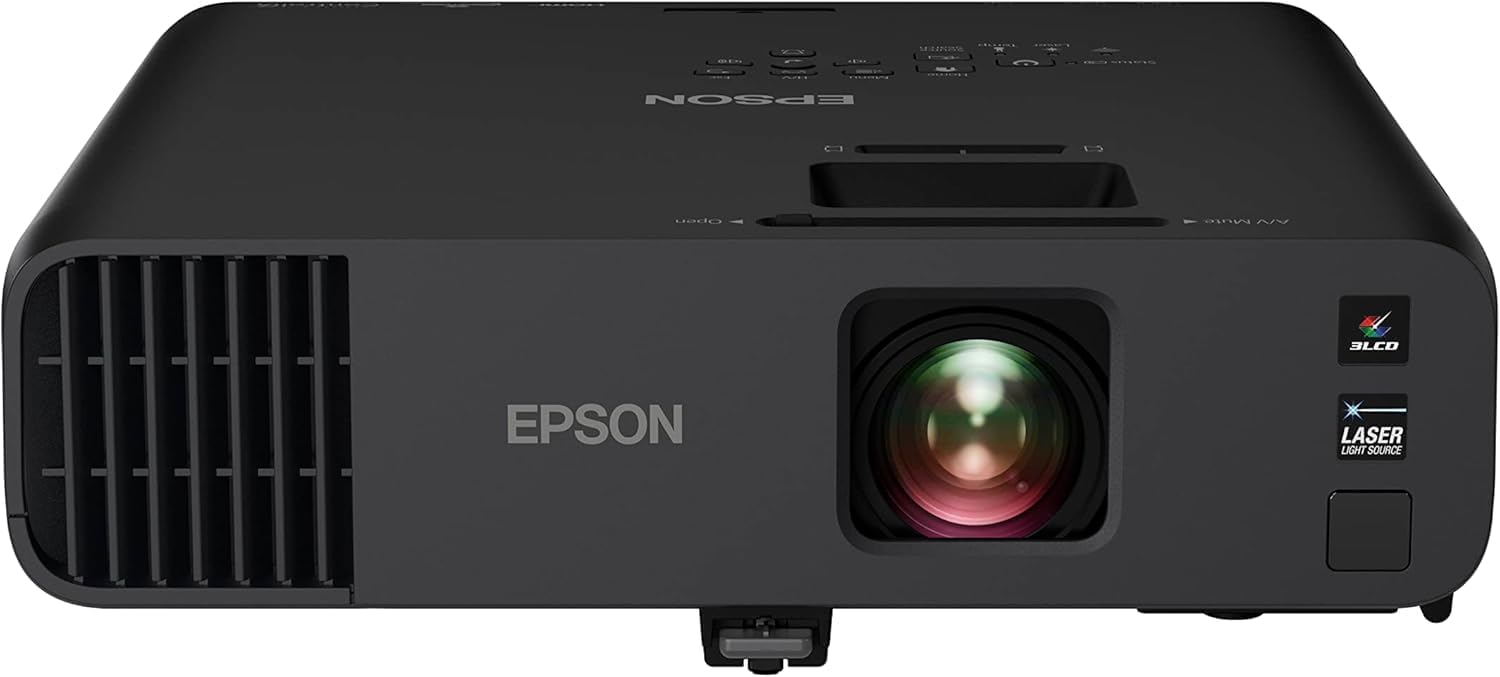 Epson Pro EX11000 Full HD 1080p Wireless Laser
|
9.6/10 | Buy on Amazon |
| -9% OFF |
 ViewSonic LS740HD 5500 Lumen 1080P Full HD Laser
|
9.8/10 | Buy on Amazon |
| -14% OFF |
 ViewSonic LS901-4K 4K UHD Laser Projector
|
9.9/10 | Buy on Amazon |
 ViewSonic LSD400W WXGA Laser Projector
|
9.9/10 | Buy on Amazon |
Pros
- Extremely bright 6,000 lumen output suited for large, light-filled venues
- Long-lasting laser light source reduces total cost of ownership
- Flexible installation options with zoom, lens shift, and 360-degree projection
- Strong connectivity including dual HDMI, LAN, and HDBaseT for AV integration
- Backed by a generous five-year warranty and first-year exchange service
Cons
- High price point puts it out of reach for casual or home users
- Large 6.5 kg body and ceiling-mount design require professional installation
- No built-in wireless connectivity, so network features rely on wired LAN or HDBaseT
The ViewSonic LS920WU is a professional-grade WUXGA laser projector designed for institutions and businesses that need to fill large screens, up to 300 inches, with clear, bright imagery. It targets auditoriums, lecture halls, boardrooms, and hospitality venues rather than home theater setups.
Its standout feature is the 6,000 ANSI lumen output, which keeps images punchy even in rooms with significant ambient light, a common challenge for venues like sports bars or daytime conference rooms. Paired with native WUXGA resolution and 4K HDR/HLG support through dual HDMI 2.0b ports, it handles both business content and high-quality video sources without losing detail.
Installation flexibility is another strong point. With 1.6x optical zoom, horizontal and vertical lens shift, 360-degree projection, and corner adjustment tools, AV integrators can mount this unit in awkward ceiling spaces or unconventional angles and still achieve a clean, aligned image. The compact chassis, at just under 16 inches long, belies the power packed inside.
The main tradeoffs are size, price, and setup complexity. At 6.5 kg and requiring ceiling mounting, this is not a plug-and-play consumer projector, and it lacks wireless streaming, leaning instead on wired LAN and HDBaseT for network integration. It's clearly built for planned, professional installations rather than casual use.
Overall, the LS920WU is a solid investment for schools, corporations, and venues that need dependable, high-brightness projection with minimal long-term maintenance thanks to its 20,000-hour laser light source. Buyers who need a flexible, durable projection solution for big rooms will find it a capable, future-ready choice backed by a strong five-year warranty.
The LS920WU features a native WUXGA resolution of 1920x1200 with support for 4K HDR/HLG input signals, and an exceptional contrast ratio of 3,000,000:1 for deep blacks and sharp detail.
Throw distance ranges from 0.88 to 14.09 meters, supporting image sizes from 30 to 300 inches, making it adaptable for small meeting rooms as well as large auditoriums.
Connectivity includes dual HDMI 2.0 ports, USB 2.0 Type-A, and Ethernet LAN (RJ45), along with built-in HDBaseT support for extended cable runs in professional AV setups.
The laser light source is rated for up to 20,000 hours, and the unit is backed by a five-year limited warranty on parts and labor, plus a one-year lamp warranty and first-year Express Exchange service.
Pros
- Very high brightness suitable for well-lit conference rooms and open workspaces
- Short throw design saves space while still producing large screen images
- Long-lasting laser light source reduces maintenance and replacement costs
- Flexible installation with wide lens shift, zoom, and 360-degree mounting
- Strong wireless and casting support for modern hybrid work setups
Cons
- High price point puts it out of reach for casual or home users
- Best suited for professional installation given its advanced setup options
- Limited customer review data available to confirm long-term reliability
The Epson PowerLite L690SU is a professional-grade short throw laser projector designed for businesses, conference rooms, hybrid workspaces, and large-venue applications like museum exhibits or golf simulators. It is not a consumer home theater unit, but rather a tool built for installers and IT teams who need bright, reliable, large-scale projection.
Its standout feature is the 6,200-lumen brightness paired with WUXGA resolution, which allows it to produce sharp, vivid images even in rooms with significant ambient light. The short throw ratio of 0.79 to 1.36, combined with 1.7x optical zoom, lets it project up to a massive 400-inch display from a relatively short distance, making it versatile for tight or unconventional room layouts.
Build quality reflects Epson's business-line engineering, with a compact, lightweight chassis that supports 360-degree mounting and wide lens shift for flexible placement. The 30,000-hour laser light source and sealed air filter mean this projector is essentially maintenance-free for years of continuous use, a major advantage for corporate or institutional buyers.
On the downside, this is a premium-priced unit aimed squarely at commercial buyers rather than casual users, and its advanced setup features, such as geometric correction and multi-projector alignment via the optional PixAlign camera, are best handled by a professional installer. Available customer feedback is also limited, so long-term reliability is largely backed by Epson's reputation and 2-year warranty rather than extensive user history.
Overall, the PowerLite L690SU is a well-engineered solution for organizations that need a bright, flexible, low-maintenance projector for demanding professional environments. If you're outfitting a conference room, classroom, or large exhibit space and need reliable performance with minimal upkeep, this projector is a smart, future-proof investment.
The PowerLite L690SU features a native WUXGA resolution of 1920x1200 with a maximum display resolution of 1920x1080, powered by 3LCD laser technology for consistent color and brightness performance.
Throw distance ranges from 5.8 to 22.7 feet, supporting image sizes up to 400 inches, making it suitable for both mid-size rooms and large venues. Connectivity includes HDMI along with wireless support for screen casting protocols like AirPlay and Miracast.
The laser light source is rated for 30,000 hours of operation, and the unit is backed by a 2-year manufacturer warranty. It ships with a power cord and remote, and is designed primarily for ceiling mount installation in business environments.
Pros
- Extremely bright 7,000-lumen output suited for large screens up to 500 inches
- Laser light source reduces long-term maintenance and operating costs
- Flexible installation options with lens shift, zoom, and geometric correction tools
- Strong connectivity suite for professional AV and network integration
- 3-year manufacturer warranty backs a premium build
Cons
- High price point puts it out of reach for casual or home users
- Large and heavy at over 19 pounds, requiring professional mounting
- Advanced features like PixAlign camera and wireless adapter are sold separately
The Epson PowerLite L775U is a high-performance installation projector designed for business, education, and large-venue environments rather than home theater use. With 7,000 lumens of brightness and WUXGA resolution enhanced for near-4K clarity, it targets AV professionals who need dependable, ultra-bright projection in classrooms, boardrooms, and museums.
Its standout feature is the combination of 3-chip 3LCD technology and a 20,000-hour laser light source, which together deliver vivid, color-accurate images while nearly eliminating the maintenance headaches of traditional lamp-based projectors. The ability to project in ultra-wide 21:9 or 16:6 formats also makes it a strong choice for immersive video conferencing and wide-format signage.
Build quality reflects its professional positioning, with a rugged ceiling-mountable chassis weighing over 19 pounds and support for wide lens shift, 1.6x optical zoom, and built-in geometric correction. Installation flexibility is excellent, and the inclusion of HDBaseT, dual HDMI, and RJ-45 ports ensures compatibility with complex AV setups.
The main drawbacks are practical rather than performance-related: its size and weight demand professional mounting, and some of its most powerful multi-projector tools, like the PixAlign camera, require additional purchases. It's also clearly not designed or priced for casual consumers.
Overall, the PowerLite L775U is a capable, future-proofed projector for institutions and businesses that need reliable, ultra-bright, wide-format projection with minimal upkeep. It's an excellent investment for large-scale, long-term installations, though overkill for smaller or home-based setups.
Pros
- Extremely bright output performs well even in ambient light
- Sharp, clear image quality confirmed by real user feedback in simulator and presentation setups
- Lightweight and compact for its class, easing transport and installation
- Long-lasting laser light source reduces bulb replacement costs
- Flexible lens correction and keystone adjustment simplify tricky installations
Cons
- No Digital Link (HDBaseT) support, which may limit long-distance cable runs in some installs
- Native light source life listed at 2000 hours in specs, which seems inconsistent with the advertised 24,000-hour ECO rating and should be confirmed before purchase
- Limited customer review volume makes it harder to gauge long-term reliability
The Panasonic PT-VMZ51S is a WUXGA LCD laser projector built for environments where ambient light is a challenge, think classrooms, boardrooms, or dedicated simulator rooms. With 5200 lumens of brightness and native 1920x1200 resolution, it targets users who need consistently sharp, visible images without dimming the lights.
What stands out most is the combination of brightness and contrast: a 3,000,000:1 ratio gives the image real depth, with reviewers specifically praising how clear and sharp visuals appear in real-world use, including a golf simulator setup where the picture reportedly looked as if users were 'actually on the course.' The laser light engine also promises up to 24,000 hours in ECO mode, which should minimize maintenance over the projector's lifespan.
Design-wise, Panasonic kept this unit compact and lightweight at just 6.5 kg, positioning it as one of the smallest and lightest in its class. The 1.6x zoom lens, wide keystone correction range, and 6-point screen correction give installers real flexibility, including the ability to project from corners or off-center angles without warping the image.
On the downside, this model skips Digital Link (HDBaseT) support, which could be a limitation for setups requiring long cable runs without signal loss. There's also a discrepancy in the listed light source life between the spec sheet (2000 hours) and the marketed ECO mode rating (24,000 hours) that buyers should clarify with the seller before purchase.
Overall, the PT-VMZ51S is a strong choice for anyone needing a bright, sharp, and flexible projector for business, education, or specialty setups like simulators. It's not the cheapest option, but the brightness, resolution, and installation flexibility justify the investment for demanding lit-room environments.
The PT-VMZ51S features a native WUXGA resolution of 1920x1200 with an LCD display panel and a laser light source rated for extended operational life. Brightness is rated at 5200 ANSI lumens, with a contrast ratio of 3,000,000:1 for enhanced depth and clarity.
Connectivity includes dual HDMI inputs with CEC command support and 4K signal compatibility, along with USB, LAN, VGA, and serial ports for flexible integration with laptops, gaming consoles, tablets, and smartphones.
Physically, the projector weighs 6.5 kg (14.33 lbs) and is designed as a portable, tabletop-mountable unit. It supports H.264 and H.265 video encoding and includes remote control operation alongside physical button controls.
Pros
- Exceptional 4,600-lumen brightness performs confidently in well-lit rooms without washing out the image
- Laser light source eliminates ongoing lamp replacement costs and downtime over a 20,000-hour lifespan
- 3-Chip 3LCD technology provides superior color accuracy and eliminates the color-wheel rainbow effect common in DLP projectors
- Versatile connectivity with dual HDMI, USB power, Miracast, RJ-45, and RS-232 suits virtually any business setup
- Large 300-inch projection capability makes it ideal for big conference rooms and auditorium-style presentations
Cons
- At nearly 9.5 lbs and a premium price point, this projector is better suited as a semi-permanent installation than a portable travel unit
- Wireless functionality is limited to Miracast only, lacking native Apple AirPlay support found on some competing models
- The higher price compared to lamp-based alternatives may be difficult to justify for light or infrequent users
The Epson Pro EX11000 is a professional-grade Full HD laser projector built specifically for the modern workplace. Designed for conference rooms, training spaces, and large-group presentations, it delivers a 300-inch 1080p image with 4,600 lumens of color and white brightness, making it one of the brightest business projectors in its class. It is best suited for organizations that need reliable, high-quality projection on a daily basis.
The standout feature of this projector is its 20,000-hour laser light source, which effectively eliminates the recurring cost and hassle of lamp replacements. Paired with Epson's 3-Chip 3LCD technology, every frame is rendered using 100% of the RGB color signal, resulting in accurate, vibrant colors without the distracting rainbow effect associated with single-chip DLP projectors. In real-world use, the brightness holds up impressively well even with ambient lighting left on, which is a critical advantage in busy office environments.
Connectivity is a genuine strength of the EX11000. Two HDMI ports, a USB power port for streaming sticks, Miracast wireless mirroring, RJ-45, RS-232, and legacy inputs like RCA and D-Sub make this one of the most versatile projectors available in its category. The built-in 16W speaker is notably powerful for a projector, reducing the need for external audio equipment during meetings and video conferences.
On the downside, the EX11000 is a relatively heavy unit at 9.5 lbs, which makes it less practical for users who need to carry a projector between locations regularly. Apple AirPlay is absent, which may frustrate teams that rely heavily on iOS and macOS devices for wireless sharing. The premium price point also means it requires a clear business case to justify over more affordable lamp-based alternatives.
Overall, the Epson Pro EX11000 is a compelling investment for businesses that prioritize image quality, long-term reliability, and versatile connectivity. Its laser technology, exceptional brightness, and rich feature set make it a top-tier choice for organizations ready to upgrade their presentation infrastructure for the long haul.
Resolution: Full HD 1080p | Brightness: 4,600 lumens color and white (IDMS/ISO rated) | Light Source: Laser, up to 20,000 hours | Technology: 3-Chip 3LCD
Connectivity: 2x HDMI, RCA, D-Sub, RS-232, RJ-45, USB Power (5V-2A) | Wireless: Miracast | Optical Zoom: 1.0x to 1.6x | Vertical Correction: Auto
Built-In Speaker: 16W | Max Screen Size: 300 inches | Dimensions: 12.8 x 11.8 x 4.1 inches | Weight: 9.5 lbs | Warranty: 1-Year Limited
If you are evaluating the Epson Pro EX11000 against other business projectors, the most important factor to consider is your room size and lighting conditions. This projector's 4,600-lumen output is specifically designed for medium to large conference rooms where the lights stay on, giving it a clear edge over lower-lumen competitors in the same lineup.
For organizations planning a long-term installation, the laser light source is a major financial consideration. While the upfront cost is higher than lamp-based models, eliminating bulb replacements over a 20,000-hour lifespan can result in significant savings and reduced IT overhead over time. It is an especially smart choice for high-frequency users such as corporate training centers, universities, or boardrooms.
If wireless connectivity is a priority, confirm that your devices support Miracast before purchasing, as this projector does not include Apple AirPlay. Teams that rely primarily on iPhones and MacBooks may want to consider a streaming stick such as an Apple TV connected via HDMI as a simple workaround. For everyone else, the combination of dual HDMI, USB power for streaming devices, and Miracast covers virtually every modern use case with ease.
Pros
- Exceptional brightness at 5,500 lumens handles ambient light in classrooms, boardrooms, and large venues with ease
- Laser light source eliminates lamp replacement costs and hassle, making long-term ownership highly economical
- Flexible installation options including ceiling mount, 360-degree rotation, and optical zoom suit a wide range of environments
- Dedicated Golf Mode adds unique value for home simulator setups, setting it apart from standard commercial projectors
- Comprehensive connectivity with LAN control via Crestron, AMX, PJ Link, and Extron simplifies large-scale AV integration
Cons
- At over $1,000, the price point may be a stretch for casual home users who do not need commercial-grade brightness or durability
- The 1.1 to 1.5 throw ratio is not ultra-short throw, so smaller rooms may require careful placement planning
- Wireless casting requires a separately purchased ViewShare kit, which adds to the total cost of a fully wireless setup
The ViewSonic LS740HD is a Full HD 1080p laser projector designed primarily for professional and semi-professional environments such as classrooms, auditoriums, boardrooms, and large home theaters. With 5,500 ANSI lumens of brightness and a laser phosphor light source, it targets users who need reliable, high-quality projection without the ongoing cost of lamp replacements. It also appeals to home golf simulator enthusiasts thanks to its dedicated Golf Mode.
Performance is where the LS740HD truly shines. The 5,500-lumen output ensures images remain crisp and vivid even in rooms with significant ambient light, a common challenge in educational and corporate settings. The Texas Instruments 0.65-inch DMD chip delivers a high native contrast ratio, adding visual depth and legibility to presentations, videos, and simulations. DLP technology further ensures accurate color reproduction and eliminates the screen-door effect common in older projection systems.
Installation flexibility is a major strength of this projector. The 1.3x optical zoom, combined with horizontal and vertical keystone correction and 4-corner adjustment, makes it straightforward to achieve a perfectly shaped image in almost any room configuration. The 360-degree projection capability and portrait mode open up creative use cases like projection mapping and floor displays, making it a versatile tool for events and staging professionals.
On the downside, the price is firmly in the commercial tier, which may deter budget-conscious buyers. The throw ratio of 1.1 to 1.5 means it is not suited for very short projection distances, and users in compact spaces should measure carefully before purchasing. Wireless content sharing, while supported, requires an additional accessory purchase, which feels like an oversight at this price level.
Overall, the ViewSonic LS740HD is a well-rounded, high-performance laser projector that delivers exceptional value for commercial, educational, and enthusiast applications. Its combination of brightness, maintenance-free operation, installation flexibility, and unique Golf Mode make it one of the more compelling options in its class. For anyone needing a dependable large-venue or simulation projector, it is a highly recommended investment.
Resolution: Full HD 1920x1080p (1080p) native resolution for sharp, detailed imagery across all content types.
Brightness and Contrast: 5,500 ANSI lumens with a high native contrast ratio achieved through a Texas Instruments 0.65-inch DMD chip, ensuring deep blacks and bright whites simultaneously.
Light Source: 3rd-generation laser phosphor technology rated for up to 30,000 hours of use, delivering consistent brightness over its lifespan without lamp replacements.
Throw and Zoom: 1.1 to 1.5 throw ratio with 1.3x optical zoom and 0.8x to 2.0x digital zoom. Projects a 100-inch image from approximately 8.2 feet, with a maximum screen size of 300 inches.
Adjustment and Installation: Features H/V keystone correction, 4-corner adjustment, 360-degree projection, portrait mode, and ceiling mount compatibility. Compatible with ViewSonic mount PJ-WMK-007.
Connectivity and Control: Supports Crestron, AMX, PJ Link, ATEN, and Extron for centralized LAN control. USB firmware update support and optional ViewShare Wireless Screen Casting Kit compatibility.
Durability: IP6X-rated sealed filter-free design for dust resistance. Rated for 24/7 continuous commercial operation.
Who Should Buy the LS740HD? This projector is best suited for IT managers, AV integrators, educators, and serious home theater or golf simulator enthusiasts who need a high-brightness, low-maintenance solution. If you regularly present in large rooms with uncontrolled lighting, the 5,500-lumen output is a significant advantage over consumer-grade projectors.
Room Size and Throw Distance: Before purchasing, measure your available projection distance. The LS740HD requires roughly 8.2 feet to display a 100-inch image and up to about 12.3 feet for a 150-inch image. It is not an ultra-short-throw projector, so very small rooms may not be ideal. For large classrooms, conference rooms, or dedicated home theater spaces, it fits perfectly.
Golf Simulator Compatibility: If your primary use case is a home golf simulator, the LS740HD is one of the few projectors in its class with a dedicated Golf Mode that supports major simulator software platforms. Pair it with a quality impact screen and simulator software for a premium indoor golf experience.
Commercial and 24/7 Use: For businesses or institutions that need a projector running all day, the industrial-grade design and laser light source make the LS740HD a cost-effective long-term investment. The absence of consumable lamps reduces operational costs significantly over time.
Budget Consideration: At its price point, the LS740HD competes with other commercial laser projectors. If you only need occasional home use at moderate brightness, a lower-cost consumer projector may suffice. However, for demanding environments where reliability and brightness are non-negotiable, the LS740HD justifies its cost.
Pros
- Exceptional brightness that holds up well in normal room lighting
- Low input lag and high refresh rate ideal for gaming
- Sharp 4K image quality with strong HDR performance
- Flexible setup options including 360-degree projection and ceiling mount compatibility
- Strong value compared to pricier competitors in similar performance tiers
Cons
- Limited third-party reviews and testing data available online
- Requires more effort to set up and calibrate than plug-and-play projectors
- Color accuracy dips slightly when using the brightest picture mode
The ViewSonic LS901-4K is a 4K UHD laser projector aimed at home theater enthusiasts, gamers, and even golf simulator setups that need serious brightness and clarity. With 5,500 ANSI lumens, it's designed to perform well in larger rooms or spaces with some ambient light, making it more versatile than typical home theater projectors that require full darkness.
Performance-wise, the standout features are its 240Hz refresh rate and 4.2ms input lag, which reviewers confirm translate into smooth, responsive visuals for fast-paced gaming. The native 21:9 aspect ratio and HDR/HLG support also give movies a distinctly cinematic feel, with one reviewer comparing its image quality favorably to a $3,500 Epson model.
Setup flexibility is another strong point, thanks to 1.7x optical zoom, horizontal and vertical keystone correction, and support for 360-degree projection. This makes it easier to fit into rooms with unconventional layouts, and its compatibility with ViewSonic's ceiling mount adds to its installation versatility.
On the downside, buyers note that calibration takes more effort than simpler projectors, and the brightest picture mode sacrifices some color accuracy for maximum lumens. Independent testing and long-term reliability data are also still fairly limited online, which may give cautious buyers pause.
Overall, the LS901-4K earns its reputation as a high-value pick for anyone wanting a bright, 4K-capable laser projector that can double as a gaming display or golf simulator screen. It's best suited to users willing to spend a bit more time dialing in settings in exchange for excellent brightness, low lag, and long-term laser reliability.
Pros
- Long 30,000-hour lamp-free lifespan cuts maintenance and replacement costs
- Bright 4,000-lumen output handles well-lit rooms without washing out images
- Compact, dust-sealed design fits tight installations and skips filter cleaning
- Instant on/off with no warm-up delay speeds up daily use
- 3-year limited warranty on parts and labor adds peace of mind
Cons
- WXGA (1280x800) resolution falls short of Full HD for detail-critical presentations
- No wireless connectivity listed, so casting or streaming requires additional hardware
- As a new listing with no reviews yet, real-world reliability is still unproven
The ViewSonic LSD400W is a laser-powered installation projector aimed squarely at classrooms, conference rooms, and small auditoriums where budget and uptime matter more than 4K sharpness. Its WXGA resolution and 4,000 ANSI lumens are tuned for text-heavy presentations and everyday business use rather than home theater visuals.
The standout here is the laser phosphor light source, rated for up to 30,000 hours without lamp swaps. Combined with instant-on brightness and no warm-up or cooldown wait, this projector is built for environments where it gets turned on and off multiple times a day. The IP6X-rated sealed engine also means no filters to clean, which is a real convenience for IT staff managing multiple units.
Build-wise, ViewSonic shrank the chassis by 32% compared to earlier models, making it easier to ceiling-mount in tighter rooms. Support for full 360° projection and portrait mode adds installation flexibility that's useful for unconventional setups like golf simulators or angled mounting.
The main tradeoff is resolution: WXGA (1280x800) is fine for spreadsheets, slides, and video calls, but it won't match the crispness of Full HD or 4K projectors for detailed graphics. There's also no built-in wireless casting, so schools or offices wanting screen mirroring will need extra streaming hardware.
Overall, the LSD400W is a sensible, low-maintenance choice for institutions and businesses that run projectors daily and want to avoid lamp replacement costs. It's not designed for cinephiles or 4K enthusiasts, but for its intended use case, the value proposition is strong.
Resolution: WXGA native (1280 x 800), max image size 300 inches.
Brightness: 4,000 ANSI lumens with a 3,000,000:1 contrast ratio for solid clarity in ambient light.
Light Source: Laser phosphor rated for 20,000-30,000 hours, using up to 49% less power (114 watts) than traditional lamp projectors.
Connectivity: Dual HDMI, USB, and 3.5mm audio jack; ceiling-mountable with a throw distance range of 3.28 to 36.45 feet.
Build: 6.8 pounds, 8.5" x 11.26" x 5.08", IP6X dust-sealed engine, backed by a 3-year limited warranty on parts and labor.
How to Choose a Conference Room Laser Projector
Brightness and Image Clarity
Lumens determine how well your image holds up against room lighting. For typical conference rooms with windows or overhead lights, aim for at least 4,000 lumens. Larger spaces or venues with very bright lighting demand 5,500 lumens or more for truly vivid presentations.
Resolution is equally critical. WUXGA (1920×1200) provides extra vertical pixels ideal for spreadsheets and documents, while 4K UHD offers unmatched detail for video content. Full HD (1080p) remains a solid, cost-effective choice for clear general use. Our review of the best boardroom projectors for large screens delves deeper into resolution needs.
Setup Flexibility and Installation
Your room’s layout dictates the projector’s placement needs. Optical zoom and lens shift allow you to position the unit flexibly without moving the mount. Keystone correction digitally squares the image if the projector isn’t perfectly aligned.
Short-throw models can project a large image from just a few feet away, reducing shadows and presenter glare. For permanent installations, confirm ceiling mount compatibility. Consider a model with 360-degree projection capability if your setup is unconventional.
Laser Light Source and Reliability
The core advantage of laser technology is longevity. Look for a rated light source life of 20,000 hours or more. This translates to over a decade of typical business use without a costly bulb replacement.
This maintenance-free operation lowers the total cost of ownership. Many laser projectors also feature instant on/off functionality, eliminating the warm-up and cool-down delays associated with lamps. This keeps meetings flowing smoothly.
Connectivity and Professional Features
Modern meetings use diverse devices. Ensure your projector has dual HDMI ports to switch between a laptop and a video conferencing system seamlessly. Network connectivity (LAN) allows for remote management and monitoring.
For hybrid meetings, features like wireless screen mirroring (Miracast) are invaluable. Built-in speakers provide adequate audio for smaller rooms, while audio-out ports let you connect to a superior sound system. For dedicated video conferencing setups, see our picks for the best boardroom projectors for video conferencing.
Final Thoughts
Choosing the right laser projector transforms your conference room into a dynamic and professional presentation space. For organizations needing exceptional brightness and WUXGA clarity for large venues, the Epson PowerLite L690SU 6,200-Lumen Short Throw is a standout choice. If your priority is delivering stunning 4K content with high brightness for a premium experience, the ViewSonic LS901-4K 5500 Lumens 4K Laser Projector offers incredible value and performance. We are confident one of the models reviewed here will meet your specific needs and elevate every meeting in 2026.
Frequently Asked Questions
Are laser projectors better than lamp projectors for business use?
Yes, for most professional environments, laser projectors are superior. They offer significantly longer lifespans, often exceeding 20,000 hours, which eliminates frequent and costly bulb replacements. They also provide consistent brightness from the moment you turn them on, with no gradual dimming over time. This reliability is crucial for maintaining a professional standard in daily business operations.
What size screen can I expect from a conference room laser projector?
Most laser projectors designed for conference rooms can easily handle screens from 100 inches to 300 inches diagonally. The maximum size depends on the projector’s brightness, resolution, and throw ratio. A high-brightness model (5,500+ lumens) is necessary to maintain image integrity on very large screens, especially in lit rooms. Our guide on conference room projectors with tabletop stands covers considerations for different screen sizes.
How important is resolution for data and spreadsheet presentations?
Resolution is critically important for displaying text, numbers, and fine details clearly. A WUXGA (1920×1200) resolution provides 20% more vertical pixels than standard 1080p, making it ideal for showing full spreadsheet pages, dense slides, and architectural plans without scrolling. For general PowerPoint and video, Full HD (1080p) is perfectly adequate and offers a more budget-friendly option.
Can I use a laser projector in a room with lots of windows?
You can, but you must select a model with sufficiently high brightness. For rooms with significant ambient light from windows, a projector rated at 5,000 ANSI lumens or higher is recommended to ensure the image remains vivid and colors stay true. Lower brightness models will appear washed out. Always prioritize lumens over contrast ratio when dealing with challenging lighting conditions.


Write Your Review
No reviews yet. Be the first to share your experience!