

Your conference room is the stage for important presentations, client pitches, and collaborative meetings. A subpar projector can undermine your message with dim images, poor color, and distracting setup hassles. Laser projectors offer a significant upgrade with longer lifespans, consistent brightness, and instant on/off functionality, making them ideal for the demanding pace of business environments.
This guide is crafted for business owners, office managers, and IT professionals tasked with outfitting or upgrading a professional meeting space. We have assessed four standout laser projectors that deliver exceptional performance without requiring a massive budget. Whether you need an integrated video conferencing solution or a powerful, dedicated display, our reviews will point you toward the right tool for your needs. For more options tailored to tighter budgets, explore our guide on the best meeting room projectors under $500.
| Pick | Product | AI Score | Buy |
|---|---|---|---|
 CZUR StarryHub Q1 Pro All-in-One Video
|
9.4/10 | Buy on Amazon | |
 ViewSonic LS740W WXGA Laser Projector 5500 Lumens
|
9.7/10 | Buy on Amazon | |
| -15% OFF |
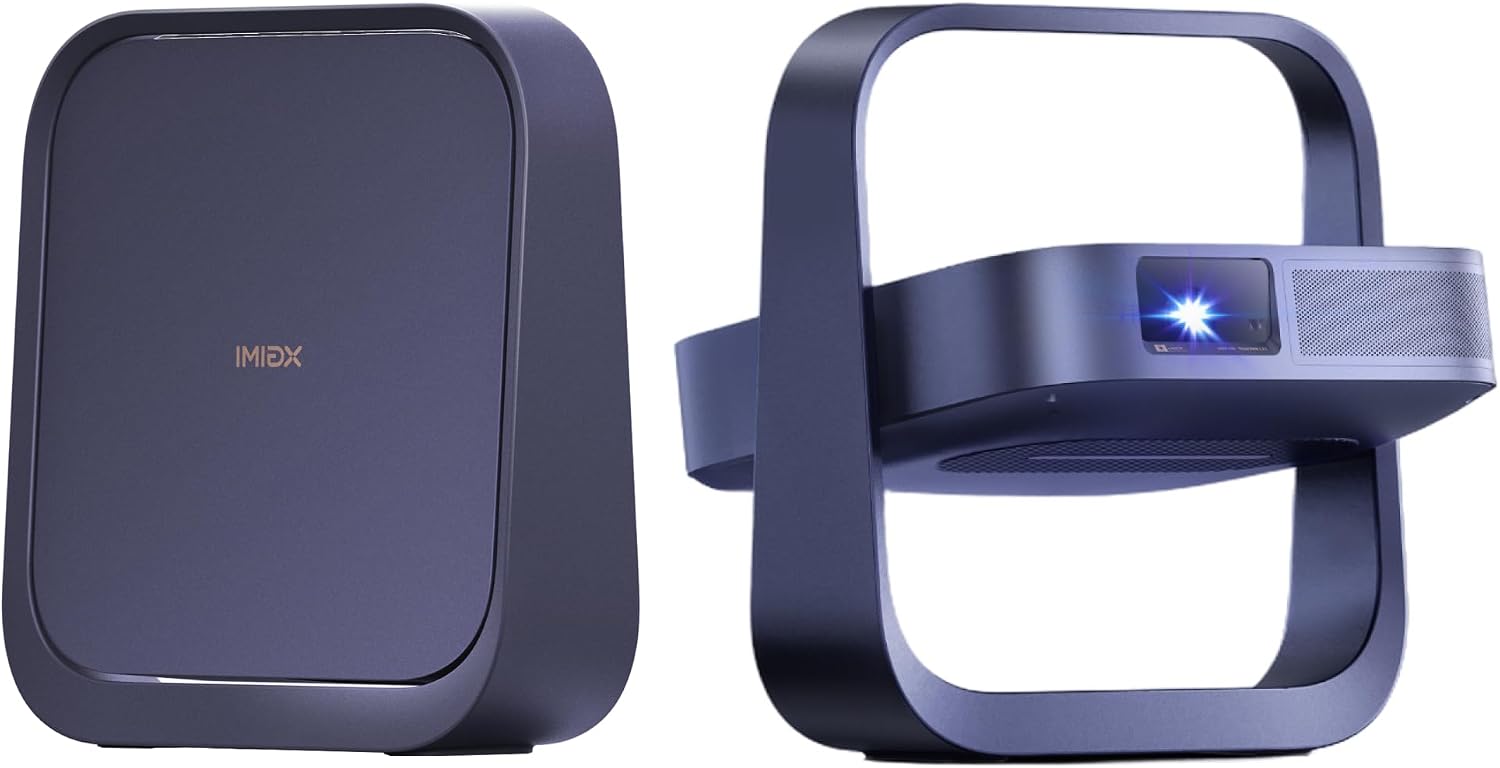 XGIMI Elfin Flip Laser 1080P Portable Projector
|
9.6/10 | Buy on Amazon |
 Optoma HZ41 4600-Lumen Full HD Laser DLP Projector
|
9.6/10 | Buy on Amazon |
Pros
- True all-in-one design eliminates the need for separate projector, camera, mic, and speaker setups
- Bright, sharp projection stays visible even with ambient light
- Strong microphone range and voice clarity praised by real users
- Fast, simple setup with minimal cabling required
- Compatible with all major video conferencing platforms
Cons
- Premium price point may be steep for smaller teams or personal use
- TouchBoard remote requires a short learning curve according to reviewers
- Short-throw projector still needs adequate table space and distance for optimal image size
The CZUR StarryHub Q1 Pro is an all-in-one video conferencing system designed for businesses, classrooms, and home offices that want to consolidate multiple pieces of AV equipment into a single device. It merges a short-throw projector, a wide-angle 1080P camera, a six-microphone array, and built-in speakers into one compact unit, making it well suited for meeting rooms hosting up to 20 people.
In real-world use, the standout features are the projector's brightness and the camera's auto-framing capability. At 2200 ANSI lumens, the projected image stays legible even with lights on or during the day, a common weak point for lower-end projectors. The auto-framing camera and AI noise cancellation work together to keep remote participants engaged, automatically centering speakers and filtering out background chatter.
Build quality reflects its positioning as a professional-grade device, with a solid 6.6-pound tabletop unit and a magnetic touchpad remote that wakes the system instantly when lifted from its dock. The inclusion of HDMI, USB 2.0/3.0, and LAN ports means it can also serve as a wired hub when wireless casting isn't preferred, and support for four simultaneous split-screen connections adds real flexibility for collaborative sessions.
The main drawbacks are the price and the learning curve associated with the TouchBoard controller, which some reviewers noted takes a bit of getting used to. It's also a device best suited to dedicated meeting spaces rather than casual, on-the-go use, given its size and setup expectations around throw distance.
Overall, the StarryHub Q1 Pro is a strong option for organizations looking to replace a cluttered mix of conferencing hardware with a single, easy-to-manage system. Reviewers consistently praise its simplicity, audio clarity, and picture quality, making it a solid investment for teams running frequent hybrid or in-person meetings.
The StarryHub Q1 Pro features a DLP short-throw projector with 2200 ANSI lumens brightness and native 1920x1080 resolution, supporting display sizes from 30 to 150 inches with an optimal range of 80 to 100 inches. Auto keystone correction adjusts for a perpendicular angle up to ±45 degrees.
Its built-in camera offers a 120° wide-angle field of view with HD WDR technology at 1920x1080 resolution, paired with a six-microphone array capable of picking up voices from 8 to 10 meters away. Connectivity includes LAN, HDMI 1.4, USB 3.0, USB 2.0, and DC input, with the unit weighing 6.6 pounds and measuring 7.8 x 7.8 x 8.6 inches.
Pros
- Exceptional 6,000 ANSI lumen brightness performs confidently in well-lit rooms and large spaces without needing blackout conditions
- Lamp-free laser technology means no bulb replacements, significantly lowering total cost of ownership over time
- Highly versatile installation options including 360-degree rotation, portrait mode, ceiling mount compatibility, and optical zoom
- Dedicated Golf Mode adds niche value for simulation setups, making this projector a dual-purpose investment for entertainment and professional use
- IP6X dust-sealed design and 24/7 operation rating make it genuinely suitable for continuous commercial deployment
Cons
- WXGA (1280x800) native resolution may feel limiting compared to Full HD or 4K alternatives, especially for detail-critical applications at close viewing distances
- The price point positions it firmly in the commercial segment, which may be difficult to justify for casual home theater or light office use
The ViewSonic LS740W is a WXGA laser projector built for demanding commercial and institutional environments. With 6,000 ANSI lumens powered by third-generation laser phosphor technology, it is engineered for spaces like auditoriums, lecture halls, boardrooms, and large training rooms where ambient light cannot always be controlled. Its added Golf Mode also makes it an appealing pick for indoor golf simulation setups.
Performance is where this projector genuinely impresses. The Texas Instruments 0.65-inch DMD chip and advanced DLP technology combine to deliver a high native contrast ratio, producing images with visual depth and legibility that hold up even on screens up to 300 inches. The IP6X-sealed, filter-free design ensures the optics stay clean over time, which is critical for venues running the projector around the clock.
Setup flexibility is a clear strength of the LS740W. The 1.3x optical zoom, horizontal and vertical keystone correction, 4-corner adjustment, and full 360-degree projection capability mean installers can adapt to almost any room geometry without compromise. Portrait mode and ceiling-mount compatibility via the ViewSonic PJ-WMK-007 bracket further expand where and how this projector can be deployed.
The main trade-off to consider is native resolution. At 1280x800 WXGA, the LS740W is not a Full HD or 4K projector, and in close-up or detail-heavy applications this may become noticeable. The price also reflects its commercial positioning, so buyers seeking a budget home projector should look elsewhere.
Overall, the ViewSonic LS740W earns its place as a reliable, versatile workhorse for commercial projection. Its combination of high brightness, maintenance-free operation, and installation flexibility make it a smart long-term investment for education, enterprise, and specialty simulation environments alike.
Resolution: WXGA 1280x800 pixels. Brightness: 6,000 ANSI lumens. Light Source: Laser phosphor (3rd generation), lamp-free and maintenance-free.
Throw Ratio: 1.2 to 1.5. Optical Zoom: 1.3x. Digital Zoom: 0.8x to 2.0x. Projection Distance: 6.7 ft to 12.5 ft for 80 to 150-inch screens; 100-inch image from approximately 8.3 ft.
Image Adjustment: Horizontal and vertical keystone correction, 4-corner adjustment, 360-degree projection, portrait mode. Connectivity: USB firmware update support, compatible with ViewShare Wireless Screen Casting Kit. Mounting: Ceiling mountable, compatible with ViewSonic PJ-WMK-007 mount.
Durability: IP6X-rated sealed, filter-free design. Operation: Rated for 24/7 continuous use. Chip: Texas Instruments 0.65-inch DMD. Max Screen Size: Up to 300 inches.
The ViewSonic LS740W is best suited for buyers who need a high-brightness, low-maintenance projector for commercial or semi-commercial use. If you are outfitting a lecture hall, corporate training room, house of worship, or auditorium, the combination of 6,000 lumens and 24/7 operation rating makes this a compelling choice over lamp-based alternatives.
For golf simulator enthusiasts, the dedicated Golf Mode is a meaningful feature that ensures compatibility with leading simulation software. Paired with a large screen or impact-rated projection surface, this projector can create a convincing and immersive indoor golf experience. It is worth budgeting for a quality screen and proper room setup to get the most from the image quality.
Buyers who prioritize native Full HD or 4K resolution should weigh the WXGA limitation carefully. For most presentation, simulation, and large-venue use cases the resolution is more than adequate, but video production, fine-art display, or pixel-critical applications may benefit from a higher-resolution model. Consider pairing the LS740W with the ViewShare wireless casting kit for cable-free content sharing in collaborative spaces.
Pros
- Bright, vivid 1080P image thanks to RGB Triple Laser and high lumen output
- Compact, lightweight, book-sized design that's easy to transport
- Strong built-in audio from Harman Kardon reduces need for extra speakers
- Quick, simple setup with auto-focus and intuitive Google TV interface
- Versatile for both indoor movie nights and outdoor backyard viewing
Cons
- Limited native app selection beyond Netflix compared to some competitors
- No Miracast support, limiting screen mirroring options for certain devices
- Clarity can feel slightly below expectations for detailed content like text-heavy slides
The XGIMI Elfin Flip Laser is a portable 1080P projector designed for people who want cinema-quality visuals without being tied to a single room. Its book-sized, foldable form factor makes it ideal for bedrooms, backyards, camping trips, or classrooms where flexibility matters.
The standout feature is its RGB Triple Laser light source, which pushes color accuracy and brightness well beyond typical LED projectors in this class. With 1600 ISO Lumens and a 110% BT.2020 color gamut, it holds up surprisingly well even in rooms with ambient light, while the 10,000:1 contrast ratio helps deliver deep blacks and rich color separation during movies and shows.
Build quality benefits from the flip design, which protects the lens and allows quick angle adjustments for wall or ceiling projection. Reviewers consistently praise how fast and simple setup is, with auto-focus doing most of the work and the interface feeling intuitive right out of the box.
On the software side, built-in Google TV and Harman Kardon audio turn this into a self-contained entertainment hub, cutting down on extra cables and devices. The main drawbacks are a smaller native app library beyond Netflix and no Miracast support, which may frustrate users who rely heavily on screen mirroring from Android devices.
Overall, the Elfin Flip Laser earns its strong reputation among portable projectors by balancing brightness, color performance, and portability at a reasonable price point. It's a smart pick for casual home theater fans, travelers, and even light professional use, though those needing extensive app support or heavy screen mirroring may want to look elsewhere.
Pros
- Exceptional brightness at 4,600 lumens makes it usable in well-lit living rooms without blacking out windows
- Laser light source eliminates costly lamp replacements and delivers consistent brightness over time
- Fast 8.6ms input lag at 120Hz is genuinely competitive for gaming projectors in this price range
- Versatile connectivity including VGA, RJ45, and RS232 makes it suitable for home office or classroom use too
- Compact chassis with 360-degree placement support simplifies setup in a variety of room layouts
Cons
- Native 1080p resolution may feel limiting for buyers who want true 4K sharpness, especially on very large screens
- With only 19 reviews and a 3.7-star rating, long-term reliability and real-world performance data is still limited
- The 1.1x zoom range is narrow, which may require precise placement to fill your screen at the right size
The Optoma HZ41 is a Full HD laser projector aimed at home theater enthusiasts, casual gamers, and families who want a big-screen experience without the hassle of traditional lamp-based projectors. Priced as an accessible entry into laser projection, it targets buyers who want brightness, low maintenance, and gaming-ready performance in a single package.
The standout feature is its 4,600-lumen output, which is unusually high for this price tier and makes the HZ41 genuinely usable in rooms with ambient light. Paired with HDR10 and HLG support and a 300,000:1 Dynamic Black contrast ratio, the image quality is punchy and cinematic. The Enhanced Gaming Mode drops input lag to 8.6ms at 1080p/120Hz, which is competitive with dedicated gaming monitors and a real advantage for console and PC gamers.
The projector's compact chassis supports 360-degree installation and includes both horizontal and vertical keystone correction, giving it real flexibility for awkward room layouts. The port selection is generous, with dual HDMI 2.0, VGA, RJ45, RS232, and USB-A ports making it as practical for a small office or classroom as it is for a living room setup. The built-in 15W speaker is a useful addition for casual viewing without a separate sound system.
On the downside, the native 1080p resolution is a ceiling that buyers considering large screens above 100 inches may notice. The 1.1x optical zoom is narrow, demanding more precise placement than projectors with wider zoom ranges. The relatively small number of user reviews also means there is limited community data on long-term durability, though Optoma's DuraCore laser technology has a strong track record across their lineup.
Overall, the HZ41 is a compelling choice for buyers stepping up from lamp projectors who prioritize brightness, gaming performance, and maintenance-free operation. It is not a 4K projector, but for Full HD home entertainment and gaming it delivers strong value and a noticeably better experience than comparably priced lamp-based alternatives.
Resolution: Native Full HD 1920x1080, accepts 4K UHD HDR input signals for compatibility with modern streaming devices and consoles.
Brightness and Contrast: 4,600 ISO lumens of laser brightness with a 300,000:1 Dynamic Black contrast ratio. Supports HDR10 and HLG tone mapping for enhanced image depth.
Light Source: DuraCore laser rated up to 30,000 hours in eco mode. No lamp replacements required, with instant on/off operation and consistent brightness over the lifespan.
Gaming Performance: Enhanced Gaming Mode delivers 8.6ms input lag at 1080p/120Hz refresh rate, suitable for competitive and casual gaming alike.
Connectivity: 2x HDMI 2.0, VGA-In, 3.5mm Audio-In, 2x USB-A (power and Bluetooth), 3.5mm Audio-Out, RS232, RJ45, 3D Sync, and 12V trigger. Throw ratio of 1.48:1 to 1.62:1 with 1.1x optical zoom. Built-in 15W speaker included.
Who should buy the HZ41? This projector is best suited for buyers who want a bright, low-maintenance laser projector for a mixed-use living room or family entertainment space. If you frequently watch sports, stream movies, or play console games in a room that is not fully darkened, the 4,600-lumen output is a significant practical advantage over dimmer models.
Who should consider alternatives? If 4K resolution is a priority, the Optoma UHZ36 is worth considering at a higher price point. If your room is consistently dark and you value maximum contrast and image depth over raw brightness, a lower-lumen projector with a higher contrast ratio may suit your needs better.
Installation considerations: The 1.1x zoom range is limited, so measure your room carefully before purchasing. At a 1.48:1 to 1.62:1 throw ratio, you will need roughly 1.5 feet of distance for every foot of image width. The horizontal and vertical keystone correction adds flexibility, but optical zoom adjustments are minimal, so placement planning matters.
Gaming setup tip: Enable Enhanced Gaming Mode through the projector menu to activate the low-latency 8.6ms response. The dual USB-A ports can power a Fire TV Stick or Roku directly from the projector, keeping your setup clean and cable-light.
Buying Guide: Key Factors for Your Conference Room Projector
Brightness and Image Clarity
Conference rooms are rarely perfectly dark. Ambient light from windows or overhead fixtures can wash out a dim image. Look for a projector with sufficient lumens to maintain a crisp, viewable picture for all attendees. Laser light sources provide excellent brightness stability over time compared to traditional lamps.
Consider the screen size you need and the room’s typical lighting conditions. A model like the ViewSonic LS740W WXGA Laser Projector, with its high lumen output, is engineered to perform brilliantly even in well-lit spaces, ensuring your data charts and graphics remain sharp and legible.
Connectivity and Integration
Modern meetings are hybrid and multi-device. Your projector should simplify connections, not complicate them. Essential ports include HDMI for laptops and media players, USB for presentations on a flash drive, and possibly LAN for networked control. Wireless screen mirroring capabilities are a huge plus for quick sharing from smartphones and tablets.
For a seamless, all-in-one approach, the CZUR StarryHub All-in-One Video Conferencing integrates the display, camera, and audio into a single system. This drastically reduces cable clutter and setup time, allowing you to start a video conference with minimal friction, compatible with platforms like Zoom and Microsoft Teams.
Ease of Setup and Adjustment
Not every conference room has a perfect, centered mounting point. Features like optical zoom, lens shift, and digital keystone correction are invaluable for fitting the image to your screen without physically moving the projector. Ceiling mount compatibility is standard for permanent installations.
Look for models with flexible installation options. The ability to project from a table or ceiling, and to adjust the image corners individually, means you can achieve a perfectly rectangular projection even in challenging room layouts. This flexibility is a hallmark of professional-grade units.
Audio Considerations
While built-in speakers are convenient for basic audio, a large conference room may require a dedicated sound system for clear, room-filling volume. Assess whether the projector’s audio output is sufficient for your space or if you will need to connect to external speakers.
Some projectors, like the XGIMI Elfin Flip Laser 1080P Portable Projector, partner with premium audio brands to offer surprisingly robust built-in sound. For larger auditoriums or spaces where audio quality is paramount, pairing your projector with a dedicated sound system is often the best path forward.
Final Thoughts
Choosing the right laser projector ultimately depends on your specific conference room dynamics and meeting style. For teams deeply engaged in hybrid work, the integrated solution offered by the CZUR StarryHub All-in-One Video Conferencing system is a transformative choice that consolidates technology elegantly. If your primary need is a powerful, reliable, and bright image for presentations in a dedicated space, the high-performance ViewSonic LS740W WXGA Laser Projector stands out as a robust workhorse. Both represent smart investments in professional communication for 2026.
Frequently Asked Questions
Are laser projectors really better for a conference room than lamp-based models?
Yes, laser projectors offer several key advantages for business use. They have a much longer lifespan, often exceeding 20,000 hours, which means far less maintenance and lower cost of ownership. They also turn on and off instantly, with no cool-down period, and maintain consistent brightness throughout their life, unlike lamps that dim over time.
What resolution should I look for in a conference room projector?
Full HD (1920×1080) is an excellent standard for most conference rooms, providing sharp detail for text, spreadsheets, and high-definition video. WXGA (1280×800) is also common and cost-effective, offering a wide aspect ratio well-suited for presentations. For displaying fine details or 4K content, you may need to explore models beyond the scope of this guide, such as those in our roundup of business projectors for conference rooms under $1500.
How important is input lag for a business projector?
For standard presentations and video conferencing, typical input lag is not a critical concern. However, if your conference room doubles as a space for interactive displays, training simulations, or casual gaming, a lower input lag (measured in milliseconds) provides a more responsive and immediate feel. Some models, like the Optoma HZ41 4600-Lumen Full HD Laser DLP Home, highlight features like a high refresh rate and low input lag for such use cases.
Can I use a portable projector like the XGIMI Elfin in a permanent conference room setup?
While portable projectors are incredibly versatile for moving between rooms or for off-site meetings, they can certainly serve in a fixed location. Their compact size is an advantage. Just ensure the brightness (lumens) is sufficient for your room’s ambient light, and that it has the necessary mounting options or placement flexibility for your screen. For a dedicated, high-performance installation, a traditional form factor often provides more robust connectivity and adjustment features.


Write Your Review
No reviews yet. Be the first to share your experience!