

Finding the right projector for your school can feel overwhelming. You need a device that is bright enough for a sunlit room, connects to all your current and future devices, and is reliable enough to last through countless lessons. This guide is designed for educators, administrators, and tech coordinators seeking a high-value solution that enhances learning without complexity. We have evaluated several models to identify the best school projectors under $800, focusing on practical classroom needs. For those with a stricter budget, you can also explore our guide to the best school projectors under $200.
| Pick | Product | AI Score | Buy |
|---|---|---|---|
 InFocus IN136 DLP Projector 4000 Lumens WXGA 3D
|
9.9/10 | Buy on Amazon | |
 Epson EX3240 SVGA 3LCD Projector
|
9.5/10 | Buy on Amazon | |
 Epson PowerLite 98H XGA 3LCD Classroom Projector
|
9.7/10 | Buy on Amazon | |
 ViewSonic PA503HD 4000 Lumens 1080p Full HD DLP
|
9.7/10 | Buy on Amazon |
Pros
- Exceptional brightness at 4000 lumens ensures clear visibility even in daylit rooms
- Innovative TechStation eliminates need for separate media players or laptops
- Industry-leading quiet operation preserves classroom focus and student engagement
- Long lamp life significantly reduces total cost of ownership over time
- Lightweight and portable with multiple connectivity options for flexible deployment
Cons
- WXGA resolution is lower than 1080p or 4K alternatives, which may impact fine detail visibility
- Limited to 300-inch maximum image size, constraining use in very large auditoriums
- Requires separate purchase of media devices to fully utilize TechStation capability
The InFocus IN136 is a portable DLP projector designed primarily for educational institutions, corporate training rooms, and small-to-medium event spaces. With its compact 3.2 kg form factor and network-ready features, it serves professionals who need reliable, manageable projection without complexity. The inclusion of ProjectorNet 4.1 software makes it particularly valuable for IT departments overseeing multiple classroom installations.
The standout feature is undoubtedly the 4000-lumen brightness combined with TechStation compatibility. This allows educators to dock a Google Chromecast, Fire TV stick, or Intel compute stick directly into the projector, transforming it into a complete presentation hub without external cables or computers. The 28,500:1 contrast ratio and WXGA resolution deliver solid image quality for most educational and business content, though fine details may not match higher-resolution alternatives.
Design and build quality reflect InFocus's classroom heritage. The projector employs whisper-quiet fan technology with smooth-flow cooling and silent bearings, critical for maintaining classroom focus. The flexible throw distance of 1-12 meters accommodates various room configurations, while the 300-inch maximum image size suits standard classroom and meeting room dimensions.
The main limitation is WXGA resolution, which, while adequate for presentations and video content, falls short of 1080p or 4K standards. Additionally, the 300-inch size ceiling restricts use in larger venues. The 15,000-hour lamp life in dynamic mode is excellent for reducing operational costs, though this requires commitment to the dynamic mode setting.
The InFocus IN136 represents solid value for schools and organizations prioritizing ease of use, quiet operation, and network management over cutting-edge resolution. Its five-star rating reflects consistent customer satisfaction, making it a dependable choice for institutional buyers seeking hassle-free projection solutions.
Display and Image Quality: WXGA native resolution (1280 x 800), 4000 lumens brightness, 28,500:1 contrast ratio, DLP display technology, up to 300-inch maximum image size.
Connectivity: 3x HDMI ports, VGA input, wireless connectivity, Wi-Fi ready, TechStation HDMI bay for media devices. Compatible with Chromecast, Fire TV, Intel compute sticks, and other streaming devices.
Performance: 1-12 meter throw distance, 300-watt power consumption, 245-watt lamp, 15,000-hour lamp life in dynamic mode, 3D capable.
Physical: Portable design, 3.2 kg weight, tabletop mount compatible, 120-volt operation, button and app-based controls.
Management: ProjectorNet 4.1 software, Crestron Roomview compatible, AMX Device Discovery support for network-based administration.
Ideal For: K-12 schools and universities seeking reliable classroom projection, corporate training departments needing portable solutions, small meeting rooms, libraries, and community centers requiring easy-to-manage presentation systems.
Best Use Cases: Daily classroom instruction, training presentations, video playback, PowerPoint lectures, interactive learning environments where quiet operation is essential, and multi-room deployments requiring centralized network control.
Not Ideal For: Large auditoriums or venues requiring 1080p or 4K resolution, applications demanding silent operation below the projector's specifications, or environments where image size exceeds 300 inches.
Pros
- Bright, accurate color performance thanks to 3LCD technology
- Easy, quick setup with HDMI support
- Compact and portable with included carrying case
- Strong contrast ratio for the price point
- Long-lasting lamp reduces maintenance costs
Cons
- SVGA resolution (800x600) is low by modern standards, limiting detail for HD content
- Not ideal for high-definition movies or detailed graphics work
- No wireless connectivity, relies on wired HDMI or legacy inputs
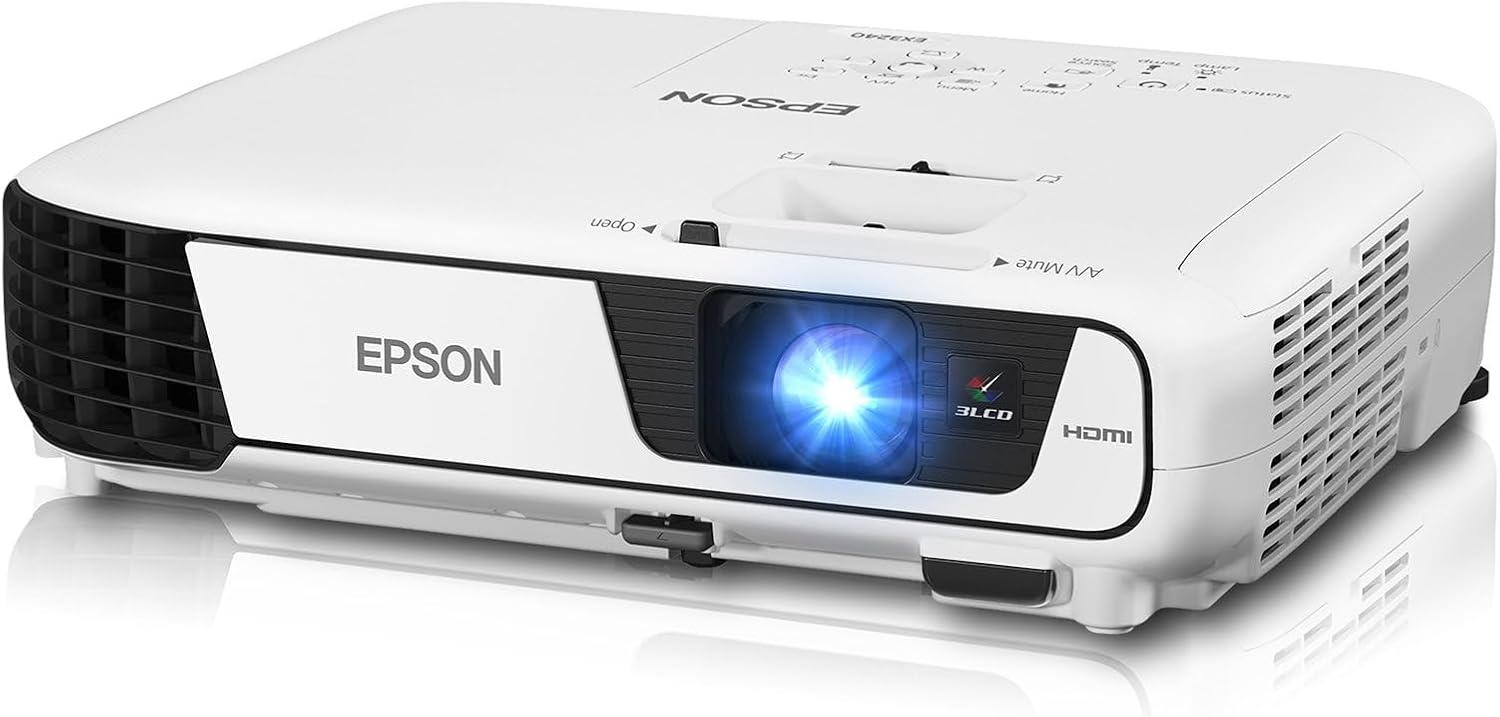
The Epson EX3240 is an entry-level SVGA projector designed for users who need a straightforward, affordable solution for presentations, classroom lessons, or casual media viewing. Its 800x600 native resolution makes it best suited for basic slideshows and documents rather than detailed video or gaming content.
What sets this projector apart is its use of Epson's 3LCD, 3-chip technology, which produces 3200 lumens of both color and white brightness. This matters in real-world use because many competing DLP projectors advertise high white brightness but fall short on color brightness, resulting in washed-out or dull images, an issue the EX3240 largely avoids.
Build quality is functional and portable, weighing about 2.4 kg and measuring roughly 14.5 x 13.8 x 6.2 inches, making it easy to move between rooms or carry in the included bag. The button controls and remote are simple, and setup is quick thanks to Epson's straightforward menu system and HDMI connectivity.
The main drawback is the SVGA resolution, which feels dated even for budget projectors and will disappoint anyone expecting sharp text or HD video playback. It's also limited to wired connections, with no built-in wireless streaming options, so cord management is something to plan for.
Overall, the Epson EX3240 is a solid pick for budget-conscious buyers, schools, or small business users who prioritize color accuracy and brightness over resolution. It's not the choice for home theater enthusiasts, but for basic presentation needs it delivers reliable, vivid performance at a reasonable price.
Resolution: SVGA native (800 x 600), supports up to 1400 x 1050p input.
Brightness: 3200 lumens color brightness and 3200 lumens white brightness with a 15000:1 contrast ratio.
Connectivity: HDMI input, compatible with laptops and gaming consoles.
Lamp Life: Up to 5000 hours, with a maximum image size of 300 inches and throw distance up to 350 inches.
Dimensions & Weight: 14.5 x 13.8 x 6.2 inches, approximately 2.4 kg, includes a carrying bag for portability.
Pros
- Excellent brightness compared to similarly priced projectors
- Dual HDMI connectivity simplifies hooking up multiple devices like Apple TV
- Precise 'perfect fit' keystone correction saves setup time
- Long lamp life lowers maintenance costs over time
- Positive feedback from bulk classroom purchases
Cons
- Native XGA resolution (1024x768) is lower than modern HD or 4K standards
- At least one reported unit failure with no return option, raising reliability concerns
- Limited to portable tabletop mounting, not ideal for permanent ceiling installs
The Epson PowerLite 98H is a 3LCD projector designed specifically for classroom and educational use, though its features also suit small business or meeting room setups. With XGA resolution and 3000 lumens of brightness, it's built to handle well-lit environments where clarity matters most.
What stands out is Epson's 3LCD technology, which the brand claims delivers three times brighter colors than competing projectors in its class. Reviewers who purchased in bulk for school installations confirmed this, noting it outperformed five other models in brightness testing. The dual HDMI ports, one of which is MHL-enabled, make it simple to connect laptops, tablets, or streaming devices like Apple TV.
Build quality leans practical rather than premium, with a lightweight 6-pound white housing designed for tabletop mounting rather than permanent installation. The 'perfect fit' keystone correction feature received praise for letting users fine-tune all four corners of the image, saving significant setup time compared to manually adjusting projector placement.
On the downside, its XGA resolution is dated compared to newer HD projectors, which may disappoint users wanting sharper detail for video content. There's also at least one reported case of a unit failing shortly after purchase, which is a fair reliability concern to note, especially given the short return window on Amazon.
Overall, the PowerLite 98H is a dependable, budget-conscious choice for classrooms and BYOD environments that prioritize brightness, connectivity, and low running costs over top-tier resolution. It's best suited for educators and administrators outfitting multiple rooms rather than users seeking a high-end home theater experience.
Pros
- Exceptionally bright 4,000-lumen output performs well even in rooms that are not fully darkened
- Full HD resolution ensures crisp, legible visuals for both detailed presentations and cinematic content
- Low 16ms input latency and 120Hz refresh rate make it genuinely suitable for gaming alongside business use
- Large 300-inch projection capability offers tremendous screen size for auditoriums or home theaters
- USB firmware update support keeps the projector current without requiring service visits
Cons
- Lamp-based technology means eventual bulb replacement costs and a shorter lifespan compared to laser projectors
- The 1.1x optical zoom range is relatively limited, requiring careful placement to achieve the desired screen size
The ViewSonic PA503HD is a full HD DLP lamp projector designed to serve a wide audience, from corporate presenters and classroom educators to home theater enthusiasts and casual gamers. With 4,000 ANSI lumens of brightness and a 1920x1080 native resolution, it positions itself as a versatile, high-performance option in the mid-range projector market.
The standout feature here is undeniably the brightness. At 4,000 lumens, the PA503HD holds its own in moderately lit rooms, making it practical for daytime presentations without requiring blackout curtains. Paired with a 22,000:1 dynamic contrast ratio and Texas Instruments 0.65-inch DMD chip, colors appear vivid and blacks look genuinely deep, which is impressive for a lamp-based unit at this price point.
For gamers and sports viewers, the 120Hz refresh rate and 16ms input latency are welcome additions that go beyond what most business projectors offer. Motion appears smooth and responsive, and fast-action scenes are rendered with minimal blur. The dual HDMI inputs and USB-A port add practical connectivity, and the auto vertical keystone correction simplifies setup considerably when ceiling mounting or placing on an uneven surface.
On the downside, the 1.1x optical zoom is narrower than competing models, which limits placement flexibility. Being a lamp-based projector, users should also factor in eventual bulb replacement costs and the fact that brightness will diminish gradually over the lamp's lifespan. Laser alternatives may offer longer-term value for heavy daily use.
Overall, the ViewSonic PA503HD delivers a compelling combination of brightness, image quality, and gaming-capable performance that justifies its position in the lineup. It is best suited for users who need a dependable, bright projector for mixed use across work, entertainment, and gaming, and who are comfortable with standard lamp maintenance over time.
Resolution: Full HD 1920x1080 (1080p)
Brightness: 4,000 ANSI Lumens
Contrast Ratio: 22,000:1 Dynamic
Technology: DLP with Texas Instruments 0.65-inch DMD Chip
Throw Ratio: 1.4 to 1.6
Optical Zoom: 1.1x
Digital Zoom: 0.8x to 2.0x
Screen Size Range: 80 inches to 150 inches (standard); up to 300 inches maximum
Throw Distance for 100-inch Image: 10.8 feet
Refresh Rate: 120Hz
Input Latency: 16ms
Connectivity: 2x HDMI, 1x USB-A
Keystone Correction: Auto Vertical Keystone
Firmware Updates: Via USB connection
Mounting: Ceiling mountable, compatible with ViewSonic PJ-WMK-007
If you are considering the ViewSonic PA503HD, the first question to ask is how much ambient light your space typically has. This projector shines brightest, literally, in environments where full blackout is not always possible, such as classrooms, conference rooms, or open living areas. Its 4,000-lumen output gives it a clear advantage over budget 2,000 to 3,000 lumen models in these settings.
For home theater purists who watch exclusively in a dark room, a projector with deeper native contrast or laser light source might be worth considering. However, if your usage spans presentations during the day and movies or gaming at night, the PA503HD handles both scenarios competently without requiring a second device.
Gamers should note that the 120Hz refresh rate and 16ms latency are genuine performance specs, not marketing additions. If you plan to connect a gaming console or PC, this projector delivers a noticeably smoother experience than standard 60Hz business projectors. Just ensure your source device supports 1080p at 120Hz to take full advantage.
Finally, consider placement before purchasing. The 1.1x optical zoom means you have limited room to adjust the image size without physically moving the projector. Measure your intended throw distance against the specification chart to confirm it fits your space before committing to a ceiling mount installation.
Key Factors for Choosing a Classroom Projector
Brightness and Image Clarity
Lumens measure a projector’s light output, which is critical for visibility in classrooms with ambient light. For most standard classrooms, a minimum of 3000 lumens is recommended. Higher brightness ensures text and images remain clear and vibrant, even with the lights on or windows uncovered. Look for models that specify both color and white brightness for accurate, lifelike visuals that keep students engaged.
Connectivity and Compatibility
A modern classroom projector must serve as a central hub for various devices. Multiple HDMI ports are essential for connecting laptops, document cameras, and streaming sticks like Chromecast. VGA ports remain useful for legacy computers. Some projectors offer integrated tech stations or wireless capabilities, simplifying setup and reducing cable clutter. This flexibility is key for supporting a Bring-Your-Own-Device (BYOD) environment.
Resolution and Technology
Resolution determines the sharpness of the projected image. WXGA (1280×800) or XGA (1024×768) are common standards suitable for presentations and educational software. For Full HD video content, a 1080p resolution is ideal. The projection technology—DLP or 3LCD—also affects performance. DLP often offers high contrast, while 3LCD technology is known for delivering richer, more consistent color brightness, which is excellent for detailed diagrams and videos. Understanding these differences can help you select the right tool for your specific teaching needs, whether in a standard classroom or a larger lecture hall.
Longevity and Total Cost of Ownership
Consider the projector’s total cost beyond the initial purchase. Lamp life is a major factor; a longer-lasting lamp (e.g., 10,000 to 15,000 hours) reduces replacement frequency and maintenance costs. A quiet cooling system is also important for maintaining a focused learning environment. Durable construction and reliable brand support ensure your investment continues to pay off year after year. For more insights on durable options, see our review of the best classroom projectors under $150.
Final Thoughts
After a thorough assessment, two models stand out for distinct educational applications. For schools prioritizing maximum brightness and future-proof connectivity with a built-in tech station, the InFocus IN136 DLP WXGA 4000 Lumens, 3X HDMI, VGA is a robust, high-performance choice. Alternatively, educators seeking vivid color accuracy and proven reliability for everyday presentations will find exceptional value in the Epson V11H687020 LCD Projector. Both options deliver the core features needed to create a dynamic and effective visual learning environment.
Frequently Asked Questions
What is the most important feature for a school projector?
Adequate brightness is paramount. A projector with at least 3000 lumens ensures content is visible to all students, regardless of classroom lighting conditions. This is followed closely by versatile connectivity to handle various teacher and student devices seamlessly.
Is DLP or 3LCD technology better for classrooms?
Both have merits. DLP projectors often provide higher contrast ratios for sharp text, while 3LCD models are celebrated for superior color brightness and consistency, which can make educational visuals more engaging. The best choice depends on whether your primary content is text-based or rich in color imagery.
How long should a classroom projector last?
A quality projector should provide several years of service. Look for a lamp life rating of 10,000 hours or more. At typical daily use, this can translate to over five years before a lamp replacement is needed, making it a sound long-term investment for your school.
Can these projectors be used in university settings?
Absolutely. The models reviewed here are suitable for various educational spaces, from K-12 classrooms to smaller college seminar rooms. For larger university auditoriums, you may need specialized high-brightness models, which you can explore in our guide to the best projectors for university classrooms.




Write Your Review
No reviews yet. Be the first to share your experience!