

Imagine unpacking your bag at a campsite or setting up in a hotel room, only to find you’re missing one crucial element for movie night: an outlet. That’s the exact freedom the best cordless pocket projectors are designed to provide. These compact devices pack a battery, a light source, and a speaker into a package small enough to slip into a jacket pocket, offering spontaneous big-screen entertainment anywhere. Whether you’re a frequent traveler, a parent looking for backyard fun, or a creative using projectors for tracing and art, this guide cuts through the clutter. We have reviewed eight of the top models available in September 2026, focusing on what makes each one unique for different needs. For more options designed for ultimate mobility, you can explore our roundup of the best battery-powered pocket projectors.
Your choice depends heavily on how you plan to use it. Will it be for outdoor movie nights under the stars, or for indoor ceiling projection in a bedroom? Is wireless screen mirroring a must-have, or is a simple HDMI connection sufficient? Perhaps you need a projector that doubles as a creative tool for cookie decorating or art tracing. The following comparison table gives you an instant overview of the eight contenders we assessed, so you can quickly see the range of options available.

Pros
- Genuinely pocket-sized and lightweight, making it the most portable projector option for travel
- Impressive 100-inch projection capability from minimal throw distance enables creative placement options
- 2-hour battery runtime provides meaningful cordless entertainment without constant charging
- Includes carrying case and cables, ready to use right out of the box
- Versatile connectivity supports smartphones, gaming consoles, laptops, and tablets seamlessly
Cons
- Low 35 lumens brightness limits use to dark rooms and nighttime viewing, not suitable for daytime outdoor projection
- USB drive compatibility issues reported by some users, may require specific file formats or drive types
- Native 640x360 resolution produces softer image quality compared to standard projectors
The KODAK Luma 75 Pocket Projector is a compact, battery-powered projector designed for travelers, outdoor enthusiasts, content creators, and anyone seeking portable entertainment. Its true pocket-sized form factor (3.46 x 3.46 x 0.91 inches) makes it the most travel-friendly projector option available, easily fitting into backpacks, camera bags, or even large jacket pockets. This projector targets users who prioritize portability and spontaneity over brightness and resolution.
The standout feature is the 2-hour rechargeable battery that enables completely cord-free viewing, a game-changer for outdoor movie nights, camping trips, and remote presentations. The 100-inch maximum display size combined with a 0.5-foot minimum throw distance means you can project large images in tight spaces, from a few feet away or even closer. Universal connectivity via HDMI, USB, and microSD accommodates smartphones, tablets, laptops, gaming consoles, and streaming devices without requiring adapters. The plug-and-play design with intuitive button controls means setup takes seconds rather than minutes.
Build quality appears solid with a protective carrying case included in the box, along with HDMI cable and power cord. The compact white housing feels durable for its price point. The 30,000-hour LED lifespan indicates this projector should provide years of reliable service. However, the 35 lumens brightness is notably low, restricting use to dimly lit rooms and nighttime outdoor settings. Daytime outdoor projection or well-lit indoor spaces will produce washed-out images.
Some users have reported USB drive compatibility issues, suggesting potential limitations with certain file formats or drive types. The native 640x360 resolution produces softer image quality than standard projectors, though this is acceptable for casual viewing and presentations. These limitations are inherent to the pocket projector category and represent necessary trade-offs for achieving such portability.
The KODAK Luma 75 excels as a travel companion and entertainment device for dark environments. If you need a projector for camping, travel, outdoor events in evening hours, or creative projects like cake decorating and art tracing, this pocket projector delivers exceptional portability and convenience. For bright room use or professional presentations requiring sharp image quality, consider a higher-brightness alternative. Overall, this is a thoughtfully designed portable projector that successfully balances capability with pocket-sized convenience.
Display and Image Quality: Native resolution of 640x360 pixels with maximum display resolution of 360x640 pixels. Maximum brightness of 35 ANSI lumens with 400:1 contrast ratio. Projects images from 3 inches to 100 inches maximum, with minimum throw distance of 0.5 feet and maximum throw distance of 8.5 feet. DLP (Digital Light Processing) technology provides reliable image quality.
Connectivity and Compatibility: HDMI, USB 2.0, microSD card slot, and 3.5mm audio jack. Compatible with gaming consoles, laptops, smartphones, and tablets. Supports MPEG-4 video encoding. Includes HDMI cable in the box for immediate connectivity.
Power and Battery: 10-watt LED lamp with 30,000-hour operating life. Rechargeable micro USB battery providing up to 2 hours of wireless runtime. 5-volt operation with included power cord. Button control interface for simple operation.
Physical Specifications: Dimensions of 3.46 inches length, 3.46 inches width, and 0.91 inches height. Includes tripod mount for flexible positioning. Comes with protective carrying bag, HDMI cable, power cord, and user manual. 1-year manufacturer warranty included.
Is This Projector Right for You? The KODAK Luma 75 is ideal if you prioritize portability above all else and plan to use the projector primarily in dark or dimly lit environments. It excels for travel, camping, outdoor evening events, bedroom entertainment, and creative applications like cake decorating or art projection. If you need bright daytime projection or professional-grade image quality, look for higher-lumen alternatives.
Best Use Cases: Travel and camping trips where portability is essential, outdoor movie nights after sunset, bedroom entertainment for kids and students, creative projects requiring projection, spontaneous gathering entertainment, backup projector for presentations, and gaming in dark rooms. The included carrying case makes it genuinely pack-and-go ready.
Setup and Troubleshooting Tips: Read the instruction manual before first use to understand power-on procedures. Test USB drives and file formats before important events, as some users report compatibility issues. Use the projector in the darkest environment possible to maximize image brightness and quality. The short minimum throw distance allows flexible placement on shelves, tables, or tripods. Ensure proper ventilation around the projector during operation.
Alternative Considerations: If you need higher brightness for daytime use, consider projectors with 100+ lumens. For better image resolution, explore models with 1080p native resolution. If battery runtime is critical, verify the 2-hour specification meets your needs. Compare this pocket projector against other portable options to ensure the feature set aligns with your specific requirements.

Pros
- Completely cord-free operation thanks to the built-in rechargeable battery, great for outdoor and travel use
- Android TV 11 eliminates the need for extra streaming devices, keeping setup simple and clutter-free
- 220-degree rotation and auto keystone correction make placement incredibly flexible with minimal manual adjustment
- Wide device compatibility via WiFi mirroring, HDMI, USB, and Bluetooth covers virtually every use case
- Compact, pocket-sized design makes it genuinely portable for camping, road trips, and bedroom ceiling projection
Cons
- Native resolution is 720P, so while 4K content is supported, the actual displayed sharpness will not match a true 4K projector
- Battery life of up to 3 hours in Eco Mode may not be sufficient for longer films or extended outdoor sessions without a power source nearby
The HOTPEAK Mini Projector is a compact, battery-powered smart projector designed for users who want flexible home entertainment without complicated setups. Running Android TV 11 out of the box, it targets bedroom movie lovers, outdoor enthusiasts, campers, and anyone who wants a portable cinema experience without hauling heavy equipment or hunting for power outlets.
The standout feature is undoubtedly the built-in rechargeable battery, which provides up to 3 hours of playback in Eco Mode, making it one of the few mini projectors in this price range that is genuinely cord-free. Combined with dual-band WiFi 6 and Android TV 11, streaming from YouTube or Prime Video is smooth and straightforward, eliminating the need for a separate Fire Stick or Chromecast. The 220-degree rotating stand is a practical highlight, allowing ceiling projection in bed or flexible wall angles with ease.
In terms of image quality, the projector offers a native 720P resolution with 4K content support and a 1500:1 contrast ratio. Auto keystone correction and electric focus handle alignment automatically, though manual lens adjustment is also available for fine-tuning. The projection size scales from 30 to 200 inches, which is impressive for a device this size, and setup is genuinely quick in practice.
There are a few honest considerations to keep in mind. The native 720P panel means that while 4K input is accepted, the output resolution will not match a dedicated 4K display. The 3-hour battery life is adequate for most movies but may fall short for longer sessions or back-to-back content without access to a charger. The built-in stereo speaker is convenient but may lack the depth that serious home theater fans expect.
Overall, the HOTPEAK Mini Projector delivers strong value for its price point, especially for casual users, travelers, and outdoor movie fans who prioritize portability and ease of use over absolute image fidelity. It is a well-rounded package that punches above its weight in features, and the Android TV 11 integration alone sets it apart from many competitors in the budget mini projector category.
Resolution: Native 720P with 4K content support. The projector accepts 4K input signals and displays them at its native 720P resolution, which is standard for mini projectors in this category.
Connectivity: Dual-band WiFi 6 (2.4GHz and 5GHz), Bluetooth 5.2, HDMI input (cable sold separately), and USB media playback. Supports wireless screen mirroring from iPhone, Android, tablets, and laptops.
Smart Platform: Android TV 11 with Google Play Store access for apps including YouTube and Prime Video. Compatible with external TV sticks via HDMI for expanded streaming options.
Battery and Projection: Built-in rechargeable battery with up to 3 hours playback in Eco Mode. Projection size ranges from 30 to 200 inches. Features auto keystone correction, electric focus, and manual lens ring adjustment. 220-degree rotating stand included.
Audio: Built-in stereo speakers with Bluetooth 5.2 support for pairing external speakers or headphones. Contrast ratio of 1500:1 for improved image depth in darker environments.
If you are considering the HOTPEAK Mini Projector, the first question to ask is how you plan to use it most often. For bedroom ceiling projection, casual outdoor movie nights, camping trips, or travel, this projector is an excellent fit. Its battery, compact size, and Android TV 11 integration make it one of the most self-contained options available at this price.
For buyers focused on image quality above all else, it is worth noting that native 720P resolution is the practical ceiling here. If you are planning to use this as a primary living room projector for 4K HDR content, a higher-end dedicated projector would serve you better. However, for the majority of casual viewing scenarios, 720P at this size and distance is perfectly watchable.
Consider your audio needs as well. The built-in stereo speakers are convenient for solo or small-group viewing, but pairing a Bluetooth speaker via the Bluetooth 5.2 connection will significantly improve the overall experience for group screenings or outdoor use. A portable Bluetooth speaker is a worthwhile companion purchase.
Finally, keep in mind that the HDMI cable is sold separately, so factor that in if you plan to connect a laptop or external streaming stick. For most users who will rely on the built-in Android TV 11 or wireless mirroring, this will not be an issue, but it is good to know before your first outdoor setup.

Pros
- Genuinely pocket-sized design that actually fits in a back pocket for travel
- Wireless mirroring capability works reliably without requiring Wi-Fi network
- Built-in speaker and audio jack provide flexible sound options
- Long-lasting LED light source rated for 30,000 hours of operation
- Affordable price point delivers excellent value for portable projection
Cons
- 40 ANSI lumens brightness limits effectiveness in well-lit rooms, better for dark environments
- Native 640x360 resolution means some image softness compared to full HD projectors
- 2-hour battery life requires planning for extended viewing sessions
The Miroir M76 is a genuinely portable pocket projector designed for anyone who needs big-screen entertainment or presentations without the bulk of traditional projectors. It's perfect for business travelers, college students, outdoor movie enthusiasts, and anyone who values mobility. The palm-sized form factor and sub-pound weight mean you can throw it in a backpack or even a large jacket pocket without thinking twice.
The standout feature is the wireless mirroring capability, which lets you cast directly from your iPhone, Android tablet, or laptop without needing an HDMI cable or Wi-Fi network. Users report that mirroring works smoothly and reliably, even in public spaces where network interference might be an issue. The DLP LED imaging technology delivers surprisingly crisp visuals with good color accuracy, and the 50-inch maximum display size is genuinely useful for small group presentations or personal entertainment.
Build quality is solid for the price point, with a lightweight plastic construction that feels durable enough for travel. The included 1W speaker handles basic audio adequately, though connecting external speakers via the 3.5mm jack is recommended for better sound. The built-in rechargeable battery is a game-changer for cordless operation, and USB charging compatibility means you can extend viewing time with a portable power bank.
The main limitation is brightness. At 40 ANSI lumens, the projector performs best in dark or dimly lit rooms. Bright daylight or well-lit conference rooms will wash out the image significantly. The native 640x360 resolution is lower than full HD projectors, though it still displays 1080p input content reasonably well. Battery life maxes out at 2 hours, so longer sessions require planning or external power.
Overall, the Miroir M76 delivers genuine value for portable projection. It excels at what it's designed for: compact, cordless, wireless projection for travel, outdoor use, and small spaces. If you prioritize portability and wireless connectivity over brightness and resolution, this projector is an excellent choice at its price point.
Display and Image Quality
Native Resolution: 640 x 360 pixels
Maximum Input Resolution: 1920 x 1080 (1080p)
Brightness: 40 ANSI lumens
Contrast Ratio: 300:1
Image Size Range: 24 to 50 inches
Throw Distance: 3 to 9 feet
Display Technology: DLP LED
Connectivity and Power
Primary Input: HDMI
Audio Outputs: Built-in 1W speaker, 3.5mm audio jack
Wireless: Wi-Fi ready, direct device mirroring
Battery: Built-in rechargeable, 2-hour runtime
Charging: USB input for charging and power delivery
Compatible Devices: iPhone, Android phones and tablets, laptops, gaming devices
Physical Specifications
Weight: Under 1 pound
Form Factor: Pocket projector
Color: Black
Power Consumption: 5 watts
Operating Voltage: 5V
Light Source Life: 30,000 hours
Mounting: Floor mount compatible
Warranty and Support
Warranty: 2-Year Limited Parts and Labor
Included Accessories: Power cord
Model: M76
Manufacturer: Miroir
Ideal For
Business travelers who need to present from hotel rooms or client sites without carrying equipment. College students wanting to watch movies in dorms or study groups. Outdoor movie enthusiasts and camping fans. Real estate agents and contractors who need to show presentations on-site. Teachers and trainers who present in multiple locations. Anyone prioritizing portability and wireless convenience over maximum brightness.
Not Ideal For
Bright room environments like conference centers or outdoor daytime use. Users needing high-resolution detail work or professional video editing review. Anyone requiring projector operation beyond 2 hours without external power. Home theater enthusiasts seeking primary entertainment solutions. Presentations in rooms with high ambient light without additional screen setup.
Pros
- Genuinely pocket-sized and lightweight design makes it one of the most portable projectors available
- Wireless mirroring via AirPlay and EZCast offers flexible, cable-free screen sharing from smartphones
- Long LED lamp lifespan of up to 30,000 hours means low maintenance and lasting value
- Tripod and remote control included in the box add real convenience right out of the package
- Versatile enough for entertainment, business presentations, and creative hobby use
Cons
- At 50 ANSI lumens, brightness is limited and a dark environment is required for a quality image, making it unsuitable for well-lit rooms
- Copyrighted streaming content from Netflix, Hulu, and similar services cannot be mirrored wirelessly or via HDMI, which is a notable restriction for streaming users
- Battery runtime of up to 2.5 hours may not be enough for longer movies without access to a power source
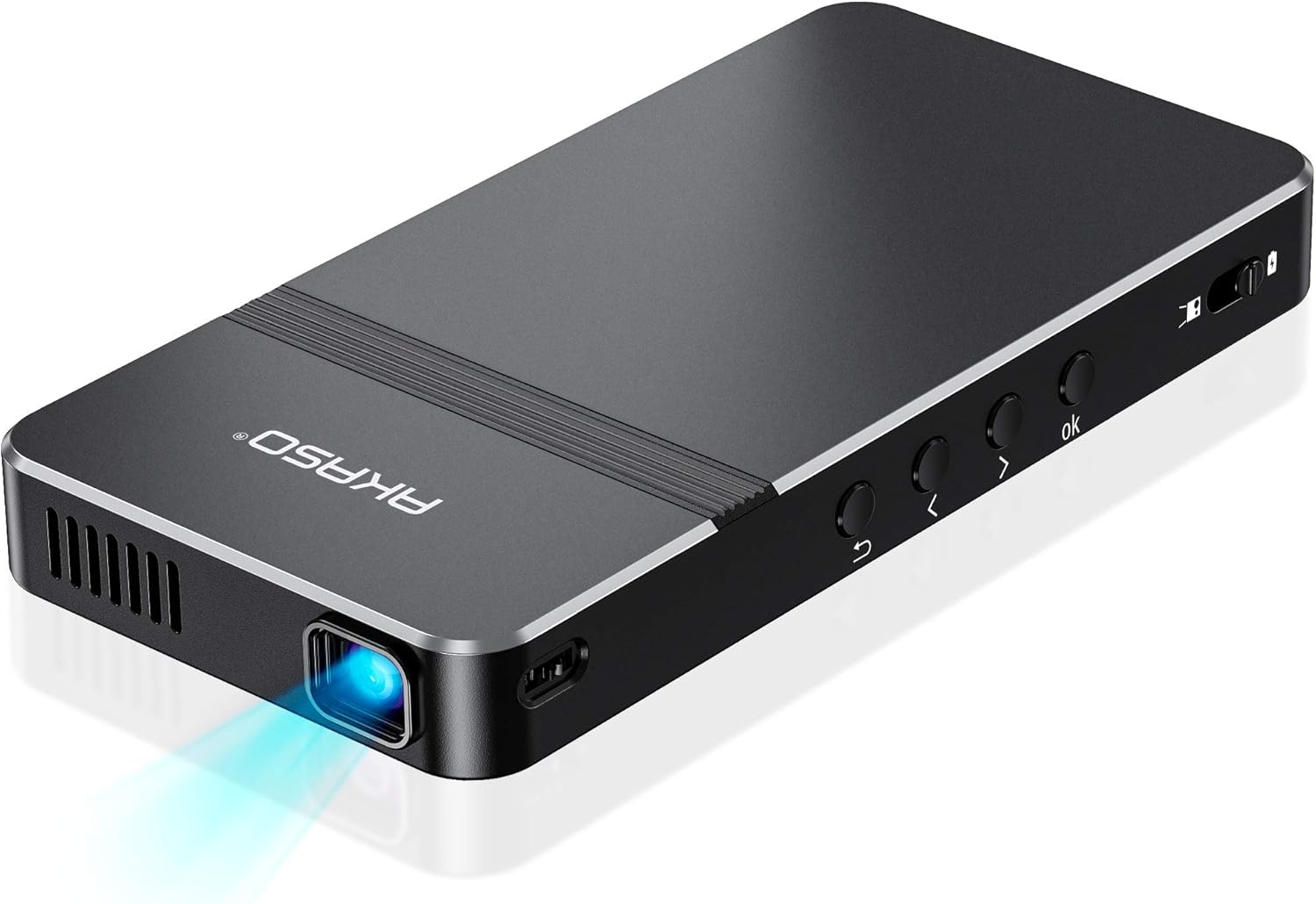
The AKASO Mini Cookie Projector is a palm-sized DLP pico projector designed for users who want big-screen experiences without the bulk of a traditional projector. It targets a wide audience ranging from casual movie watchers and gamers to small business presenters and creative hobbyists who use it for cookie decorating or art tracing. Its pocket-friendly form factor and built-in battery make it one of the more genuinely portable options in its price range.
On the performance side, the projector supports 1080P resolution and delivers a 1000:1 contrast ratio, which produces sharp and detailed images when used in a properly darkened room. The 50 ANSI lumen output is modest, and AKASO themselves recommend a dark environment for the best results, so this is not a projector for bright living rooms or outdoor daytime use. That said, the DLP LED lamp is rated for up to 30,000 hours, which is a strong long-term value proposition.
Connectivity is a genuine strength here. The updated Type-C port joins HDMI, AV, and Micro SD inputs, and wireless mirroring is supported through AirPlay and EZCast for easy smartphone casting. The included tripod and remote control add a layer of everyday convenience that many competing mini projectors skip. Setup is straightforward and the package feels well-rounded for the price.
The most significant drawback is the streaming limitation. Copyrighted content from platforms like Netflix and Hulu cannot be cast wirelessly or through HDMI, which will frustrate users who primarily want to stream. The 2.5-hour battery life is also a consideration for anyone planning to watch full-length films without a nearby outlet. These are real-world limitations worth factoring into your decision.
Overall, the AKASO Mini Projector earns its strong rating by delivering a compact, versatile, and well-equipped package at a reasonable price. It is best suited for users who value portability and creative flexibility over raw brightness. If your use case involves a dark room, short to medium-length content, and a mix of wired and wireless sources, this projector delivers solid value and a genuinely fun experience.
Projection Technology: DLP (Digital Light Processing) with LED light source rated up to 30,000 hours. Supports native and input resolution up to 1080P Full HD.
Brightness and Contrast: 50 ANSI lumens brightness with a 1000:1 contrast ratio. Best performance achieved in dark or dimly lit environments. Screen size adjustable up to 150 inches.
Connectivity: Wired inputs include Type-C (updated from Micro USB as of October 2025), HDMI (cable included), AV, and Micro SD card slot. Wireless connectivity supported via AirPlay and EZCast for screen mirroring from mobile devices.
Battery and Portability: Built-in rechargeable battery with up to 2.5 hours of playback time. Compact pocket-sized form factor with integrated stereo speakers. Tripod and remote control included in the box.
Important Note: Copyrighted streaming content from services such as Netflix and Hulu cannot be mirrored wirelessly or via HDMI cable due to DRM restrictions. A dark environment is strongly recommended for optimal image quality.
Who should buy this projector? The AKASO Mini Projector is an excellent choice for travelers, students, and hobbyists who need a portable display solution without committing to a full-sized unit. It is particularly well-suited for people who want a projector for creative projects like cookie decorating, art tracing, or craft work, as its clear and adjustable image projection fills a niche that most projectors ignore.
Is it good for movies? It can handle movies well in a dark room, but the 50 ANSI lumen brightness means ambient light will wash out the image significantly. Users who primarily want to stream Netflix or Hulu should be aware that DRM restrictions prevent wireless and HDMI mirroring of that content. Local media files via Micro SD or HDMI from a laptop work without issue.
Is it good for business use? Yes, for small meetings and informal presentations it works well. The included tripod and remote control make it easy to set up and operate independently. For larger conference rooms or presentations in bright environments, a higher-lumen projector would be a better fit.
What accessories are included? The box includes an HDMI cable, a tripod, and a remote control, which is a generous bundle for a mini projector. This means you can get started right away without purchasing additional accessories for most common use cases.

Pros
- Extremely portable and lightweight for on-the-go use
- Simple wireless mirroring once connected to the Kodak network
- Sharp, clear image quality thanks to auto-focus and 1080p support
- Versatile connectivity with HDMI, USB, and microSD inputs
- Great niche uses beyond movies, such as projecting templates for crafts and cookie decorating
Cons
- Battery life is short at about 2.5 hours and drains faster when powering external devices like a streaming stick
- Low brightness rating (55 ANSI lumens) makes it best for dim rooms rather than bright environments
- Built-in speaker sound quality is weak, often requiring an external Bluetooth speaker
The KODAK Luma 150 is an ultra-mini pocket projector designed for people who prioritize portability over raw performance. Weighing just 7.5 oz and small enough to fit in a pocket, it targets travelers, campers, and casual users who want a simple, grab-and-go home entertainment or presentation solution.
Its standout features are wireless mirroring via Miracast and AirPlay, along with auto-focus that reduces setup hassle. Reviewers confirm that once connected to the Kodak network and paired with home Wi-Fi, screen mirroring from iPhones and Android devices works smoothly, and image clarity is better than expected for its size. Several users even repurpose it creatively, projecting cookie decorating templates with sharp, clean results.
Build quality feels solid for a device this size, with a touch-based control panel, a tripod mount for flexible placement, and a versatile charging cable that includes multiple plug adapters for international use. The compact footprint and HDMI, USB, and microSD inputs make it easy to connect a variety of media sources without extra accessories.
The trade-offs come from its small size and low power draw. At only 55 ANSI lumens, it performs best in dark or dim rooms rather than bright spaces, and the built-in speaker is noticeably weak, pushing many owners toward external Bluetooth audio. Battery life, rated around 2.5 hours, drops quickly if the projector is also powering an accessory like a streaming stick.
Overall, the KODAK Luma 150 is a solid pick for casual, portable projection needs like bedroom ceiling movies, outdoor gatherings, or hobbyist projects, but it is not meant to replace a full home theater projector. Buyers seeking convenience and mobility over brightness and battery longevity will find good value here.
Pros
- Extremely compact and lightweight design makes it one of the most portable projectors in its class
- DLP technology delivers cleaner, sharper images than comparable LCD mini projectors at this price point
- Built-in Android 9.0 eliminates the need for a separate streaming device, adding great standalone value
- Multiple connectivity options including HDMI, USB, Micro SD, Bluetooth, and wireless mirroring cover virtually every use case
- Long 30,000-hour lamp life means you won't need to worry about bulb replacements for years
Cons
- Native resolution is WVGA (854x480), so while it supports 1080p input, the actual projected image is not true 1080p and may look soft on larger screens
- At only 50 ANSI lumens, brightness is limited and the projector performs best in dim or dark environments, making daytime or well-lit room use difficult
- Battery life of approximately 2 hours may not be enough for longer movies without access to a power source
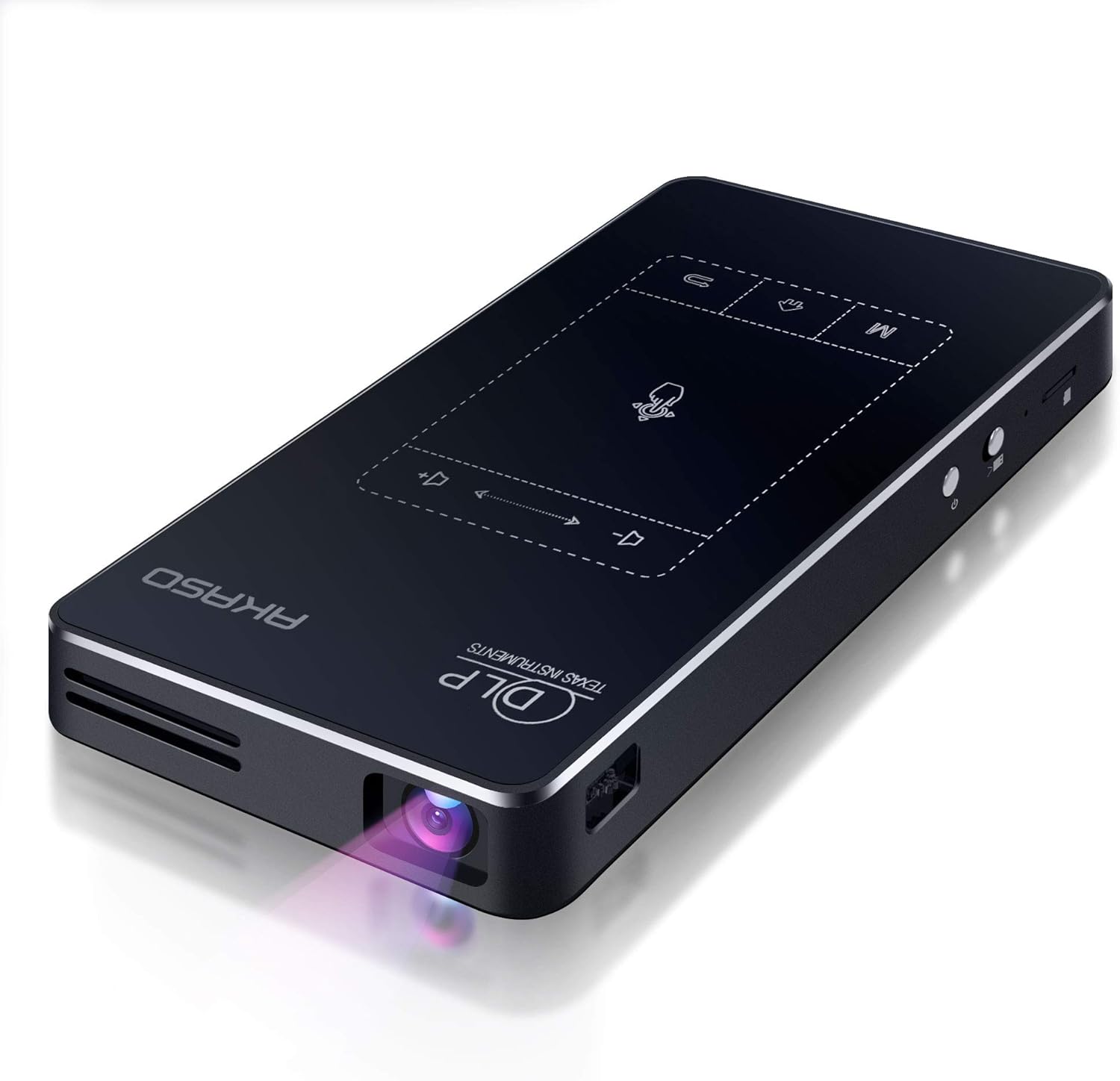
The AKASO WT50 is a palm-sized DLP projector designed for users who want big-screen entertainment without the bulk of a traditional projector. Built around an Android 9.0 system with built-in WiFi, Bluetooth, and a rechargeable battery, it targets movie fans, travelers, outdoor enthusiasts, and even creative hobbyists who need a versatile, go-anywhere display solution.
Performance-wise, the WT50 uses DLP technology with a 0.2 DMD chip, which produces noticeably cleaner and sharper images than LCD-based mini projectors at this price. Colors are vivid and the diffuse reflection design is gentler on the eyes during extended viewing sessions. That said, the native resolution is WVGA (854x480), meaning content is upscaled rather than displayed in true 1080p, so image sharpness on very large screens may not match higher-end projectors.
The build quality is a genuine highlight. The all-metal aluminum alloy casing feels premium and durable for its size, and at just 0.64 lbs, it is remarkably light. The compact footprint, roughly the size of a large smartphone, means it fits in a jacket pocket or small bag with ease. The included mini tripod and remote control add practical value right out of the box.
There are a few trade-offs worth noting. At 50 ANSI lumens, the brightness is modest, and the projector really shines only in dim or dark environments. Outdoor use at dusk or night works well, but daytime use in a lit room will result in a washed-out image. The 2-hour battery life is also a limitation for feature-length films, though a power bank or wall outlet can extend usage. Additionally, Netflix and Hulu cannot be wirelessly mirrored due to DRM restrictions, though you can download their apps directly via Google Play as a workaround.
Overall, the AKASO WT50 is an impressive feat of miniaturization and a genuinely useful portable projector for its price. It is best suited for users who prioritize portability and versatility over raw brightness or pixel-perfect resolution. Whether you are hosting a backyard movie night, decorating cookies with projected templates, or watching videos while camping, the WT50 delivers a compelling and creative experience in a remarkably small package.
Display Technology: DLP (0.2 DMD Optically Processed Chip)
Native Resolution: WVGA 854 x 480, supports up to 1920 x 1080p input
Brightness: 50 ANSI Lumens
Aspect Ratio: 16:9
Projection Size: 30 to 120 inches
Projection Ratio: 1.19:1
Operating System: Android 9.0
WiFi: Dual-band 2.4G and 5G (802.11ac)
Bluetooth: Yes
Screen Mirroring: AirPlay, Miracast, EShare, DLNA
Battery: 3.7V, 5000mAh built-in rechargeable
Battery Life: Approximately 2 to 3 hours
Lamp Life: 30,000 hours
Connectivity: HDMI, 2x USB 2.0, Micro SD (up to 32GB), 3.5mm Audio Jack
Keystone Correction: Automatic, up to 40 degrees
Dimensions: 5.5 x 3.1 x 0.8 inches
Weight: 0.64 lbs
Casing Material: Aluminum Alloy
In the Box: WT50 Projector, Remote Control, Mini Tripod, HDMI Cable, Charger, Quick Reference Guide
If you are considering the AKASO WT50, it helps to understand exactly what kind of projector this is and who it suits best. This is a mini projector built for portability and convenience, not a home theater replacement. If your priority is the sharpest possible 1080p image in a bright living room, a larger, higher-lumen projector will serve you better.
The WT50 is ideal for users who value portability above all else. Campers, travelers, and dorm room users will appreciate the battery-powered design and pocket-friendly size. The built-in Android system is a major convenience, removing the need to carry a separate Chromecast, Fire Stick, or laptop just to stream content. Simply connect to WiFi and download your preferred apps directly onto the projector.
For creative applications, the WT50 has found a surprisingly enthusiastic following. Cookie decorators, mural artists, and holiday decorators use it to project templates and designs onto surfaces with precision. The compact form and short throw distance make it well suited for these close-range creative tasks.
A few practical tips before buying: always use the projector in a dim or completely dark environment for the best image quality. Keep the projection distance between 1 and 1.5 meters for the sharpest focus. For Netflix or Hulu, download the apps directly via Google Play rather than attempting wireless mirroring. And if you plan extended sessions, keep a power bank or charger nearby to supplement the built-in battery.

Pros
- Extremely portable and lightweight design
- Simple, button-based plug-and-play operation
- Multiple input options (HDMI, USB, MicroSD)
- Built-in speaker eliminates need for extra audio equipment
- Tripod-compatible for flexible setup
Cons
- Native display resolution (640 x 360) is far below true 1080p, so fine detail will look soft on larger screens
- Low brightness (35 ANSI lumens) means it only performs well in dark or dim rooms
- Short battery-dependent playback window (up to 1.5-2 hours) limits extended use without a power source
The KODAK Luma 75 is a pocket-sized DLP projector aimed at casual users who want an ultra-portable way to enjoy movies, photos, or games on a bigger screen. It's ideal for travelers, students, or anyone who wants a fun, budget-friendly entertainment option rather than a serious home theater replacement.
Its standout feature is sheer portability, weighing just 6.35 ounces and small enough to slip into a bag or pocket. The DLP engine supports 16.7 million colors and accepts 1080p input, but the display's native resolution of 640 x 360 means actual output detail is closer to standard definition, especially noticeable at larger projection sizes.
Build quality feels solid for its size, with a simple button interface and tripod mount threading on the bottom for stable setups. The onboard media player supports MicroSD, USB, and HDMI, making it easy to plug in a laptop, streaming stick, or gaming console without fuss.
The main drawbacks are its low brightness rating of 35 ANSI lumens, which restricts good use to dark or dim rooms, and a fairly short built-in playback time. It's also worth noting the marketing '1080p' label refers to input compatibility, not native output sharpness.
Overall, the KODAK Luma 75 delivers on its promise as a fun, ultra-portable pocket projector for casual viewing, but buyers expecting sharp, true HD detail or bright daytime performance should look elsewhere. For quick backyard movie nights or travel entertainment, it's a solid, affordable choice.
Technology: DLP Optical Engine, LED Display
Resolution: Supports 1920 x 1080 input, native display output of 640 x 360
Brightness: 35 ANSI lumens, best used in dark or dim rooms
Screen Size: Up to 100 inches
Connectivity: HDMI, USB 2.0, MicroSD, 3.5mm audio output
Dimensions: 3.46" x 3.46" x 0.91", Weight: 6.35 ounces
Extras: Built-in 1W speaker, tripod mount threading, onboard media player
Pros
- Extremely compact and lightweight tri-fold design
- Fast, accurate auto focus and keystone correction
- Easy no-Wi-Fi screen mirroring for quick setup
- Doubles as a Bluetooth 5.4 speaker
- Backed by a 2-year warranty and SGS-verified brightness rating
Cons
- Only 100 ANSI lumens and a 300:1 contrast ratio limit use to dim or dark rooms
- Battery lasts just 1.5 hours in eco-mode, so longer sessions require plugging in
- DRM-protected streaming apps require an additional CastPlay Pro dongle sold separately
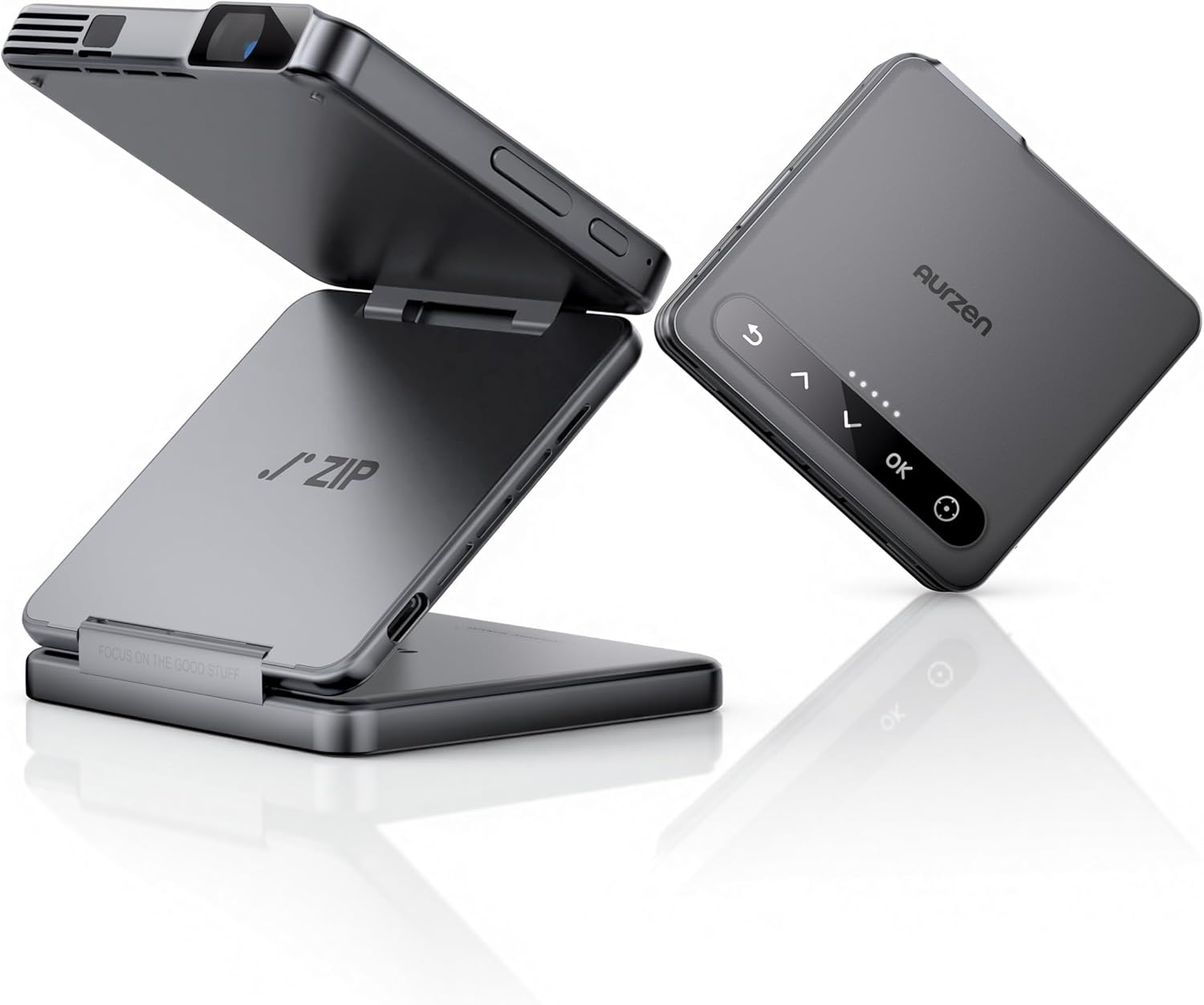
The Aurzen ZIP is a pocket-sized DLP projector aimed at people who value portability above all else. Its tri-fold, wallet-size design and built-in stand make it a natural fit for travelers, crafters, and anyone who wants a grab-and-go screen without lugging around a full-size projector.
Where the ZIP shines is in its smart engineering: ToF-based auto focus continuously adjusts the image 30 times per second, keeping content sharp even when the projector is moved or repositioned, which is especially useful for tracing, cookie decorating, or sewing projects. One-click mirroring works without Wi-Fi, and the vertical mode is a nice touch for viewing social media or sports clips in their native aspect ratio.
Build quality feels purposeful rather than premium, with a Dark Grey plastic shell that prioritizes weight savings over rigidity. At just 0.62 lb and roughly the size of a large smartphone when folded, it genuinely disappears into a bag or even a large pocket, and the integrated stand removes the need for extra accessories.
The tradeoffs are clear once you look past the form factor: 100 ANSI lumens and a 300:1 contrast ratio mean this is not a projector for bright rooms or detailed movie nights, and the 1.5-hour battery life is best supplemented with wall power for longer use. Streaming apps with DRM protection also require a separately sold CastPlay Pro dongle, and Google Cast devices are not supported at all.
Overall, the Aurzen ZIP is best understood as a creative and travel companion rather than a home theater replacement. If you want an ultra-portable screen for tracing, casual mirroring, or quick entertainment on the move, it delivers convincingly; if you need strong brightness or all-day battery life, look elsewhere.
The ZIP uses DLP display technology with a native resolution of 1280 x 720 (720p) and supports 1080p input signals. Brightness is rated at an SGS-certified 100 ANSI lumens, with a 300:1 contrast ratio and a maximum image size of 125 inches at a 9.8-foot throw distance.
Connectivity includes Bluetooth 5.4 for audio pairing and USB-C for both charging and DisplayPort Alt Mode mirroring. The built-in 5000mAh battery supports up to 1.5 hours of eco-mode playtime and can be recharged via USB-C PD, with simultaneous charge-and-play requiring a 24W or higher adapter.
Physically, the projector measures 3.3 x 3 x 1 inches when folded and weighs 0.62 lb, making it one of the smallest DLP projectors on the market. It ships with a Type-C fast charging cable, user manual, and welcome card, and is backed by a 2-year manufacturer warranty.
Buying Guide: Choosing Your Perfect Pocket Projector
Battery Life and Portability
Runtime is the heartbeat of a cordless projector. Our reviews confirmed advertised battery life ranging from 1.5 to 3 hours, which directly impacts your viewing session length. The Mini Projector with WiFi and Bluetooth offers a longer runtime in Eco Mode, ideal for extended camping trips. Meanwhile, models like the Miroir M76 Micro Pocket Projector provide a solid two hours, perfect for a feature film. True portability is a combination of weight and size. Look for projectors weighing under one pound, like the Aurzen ZIP Tri-Fold, which can literally fold down to a wallet size.
Consider your charging options as well. Many now feature USB-C for faster top-ups, which is convenient when traveling light. The balance between battery capacity and physical bulk is key. A larger battery might extend playtime but could compromise the pocket-sized promise. Our list of the best small cordless projectors focuses on models that master this balance.
Connectivity and Ease of Use
How you connect your content is critical. Modern pocket projectors offer a spectrum of options. Wired connections via HDMI or USB are reliable and universal, found on all KODAK models. For true cord-free operation, wireless screen mirroring via Miracast, AirPlay, or proprietary apps is a game-changer. The AKASO WT50 Mini Projector with WiFi and Bluetooth even includes a full Android system, allowing direct app streaming.
Setup should be nearly instantaneous. Features like automatic keystone correction and auto-focus, present on the KODAK Luma 150 and the HOTPEAK model, eliminate frustrating manual adjustments. Look for intuitive one-touch controls and a simple interface. If you plan to use it with multiple devices, from iPhones to gaming consoles, confirm the specific wireless protocols and any required adapters beforehand.
Image Quality and Brightness
Managing expectations is vital for pocket projectors. Their compact size limits raw lumen output, so they perform best in dark to dimly lit environments. DLP (Digital Light Processing) technology, used in most models we reviewed, generally offers better contrast and color accuracy compared to older LCD types. The AKASO Mini Projector, Pocket-Sized DLP, for example, provides a clear 1080P image suitable for various uses.
Native resolution is often 720p, with support for 1080p or 4K input. This means they can accept high-resolution signals but will display them at their native pixel count. For creative applications like tracing, precise focus is more important than extreme brightness. The Aurzen ZIP’s zero-lag auto-focus is specifically designed for such detailed work. For general movie viewing in a darkened room, the image quality from these DLP engines is impressively rich and vibrant.
Specialized Features and Use Cases
Many pocket projectors have evolved beyond simple movie players. Some are explicitly marketed as cookie or art projectors, designed for precise image tracing on flat surfaces. The Aurzen ZIP and certain AKASO models highlight this functionality. Others, like the HOTPEAK model with its 220-degree rotating stand, are built for versatile placement, including ceiling projection in a bedroom.
Consider built-in speakers versus audio-out jacks. Most have small, integrated speakers adequate for personal viewing, but for a more immersive experience, you’ll want to connect to external Bluetooth speakers or headphones. If you need a projector that can truly function as a standalone entertainment hub, an integrated smart TV system is a significant advantage, removing the need for an external streaming stick. For a wider selection of versatile, portable options, check out our guide on portable and mini projectors.
Final Thoughts
After reviewing these eight models, the ideal cordless pocket projector truly depends on your primary scene. For the user who values ultimate smart features and app streaming without extra gadgets, the AKASO WT50 Mini Projector with WiFi and Bluetooth is a compelling all-in-one solution. Conversely, for those who prioritize raw portability and a unique, space-saving design perfect for travel or creative tracing, the innovative folding form of the Aurzen ZIP Tri-Fold DLP Pocket Mini Projector stands out. No matter your choice, each of these projectors delivers the core promise of taking your screen anywhere, freeing you from cords and outlets for spontaneous viewing enjoyment.
Frequently Asked Questions
How long do the batteries last in cordless pocket projectors?
Battery life varies by model and usage settings like brightness. Based on our assessment of the latest models in 2026, most offer between 1.5 to 3 hours of continuous playback on a single charge. Using an Eco or low-power mode can extend this time, while maximum brightness will reduce it. It’s always wise to check the specific rated runtime for any model you’re considering.
Can I stream Netflix or Disney+ directly from a pocket projector?
This depends on the projector. Most basic models do not support direct streaming of DRM-protected content via screen mirroring due to copyright restrictions. However, projectors with a built-in Android TV system, like the AKASO WT50, allow you to download the official apps from the Google Play Store and stream directly. Alternatively, you can connect an external streaming stick (like a Fire TV Stick or Roku) via the HDMI port on almost any projector.
Are pocket projectors bright enough for daytime use?
Generally, no. Pocket projectors are designed for portability, which limits their light output. They perform best in dark or very dimly lit environments, such as a nighttime backyard, a darkened room, or a tent. For any kind of ambient light, you will need a significantly brighter (and larger) traditional projector. For ideas on projectors that offer a bit more brightness while still being highly portable, our list of best compact cordless projectors is a good next stop.
What is the difference between DLP and LCD in mini projectors?
DLP (Digital Light Processing) technology, which uses a microscopic array of mirrors, is more common in high-quality pocket projectors. It typically offers better contrast, smoother motion handling, and a more compact optical engine. LCD projectors can sometimes suffer from a visible “screen door” effect. The models we reviewed predominantly use DLP for its reliability and image quality in a small form factor.




Write Your Review
No reviews yet. Be the first to share your experience!