

Imagine setting up a big-screen movie night anywhere, from your backyard to a hotel room, using a device that fits in your pocket. That’s the promise of DLP pocket projectors, merging portability with impressive digital light processing technology for sharp, vibrant images. Whether you’re a frequent traveler, a creative professional needing a portable display, or someone who loves impromptu entertainment, choosing the right model is crucial. This guide reviews nine top-rated options, validated for performance and features, to help you select the ideal companion for your on-the-go viewing needs. For a broader look at highly portable options, explore our guide to the top ultra compact mini projectors for 2026.

Pros
- Genuinely pocket-sized and lightweight at 7.76 ounces
- Comes with a generous accessory bundle (tripod, case, screen) at no extra cost
- Wireless screen mirroring works across Android, iOS, and Windows
- Long-life LED light source rated for 30,000 hours
- Early customer reviews are uniformly positive on build quality and included accessories
Cons
- Low 55-lumen brightness limits use to dim or dark rooms
- Native resolution of only 640 x 360 falls well short of HD, so image detail is soft
- Battery life caps out at 2.5 hours, requiring a USB cable for longer sessions
The KODAK Luma 150 Type 4 is a pocket-sized DLP pico projector aimed at people who want portable entertainment without hauling around a full-size setup. It's a good fit for dorm rooms, camping trips, backyard movie nights, or quick informal presentations where absolute image quality is less important than convenience.
The standout feature is wireless casting: Miracast and AirPlay support let you mirror content from Android, iOS, or Windows devices without cables, and the bundled tripod plus 60-inch screen mean you can be projecting within a couple of minutes of unboxing. HDMI, USB, and microSD inputs add flexibility for wired sources like laptops or streaming sticks.
Build quality feels intentional for travel: at under 8 ounces and roughly the size of a smartphone, it slips into the included carrying case easily, and push-button controls with auto screen alignment keep operation simple. The 30,000-hour light source is a nice long-term reassurance that most owners won't outlast their unit's lamp.
The tradeoffs come from its size. At just 55 lumens and a 640x360 native resolution, this is not a projector for bright rooms or detail-critical content; text and fine imagery can look soft, and you'll want to dim the lights for the best picture. Battery life is also modest at 2.5 hours, so longer sessions require staying tethered to USB power.
Overall, the Luma 150 kit delivers strong value for casual, on-the-go viewing thanks to its complete accessory bundle and wireless streaming smarts. Buyers should set expectations around brightness and resolution, but for portable, low-key entertainment it's a compelling and well-reviewed pick.
Display: DLP technology with 640 x 360 native resolution, 1000:1 contrast ratio, and a maximum image size of up to 120 inches from a throw distance of 0.3 to 8.5 feet.
Brightness: 55 ANSI lumens with a 12-watt lamp rated for 30,000 hours of operation.
Connectivity: HDMI, USB, microSD, 3.5mm audio jack, and 802.11 b/g/n Wi-Fi for Miracast and AirPlay casting.
Power: Internal battery offering up to 2.5 hours of use, or continuous power via USB cable.
Dimensions & Weight: 3.94" x 3.94" x 0.91", weighing 7.76 ounces, with a tripod mount for stable placement.
Included in Kit: Carrying bag, tripod, 60-inch projector screen, HDMI cable, power adapter, and power cord, backed by a 1-year warranty.

Pros
- Compact, well-built design that's easy to carry and store
- Auto keystone and auto focus simplify picture alignment
- No Wi-Fi/Bluetooth means fewer connectivity headaches or lag
- Good picture quality when powered via external USB power source
- Comes with a metal stand and Lightning adapter for added convenience
Cons
- Resolution drops significantly (640x360) when powered directly from a phone
- No built-in speaker, requires external audio setup for sound
- Keystone correction only works vertically, not horizontally
The 8849PRO MARS Mini Projector is a compact DLP projector designed for users who want straightforward, cable-based video projection without the complications of Wi-Fi or Bluetooth setup. It's aimed at casual movie watchers, travelers, and anyone needing a quick presentation tool that works directly with a smartphone or laptop via USB-C.
Pros
- Genuinely pocket-sized and lightweight design makes it one of the most portable projectors available
- Wireless mirroring via AirPlay and EZCast offers flexible, cable-free screen sharing from smartphones
- Long LED lamp lifespan of up to 30,000 hours means low maintenance and lasting value
- Tripod and remote control included in the box add real convenience right out of the package
- Versatile enough for entertainment, business presentations, and creative hobby use
Cons
- At 50 ANSI lumens, brightness is limited and a dark environment is required for a quality image, making it unsuitable for well-lit rooms
- Copyrighted streaming content from Netflix, Hulu, and similar services cannot be mirrored wirelessly or via HDMI, which is a notable restriction for streaming users
- Battery runtime of up to 2.5 hours may not be enough for longer movies without access to a power source
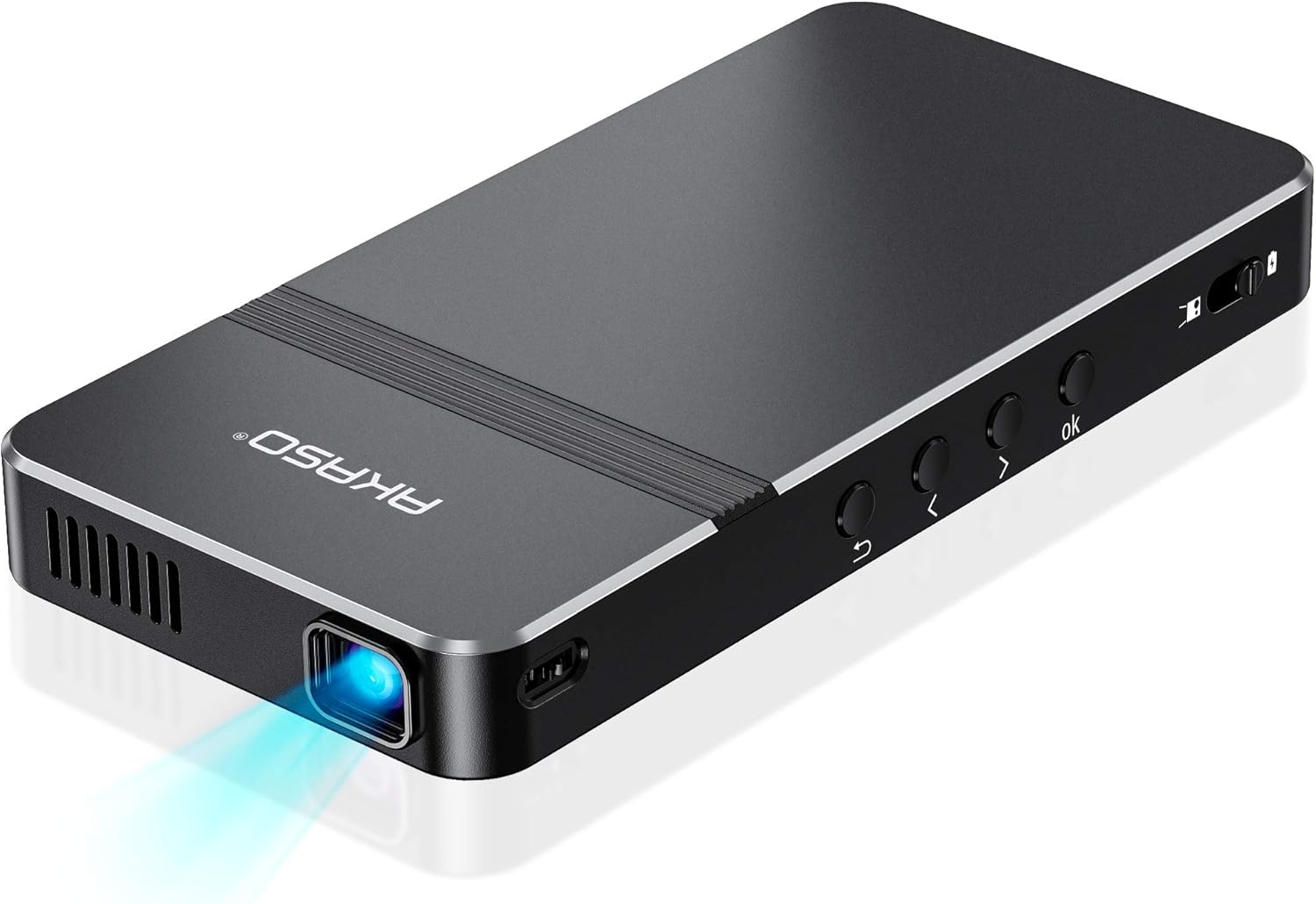
The AKASO Mini Cookie Projector is a palm-sized DLP pico projector designed for users who want big-screen experiences without the bulk of a traditional projector. It targets a wide audience ranging from casual movie watchers and gamers to small business presenters and creative hobbyists who use it for cookie decorating or art tracing. Its pocket-friendly form factor and built-in battery make it one of the more genuinely portable options in its price range.
On the performance side, the projector supports 1080P resolution and delivers a 1000:1 contrast ratio, which produces sharp and detailed images when used in a properly darkened room. The 50 ANSI lumen output is modest, and AKASO themselves recommend a dark environment for the best results, so this is not a projector for bright living rooms or outdoor daytime use. That said, the DLP LED lamp is rated for up to 30,000 hours, which is a strong long-term value proposition.
Connectivity is a genuine strength here. The updated Type-C port joins HDMI, AV, and Micro SD inputs, and wireless mirroring is supported through AirPlay and EZCast for easy smartphone casting. The included tripod and remote control add a layer of everyday convenience that many competing mini projectors skip. Setup is straightforward and the package feels well-rounded for the price.
The most significant drawback is the streaming limitation. Copyrighted content from platforms like Netflix and Hulu cannot be cast wirelessly or through HDMI, which will frustrate users who primarily want to stream. The 2.5-hour battery life is also a consideration for anyone planning to watch full-length films without a nearby outlet. These are real-world limitations worth factoring into your decision.
Overall, the AKASO Mini Projector earns its strong rating by delivering a compact, versatile, and well-equipped package at a reasonable price. It is best suited for users who value portability and creative flexibility over raw brightness. If your use case involves a dark room, short to medium-length content, and a mix of wired and wireless sources, this projector delivers solid value and a genuinely fun experience.
Projection Technology: DLP (Digital Light Processing) with LED light source rated up to 30,000 hours. Supports native and input resolution up to 1080P Full HD.
Brightness and Contrast: 50 ANSI lumens brightness with a 1000:1 contrast ratio. Best performance achieved in dark or dimly lit environments. Screen size adjustable up to 150 inches.
Connectivity: Wired inputs include Type-C (updated from Micro USB as of October 2025), HDMI (cable included), AV, and Micro SD card slot. Wireless connectivity supported via AirPlay and EZCast for screen mirroring from mobile devices.
Battery and Portability: Built-in rechargeable battery with up to 2.5 hours of playback time. Compact pocket-sized form factor with integrated stereo speakers. Tripod and remote control included in the box.
Important Note: Copyrighted streaming content from services such as Netflix and Hulu cannot be mirrored wirelessly or via HDMI cable due to DRM restrictions. A dark environment is strongly recommended for optimal image quality.
Who should buy this projector? The AKASO Mini Projector is an excellent choice for travelers, students, and hobbyists who need a portable display solution without committing to a full-sized unit. It is particularly well-suited for people who want a projector for creative projects like cookie decorating, art tracing, or craft work, as its clear and adjustable image projection fills a niche that most projectors ignore.
Is it good for movies? It can handle movies well in a dark room, but the 50 ANSI lumen brightness means ambient light will wash out the image significantly. Users who primarily want to stream Netflix or Hulu should be aware that DRM restrictions prevent wireless and HDMI mirroring of that content. Local media files via Micro SD or HDMI from a laptop work without issue.
Is it good for business use? Yes, for small meetings and informal presentations it works well. The included tripod and remote control make it easy to set up and operate independently. For larger conference rooms or presentations in bright environments, a higher-lumen projector would be a better fit.
What accessories are included? The box includes an HDMI cable, a tripod, and a remote control, which is a generous bundle for a mini projector. This means you can get started right away without purchasing additional accessories for most common use cases.

Pros
- Extremely portable and lightweight for on-the-go use
- Simple wireless mirroring once connected to the Kodak network
- Sharp, clear image quality thanks to auto-focus and 1080p support
- Versatile connectivity with HDMI, USB, and microSD inputs
- Great niche uses beyond movies, such as projecting templates for crafts and cookie decorating
Cons
- Battery life is short at about 2.5 hours and drains faster when powering external devices like a streaming stick
- Low brightness rating (55 ANSI lumens) makes it best for dim rooms rather than bright environments
- Built-in speaker sound quality is weak, often requiring an external Bluetooth speaker
The KODAK Luma 150 is an ultra-mini pocket projector designed for people who prioritize portability over raw performance. Weighing just 7.5 oz and small enough to fit in a pocket, it targets travelers, campers, and casual users who want a simple, grab-and-go home entertainment or presentation solution.
Its standout features are wireless mirroring via Miracast and AirPlay, along with auto-focus that reduces setup hassle. Reviewers confirm that once connected to the Kodak network and paired with home Wi-Fi, screen mirroring from iPhones and Android devices works smoothly, and image clarity is better than expected for its size. Several users even repurpose it creatively, projecting cookie decorating templates with sharp, clean results.
Build quality feels solid for a device this size, with a touch-based control panel, a tripod mount for flexible placement, and a versatile charging cable that includes multiple plug adapters for international use. The compact footprint and HDMI, USB, and microSD inputs make it easy to connect a variety of media sources without extra accessories.
The trade-offs come from its small size and low power draw. At only 55 ANSI lumens, it performs best in dark or dim rooms rather than bright spaces, and the built-in speaker is noticeably weak, pushing many owners toward external Bluetooth audio. Battery life, rated around 2.5 hours, drops quickly if the projector is also powering an accessory like a streaming stick.
Overall, the KODAK Luma 150 is a solid pick for casual, portable projection needs like bedroom ceiling movies, outdoor gatherings, or hobbyist projects, but it is not meant to replace a full home theater projector. Buyers seeking convenience and mobility over brightness and battery longevity will find good value here.
Pros
- Extremely compact and lightweight design makes it one of the most portable projectors in its class
- DLP technology delivers cleaner, sharper images than comparable LCD mini projectors at this price point
- Built-in Android 9.0 eliminates the need for a separate streaming device, adding great standalone value
- Multiple connectivity options including HDMI, USB, Micro SD, Bluetooth, and wireless mirroring cover virtually every use case
- Long 30,000-hour lamp life means you won't need to worry about bulb replacements for years
Cons
- Native resolution is WVGA (854x480), so while it supports 1080p input, the actual projected image is not true 1080p and may look soft on larger screens
- At only 50 ANSI lumens, brightness is limited and the projector performs best in dim or dark environments, making daytime or well-lit room use difficult
- Battery life of approximately 2 hours may not be enough for longer movies without access to a power source
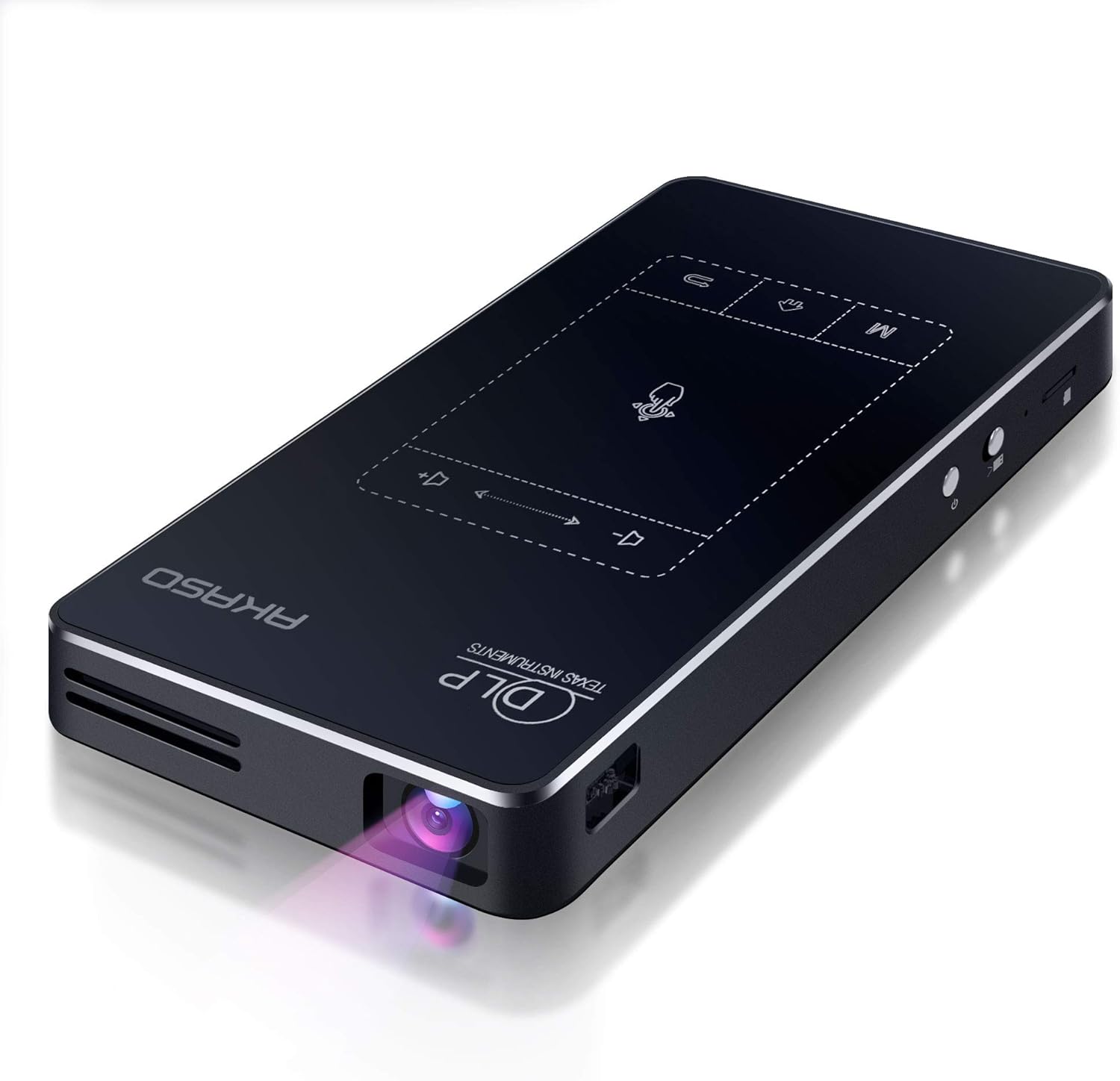
The AKASO WT50 is a palm-sized DLP projector designed for users who want big-screen entertainment without the bulk of a traditional projector. Built around an Android 9.0 system with built-in WiFi, Bluetooth, and a rechargeable battery, it targets movie fans, travelers, outdoor enthusiasts, and even creative hobbyists who need a versatile, go-anywhere display solution.
Performance-wise, the WT50 uses DLP technology with a 0.2 DMD chip, which produces noticeably cleaner and sharper images than LCD-based mini projectors at this price. Colors are vivid and the diffuse reflection design is gentler on the eyes during extended viewing sessions. That said, the native resolution is WVGA (854x480), meaning content is upscaled rather than displayed in true 1080p, so image sharpness on very large screens may not match higher-end projectors.
The build quality is a genuine highlight. The all-metal aluminum alloy casing feels premium and durable for its size, and at just 0.64 lbs, it is remarkably light. The compact footprint, roughly the size of a large smartphone, means it fits in a jacket pocket or small bag with ease. The included mini tripod and remote control add practical value right out of the box.
There are a few trade-offs worth noting. At 50 ANSI lumens, the brightness is modest, and the projector really shines only in dim or dark environments. Outdoor use at dusk or night works well, but daytime use in a lit room will result in a washed-out image. The 2-hour battery life is also a limitation for feature-length films, though a power bank or wall outlet can extend usage. Additionally, Netflix and Hulu cannot be wirelessly mirrored due to DRM restrictions, though you can download their apps directly via Google Play as a workaround.
Overall, the AKASO WT50 is an impressive feat of miniaturization and a genuinely useful portable projector for its price. It is best suited for users who prioritize portability and versatility over raw brightness or pixel-perfect resolution. Whether you are hosting a backyard movie night, decorating cookies with projected templates, or watching videos while camping, the WT50 delivers a compelling and creative experience in a remarkably small package.
Display Technology: DLP (0.2 DMD Optically Processed Chip)
Native Resolution: WVGA 854 x 480, supports up to 1920 x 1080p input
Brightness: 50 ANSI Lumens
Aspect Ratio: 16:9
Projection Size: 30 to 120 inches
Projection Ratio: 1.19:1
Operating System: Android 9.0
WiFi: Dual-band 2.4G and 5G (802.11ac)
Bluetooth: Yes
Screen Mirroring: AirPlay, Miracast, EShare, DLNA
Battery: 3.7V, 5000mAh built-in rechargeable
Battery Life: Approximately 2 to 3 hours
Lamp Life: 30,000 hours
Connectivity: HDMI, 2x USB 2.0, Micro SD (up to 32GB), 3.5mm Audio Jack
Keystone Correction: Automatic, up to 40 degrees
Dimensions: 5.5 x 3.1 x 0.8 inches
Weight: 0.64 lbs
Casing Material: Aluminum Alloy
In the Box: WT50 Projector, Remote Control, Mini Tripod, HDMI Cable, Charger, Quick Reference Guide
If you are considering the AKASO WT50, it helps to understand exactly what kind of projector this is and who it suits best. This is a mini projector built for portability and convenience, not a home theater replacement. If your priority is the sharpest possible 1080p image in a bright living room, a larger, higher-lumen projector will serve you better.
The WT50 is ideal for users who value portability above all else. Campers, travelers, and dorm room users will appreciate the battery-powered design and pocket-friendly size. The built-in Android system is a major convenience, removing the need to carry a separate Chromecast, Fire Stick, or laptop just to stream content. Simply connect to WiFi and download your preferred apps directly onto the projector.
For creative applications, the WT50 has found a surprisingly enthusiastic following. Cookie decorators, mural artists, and holiday decorators use it to project templates and designs onto surfaces with precision. The compact form and short throw distance make it well suited for these close-range creative tasks.
A few practical tips before buying: always use the projector in a dim or completely dark environment for the best image quality. Keep the projection distance between 1 and 1.5 meters for the sharpest focus. For Netflix or Hulu, download the apps directly via Google Play rather than attempting wireless mirroring. And if you plan extended sessions, keep a power bank or charger nearby to supplement the built-in battery.

Pros
- Extremely portable and lightweight design
- Simple, button-based plug-and-play operation
- Multiple input options (HDMI, USB, MicroSD)
- Built-in speaker eliminates need for extra audio equipment
- Tripod-compatible for flexible setup
Cons
- Native display resolution (640 x 360) is far below true 1080p, so fine detail will look soft on larger screens
- Low brightness (35 ANSI lumens) means it only performs well in dark or dim rooms
- Short battery-dependent playback window (up to 1.5-2 hours) limits extended use without a power source
The KODAK Luma 75 is a pocket-sized DLP projector aimed at casual users who want an ultra-portable way to enjoy movies, photos, or games on a bigger screen. It's ideal for travelers, students, or anyone who wants a fun, budget-friendly entertainment option rather than a serious home theater replacement.
Its standout feature is sheer portability, weighing just 6.35 ounces and small enough to slip into a bag or pocket. The DLP engine supports 16.7 million colors and accepts 1080p input, but the display's native resolution of 640 x 360 means actual output detail is closer to standard definition, especially noticeable at larger projection sizes.
Build quality feels solid for its size, with a simple button interface and tripod mount threading on the bottom for stable setups. The onboard media player supports MicroSD, USB, and HDMI, making it easy to plug in a laptop, streaming stick, or gaming console without fuss.
The main drawbacks are its low brightness rating of 35 ANSI lumens, which restricts good use to dark or dim rooms, and a fairly short built-in playback time. It's also worth noting the marketing '1080p' label refers to input compatibility, not native output sharpness.
Overall, the KODAK Luma 75 delivers on its promise as a fun, ultra-portable pocket projector for casual viewing, but buyers expecting sharp, true HD detail or bright daytime performance should look elsewhere. For quick backyard movie nights or travel entertainment, it's a solid, affordable choice.
Technology: DLP Optical Engine, LED Display
Resolution: Supports 1920 x 1080 input, native display output of 640 x 360
Brightness: 35 ANSI lumens, best used in dark or dim rooms
Screen Size: Up to 100 inches
Connectivity: HDMI, USB 2.0, MicroSD, 3.5mm audio output
Dimensions: 3.46" x 3.46" x 0.91", Weight: 6.35 ounces
Extras: Built-in 1W speaker, tripod mount threading, onboard media player
Pros
- Extremely compact and lightweight tri-fold design
- Fast, accurate auto focus and keystone correction
- Easy no-Wi-Fi screen mirroring for quick setup
- Doubles as a Bluetooth 5.4 speaker
- Backed by a 2-year warranty and SGS-verified brightness rating
Cons
- Only 100 ANSI lumens and a 300:1 contrast ratio limit use to dim or dark rooms
- Battery lasts just 1.5 hours in eco-mode, so longer sessions require plugging in
- DRM-protected streaming apps require an additional CastPlay Pro dongle sold separately
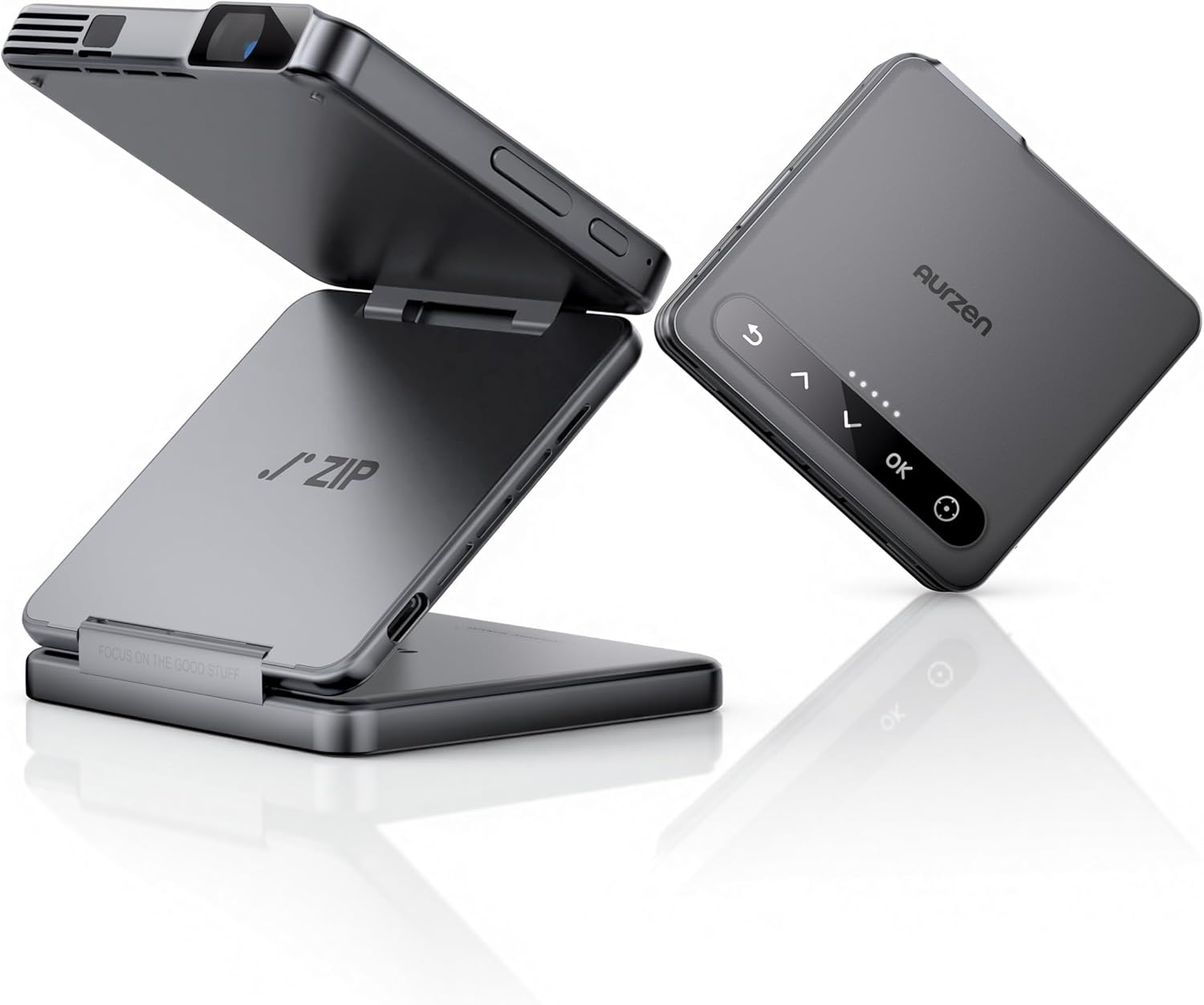
The Aurzen ZIP is a pocket-sized DLP projector aimed at people who value portability above all else. Its tri-fold, wallet-size design and built-in stand make it a natural fit for travelers, crafters, and anyone who wants a grab-and-go screen without lugging around a full-size projector.
Where the ZIP shines is in its smart engineering: ToF-based auto focus continuously adjusts the image 30 times per second, keeping content sharp even when the projector is moved or repositioned, which is especially useful for tracing, cookie decorating, or sewing projects. One-click mirroring works without Wi-Fi, and the vertical mode is a nice touch for viewing social media or sports clips in their native aspect ratio.
Build quality feels purposeful rather than premium, with a Dark Grey plastic shell that prioritizes weight savings over rigidity. At just 0.62 lb and roughly the size of a large smartphone when folded, it genuinely disappears into a bag or even a large pocket, and the integrated stand removes the need for extra accessories.
The tradeoffs are clear once you look past the form factor: 100 ANSI lumens and a 300:1 contrast ratio mean this is not a projector for bright rooms or detailed movie nights, and the 1.5-hour battery life is best supplemented with wall power for longer use. Streaming apps with DRM protection also require a separately sold CastPlay Pro dongle, and Google Cast devices are not supported at all.
Overall, the Aurzen ZIP is best understood as a creative and travel companion rather than a home theater replacement. If you want an ultra-portable screen for tracing, casual mirroring, or quick entertainment on the move, it delivers convincingly; if you need strong brightness or all-day battery life, look elsewhere.
The ZIP uses DLP display technology with a native resolution of 1280 x 720 (720p) and supports 1080p input signals. Brightness is rated at an SGS-certified 100 ANSI lumens, with a 300:1 contrast ratio and a maximum image size of 125 inches at a 9.8-foot throw distance.
Connectivity includes Bluetooth 5.4 for audio pairing and USB-C for both charging and DisplayPort Alt Mode mirroring. The built-in 5000mAh battery supports up to 1.5 hours of eco-mode playtime and can be recharged via USB-C PD, with simultaneous charge-and-play requiring a 24W or higher adapter.
Physically, the projector measures 3.3 x 3 x 1 inches when folded and weighs 0.62 lb, making it one of the smallest DLP projectors on the market. It ships with a Type-C fast charging cable, user manual, and welcome card, and is backed by a 2-year manufacturer warranty.

Pros
- Very affordable price point for a portable projector
- Small, lightweight, and easy to transport
- Battery power adds flexibility for outdoor or on-the-go use
- Popular and effective for niche uses like cookie decorating and tracing
- Long-lasting DLP lamp reduces long-term maintenance costs
Cons
- Low native resolution (640x360) and only 20 lumens limit image clarity and brightness
- Connecting smartphones, especially iPhones, often causes image skewing or requires extra adapters
- No built-in Bluetooth, so an HDMI cable is required for most device connections
The APIO AP106 is a mini DLP pocket projector designed for casual, budget-conscious users who need a portable display solution rather than a true home theater centerpiece. It's a great fit for hobbyists, students giving quick presentations, or anyone looking for a fun, low-cost way to project images, such as decorators tracing designs onto cookies.
Its standout feature is portability: the projector weighs under a pound and fits easily in a bag, thanks to its compact 3.46-inch footprint. The built-in 2600mAh battery allows up to two hours of cord-free projecting, and the dual 1W speakers offer decent built-in sound for a device this small.
Build quality feels appropriate for the price, with simple touch controls and standard HDMI and USB ports for connecting laptops, DVD players, and gaming consoles. However, the 640x360 native resolution and 20-lumen brightness are quite low, meaning images work best in dim rooms and at short throw distances rather than for detailed movie watching.
The most common drawback reported by users involves smartphone connectivity, particularly with iPhones, where image scaling and skewing become noticeable issues. Since there's no Bluetooth, an HDMI cable and possibly an adapter are required for most phone connections, which can be inconvenient for some buyers.
Overall, the APIO AP106 delivers solid value for specific, low-demand use cases like cookie decorating, tracing projects, or simple laptop-based presentations. It's not a home theater replacement, but for its price and portability, it does what it promises for the right audience.

Pros
- Compact, pocket-sized form factor is easy to carry anywhere
- Autofocus makes setup fast and hassle-free
- Decent built-in speaker for casual indoor viewing
- Long-lasting LED lamp rated for 20,000 hours
- Full accessory bundle included at no extra cost
Cons
- Actual brightness reportedly falls well short of the advertised 400 ANSI lumens
- No sleep or auto-shutoff function, screen stays on at full brightness indefinitely
- Compatibility issues reported when connecting directly to iPhones and iPads
The APIO AP225 is a compact DLP pocket projector aimed at casual users who want a portable home theater or outdoor entertainment solution without spending a fortune. It supports 1080p input with a native 720p resolution, making it a fit for movie nights, gaming, or even novelty uses like projecting cookie designs, as one reviewer creatively did.
Its standout feature is portability: the built-in 6600mAh battery allows up to two hours of untethered use, and the pocket-sized body slips easily into a bag. Autofocus and auto keystone correction simplify setup considerably, and the bundled 7-piece accessory kit, including HDMI, USB-C, and micro HDMI adapters, means you can start projecting right away with almost any device.
Build quality seems adequate for casual use, with a simple button-based control scheme rather than a remote. However, some users found the lack of a sleep mode frustrating, since falling asleep mid-movie means waking up to a blindingly bright white screen. The design also isn't suited for ceiling mounts, limiting placement options to tabletop setups only.
The biggest drawback reported is brightness. Despite the 400 ANSI lumen rating, at least one reviewer compared it more to a 35-lumen unit in real-world use, and some had trouble connecting directly to iPhones or iPads. These issues suggest the projector performs best in darker rooms with Android devices, laptops, or streaming boxes via HDMI.
Overall, the APIO AP225 is a budget-friendly, ultra-portable projector well-suited for casual indoor movie nights, camping trips, or quirky creative projects. It's not built for bright rooms or seamless Apple device pairing, but if your expectations are realistic and portability is the priority, it delivers solid value for the price.
How to Choose Your DLP Pocket Projector
Connectivity and Ease of Use
Wireless screen mirroring via AirPlay or Miracast is a major convenience, eliminating the need for cables during presentations or movie streaming. Some models, like the KODAK Luma 150 Mini Projector, Black, 1080p Input, offer this seamlessly. Others rely on wired Type-C or HDMI connections, which can be simpler but less flexible. Consider your primary devices and whether you prefer a plug-and-play setup or the freedom of wireless casting. Built-in operating systems, like Android on the AKASO WT50 Mini Projector with WiFi and Bluetooth, add smart functionality for app use without an external source.
Portability and Battery Performance
True pocket projectors should be lightweight and compact, often weighing under a pound. The KODAK Luma 75 Mini Projector, Portable Projector is famously palm-sized. Battery life is equally important, determining how long you can enjoy content away from an outlet. Look for rated playtimes, which typically range from 1.5 to 2.5 hours on a single charge. Some models support pass-through charging, allowing you to use them while plugged in, which is perfect for longer sessions.
Image Quality and Brightness
DLP technology provides excellent contrast and color accuracy, but specifications vary. Native resolution (like 720p or 1080p support) and ANSI lumens (brightness) are key. Higher lumens perform better in rooms with ambient light, but most pocket projectors are optimized for dark environments. Features like auto-focus and keystone correction, found on the MARS DLP Mini Projector, Auto Focus 720P Outdoor, ensure a sharp, rectangular image even when the projector is placed at an angle.
Specialized Use Cases
Beyond movies, some projectors cater to specific hobbies. Models with vertical screen modes and precise focus are ideal for creative tracing, cookie decorating, or crafts. The unique tri-fold Aurzen ZIP Tri-Fold DLP Pocket Mini Projector is designed for this. If you need a projector that can also function as a power bank for your phone or has built-in speakers for standalone audio, check the port specifications and audio output options. For more options focused on untethered use, see our selection of the best rechargeable pocket projectors.
Final Thoughts
Selecting the right DLP pocket projector hinges on balancing portability with the features you value most. For users who prioritize a complete, wireless-ready kit with a screen and tripod, the KODAK Luma 150 Type 4 Pocket DLP Pico Projector is a standout choice. Conversely, if your primary need is extreme compactness and innovative design for creative projects or travel, the Aurzen ZIP Tri-Fold DLP Pocket Mini Projector offers a uniquely portable form factor. We hope this detailed assessment helps you bring your big-screen dreams anywhere you go.
Frequently Asked Questions
Can I stream Netflix or Hulu directly from a pocket projector?
Most pocket projectors cannot directly stream DRM-protected content from apps like Netflix via wireless screen mirroring due to copyright restrictions. However, models with a built-in Android operating system allow you to download the streaming apps directly onto the projector and watch content that way. Always check the manufacturer’s notes on content compatibility for the specific model.
How big of a screen can a pocket projector realistically create?
While many DLP pocket projectors advertise screen sizes up to 120 or 150 inches, the ideal viewable size is often smaller for maintaining image brightness and clarity. A screen between 60 to 100 inches typically provides the best balance of size and picture quality, especially in a darkened room. The projection distance and the projector’s lumen rating are the main limiting factors.
What is the main advantage of DLP over LCD in a mini projector?
DLP (Digital Light Processing) technology generally offers higher contrast ratios, smoother motion handling, and a more compact optical engine compared to LCD. This often results in sharper images without the “screen door” effect sometimes seen on LCD models. DLP projectors also tend to have sealed optics, which better resist dust accumulation over time. For a wider selection of smart-enabled portable models, consider our review of the best smart pocket projectors available in 2026.
Are pocket projectors suitable for outdoor daytime use?
Pocket projectors are designed for portability, but their brightness is limited compared to larger home theater models. They work best outdoors after sunset or in a very shaded area. For a satisfactory image in any condition with ambient light, you need a significantly darker environment than you would for a standard TV.




Write Your Review
No reviews yet. Be the first to share your experience!