

You’ve invested in a stunning 4K laser projector, but are you getting the full cinematic experience it promises? The truth is, even the most advanced projector can’t perform its magic on a plain wall or a subpar screen. The right screen is the final, critical piece that unlocks true color accuracy, sharp detail, and immersive contrast, especially when working with a budget under $1500. This guide is designed for home theater enthusiasts and smart homeowners who want to maximize their projector’s potential without overspending. We’ve assessed the latest models from top brands like JMGO, NothingProjector, and Valerion to find screens that deliver professional-grade performance. For a broader look at options, you can explore our guide on the top 5 4K laser TV screens.
| Pick | Product | AI Score | Buy |
|---|---|---|---|
 AWOL Valerion 150" PureVision Fixed Frame
|
9.9/10 | Buy on Amazon | |
| Prime |
 NothingProjector 132" ALR Screen for Ultra Short
|
9.9/10 | Buy on Amazon |
 NothingProjector 120" ALR Fresnel Screen for
|
9.8/10 | Buy on Amazon | |
| Prime |
 ViewSonic LX700-4K Laser Projector - 3500 Lumens
|
9.4/10 | Buy on Amazon |
| Prime |
 JMGO N1S Ultra 4K Triple Laser Projector
|
N/A | Buy on Amazon |
Pros
- Reduces laser speckle noticeably compared to standard projector screens
- True 1.0 gain preserves accurate, natural color reproduction
- Wide 170-degree viewing angle suits group viewing and large rooms
- Slim bezel and tensioned frame give a premium, theater-like appearance
- Works with both long throw and UST laser projector setups
Cons
- Premium price point compared to standard fixed frame screens
- Large 150-inch size requires significant wall space and careful installation
- Limited review history makes long-term durability hard to confirm
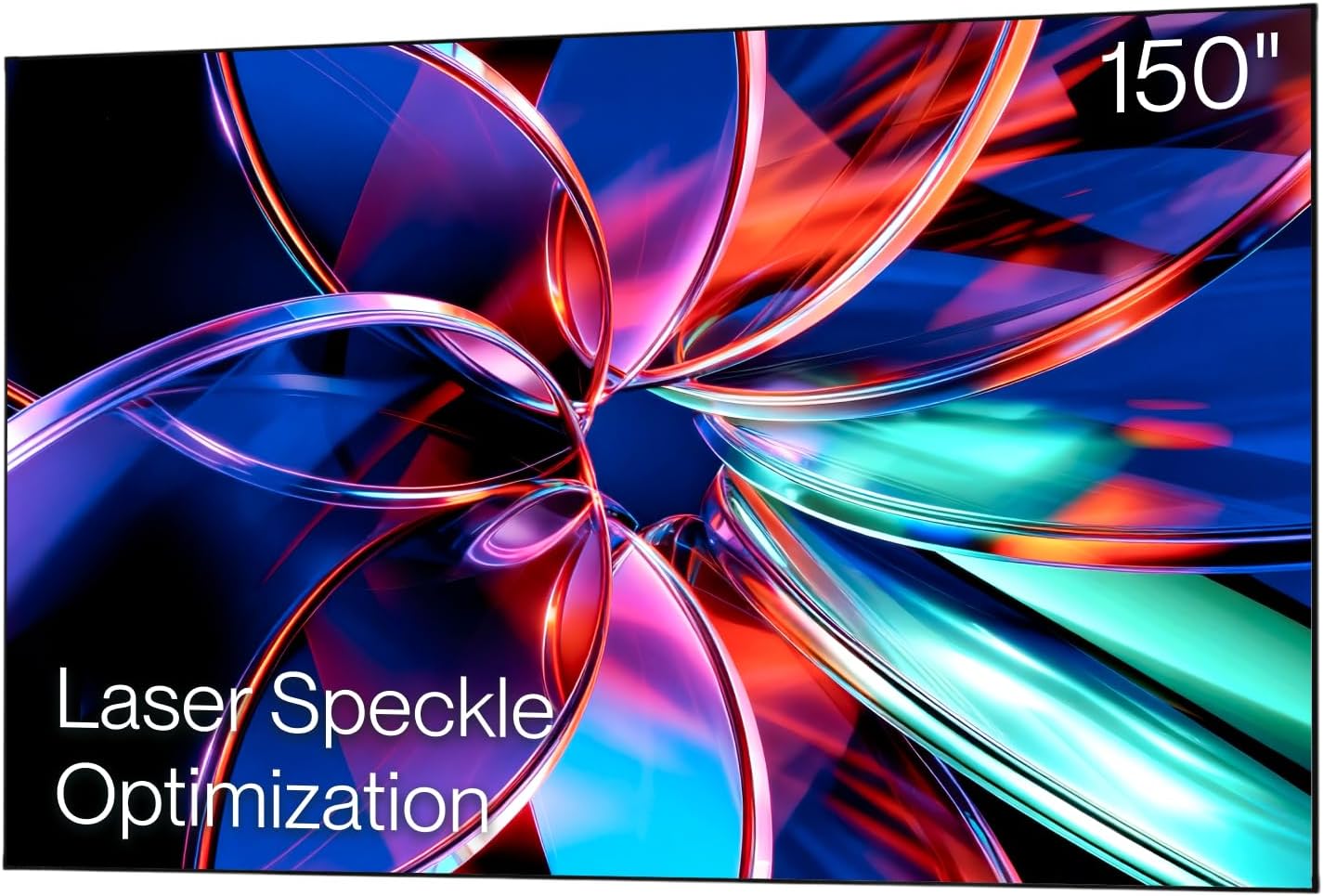
The AWOL Valerion 150-inch PureVision screen is a fixed frame projection screen purpose-built for owners of premium RGB laser projectors. It targets home theater enthusiasts who already own or plan to own a high-end laser or UST projector and want a screen engineered specifically to complement that light source rather than a generic matte panel.
The standout feature is the PureVision PET matte coating, designed to reduce laser speckle, a common visual artifact with RGB laser projectors that can create a shimmering or grainy texture. Paired with a 1.0 gain surface, the screen aims to preserve the projector's native brightness and color accuracy rather than artificially boosting contrast, which should result in a more natural, true-to-source image across movies, sports, and gaming.
Build quality centers on an aluminum fixed frame with a slim 10mm bezel and a spring-tension structure that keeps the PET material taut and flat, which is critical for maintaining sharp, distortion-free images at large sizes and high resolutions up to 8K. The 170-degree viewing angle also suggests the screen is designed with group viewing in mind, maintaining consistent brightness and color for viewers seated off-center.
Potential drawbacks include the premium price relative to standard fixed frame screens and the sheer size and installation effort required for a 150-inch panel, which demands dedicated wall space and careful mounting. Since this is optimized for laser projectors specifically, buyers using traditional lamp-based projectors may not see the same speckle-reduction benefits.
Overall, this screen is a strong match for serious home theater builders investing in a laser or UST projector setup who want a screen tuned to minimize laser-specific artifacts while keeping color and brightness faithful to the source. Casual buyers or those using standard projectors may not need this level of specialization.
Screen size: 150 inches diagonal, with display dimensions of 132 x 74 inches and overall frame dimensions of 74W x 131.5H inches.
Screen finish is matte PET material with a 1.0 gain rating, supporting resolutions up to 8K and a 170-degree wide viewing angle for consistent image quality across seating positions.
The frame uses an aluminum enclosure with a slim 10mm bezel and spring-tension design for wall or ceiling mounting, and is compatible with both long throw and ultra short throw projector types. The product carries a 1 year manufacturer warranty.
Pros
- Largest seamless ALR screen size currently available at 132 inches
- Strong ambient light rejection makes it usable in rooms that aren't fully dark
- Supports the latest 4K, 8K, 3D, and HDR sources
- Wide 170-degree viewing angle with a minimal, ultra-thin bezel
- Backed by a 1-year manufacturer warranty
Cons
- Premium price point that puts it well above standard fixed-frame screens
- Large 114" x 64" footprint requires a dedicated wall and careful space planning
- No established review history yet, so long-term durability is unproven
The NothingProjector 132" ALR Screen is purpose-built for ultra short throw projector setups, targeting home theater enthusiasts who want a genuinely large-format image without sacrificing picture quality to ambient light. At 132 inches, it pushes past the common 120-inch ceiling seen on most ambient light rejecting screens, making it a rare option for buyers who want to go bigger without switching to a segmented or tiled design.
The standout feature here is the combination of size and seamlessness. Most ALR screens over 120 inches require multiple panels or a segmented lens structure, which can introduce visible seams under certain lighting. This screen instead uses a single seamless lens, which should translate to a cleaner, more cohesive image, especially noticeable during panning shots or bright scenes.
Build quality appears solid on paper, with HBSP screen material designed to outperform basic CBSP alternatives and plain wall projections. It supports 4K, 8K, 3D, and HDR sources, so it's positioned to handle current and near-future content formats. The 170-degree viewing angle and 0.4-inch ultra-thin bezel further suggest a design focused on immersive, distraction-free viewing across a wide room layout.
On the drawback side, this is a premium-priced, large-format product, meaning it demands a dedicated wall space and a real commitment in terms of budget and room planning. It's also a newer listing with no accumulated customer reviews yet, so buyers are relying primarily on the manufacturer's claims rather than field-tested feedback.
Overall, this screen looks like a strong pick for anyone building a serious ultra short throw projector home theater in a room with some ambient light, particularly if a massive, seamless image is a top priority. Budget-conscious buyers or those with smaller rooms may want to consider a more modestly sized alternative.
Pros
- Noticeably brighter and more vibrant image quality compared to standard ALR screens
- Excellent daytime and ambient-light performance confirmed by multiple reviewers
- Sharp 4K detail with deep blacks and strong contrast
- Sleek, minimalist thin-bezel frame that disappears once the projector is on
- Sturdy, well-packaged construction that holds up once assembled
Cons
- Assembly instructions are poorly translated and unclear, making setup harder than it should be
- Requires two people and roughly an hour to properly assemble and tension the screen
- Premium price point relative to standard projection screens
The NothingProjector 120-inch ALR Fresnel Screen is designed specifically for ultra short throw (UST) projectors, aiming to combine ambient light rejection with a Fresnel lens structure to boost brightness and sharpness. It's aimed at home theater users who want a big-screen experience without a dedicated light-controlled room.
In real-world use, reviewers consistently praise how much brighter and punchier the image looks compared to a standard ALR screen. The 1.2 gain and 99.7% Rec.709 color gamut translate into vivid colors and strong contrast, with 4K content appearing crisp and detailed even with some room light present. Owners pairing it with projectors like the Epson LS650 and AWOL UST report being able to watch comfortably in broad daylight.
Build quality is a highlight, with a thin 0.4-inch bezel that nearly disappears once the projector is running, adding to the immersive feel. The frame and screen material feel sturdy and premium once assembled, and the unit can be moved without falling apart, though it takes some care.
The main drawback isn't the screen itself but the assembly process. Multiple reviewers flagged confusing, seemingly machine-translated instructions with small diagrams and missing steps, often requiring two people and close to an hour to get the screen straight and properly tensioned.
Overall, this is a strong choice for anyone serious about UST projection who wants better brightness and color performance than a typical ALR screen, as long as they're prepared for a somewhat frustrating setup process before enjoying a genuinely impressive picture.
The screen measures 105 inches wide by 59 inches tall, offering a 120-inch diagonal viewing area with a 16:9 aspect ratio suited for movies, sports, and gaming.
Constructed from Fresnel PET material with an HSBP finish, the screen features an eight-layer optical structure and supports a 90-degree viewing angle for flexible seating arrangements.
It is wall-mounted with manual setup, backed by a 1-year manufacturer warranty, and compatible with 4K and 3D content for versatile home entertainment use.
Pros
- Extremely low input lag and high refresh rate ideal for gaming
- Bright enough to use with some ambient light in the room
- Long-lasting laser light source with minimal maintenance
- Versatile mounting and adjustment options including 360-degree projection
- Strong warranty coverage with three years on parts and labor
Cons
- Higher price point compared to standard home theater projectors
- USB connectivity limited to USB-A 2.0, lacking newer USB-C options
- Gaming-focused feature set may be overkill for buyers wanting a pure cinema projector
The ViewSonic LX700-4K is a 4K laser projector purpose-built for gamers, developed in partnership with Microsoft as an officially "Designed for Xbox" device. It's aimed squarely at console and PC gamers who want a massive screen without giving up the responsiveness expected from a proper gaming display, while still doubling as a capable home theater unit.
Pros
- Fully automated setup: focus, keystone, screen fit, and obstacle avoidance all handled by sensors
- Wide color gamut (110% BT.2020) and low blue light laser design for accurate, eye-friendly color
- Google TV built-in removes the need for external streaming devices
- Strong connectivity with dual HDMI 2.1, USB, WiFi 6, and Bluetooth 5.2
- Portable design with a long 35,000-hour laser light source lifespan
Cons
- 1600:1 contrast ratio is modest compared to JMGO's own N3 Ultimate (20000:1)
- 2800 lumens is bright for a home projector but not ideal for very large screens in daylight
- Premium price point puts it in competition with higher-brightness laser projectors
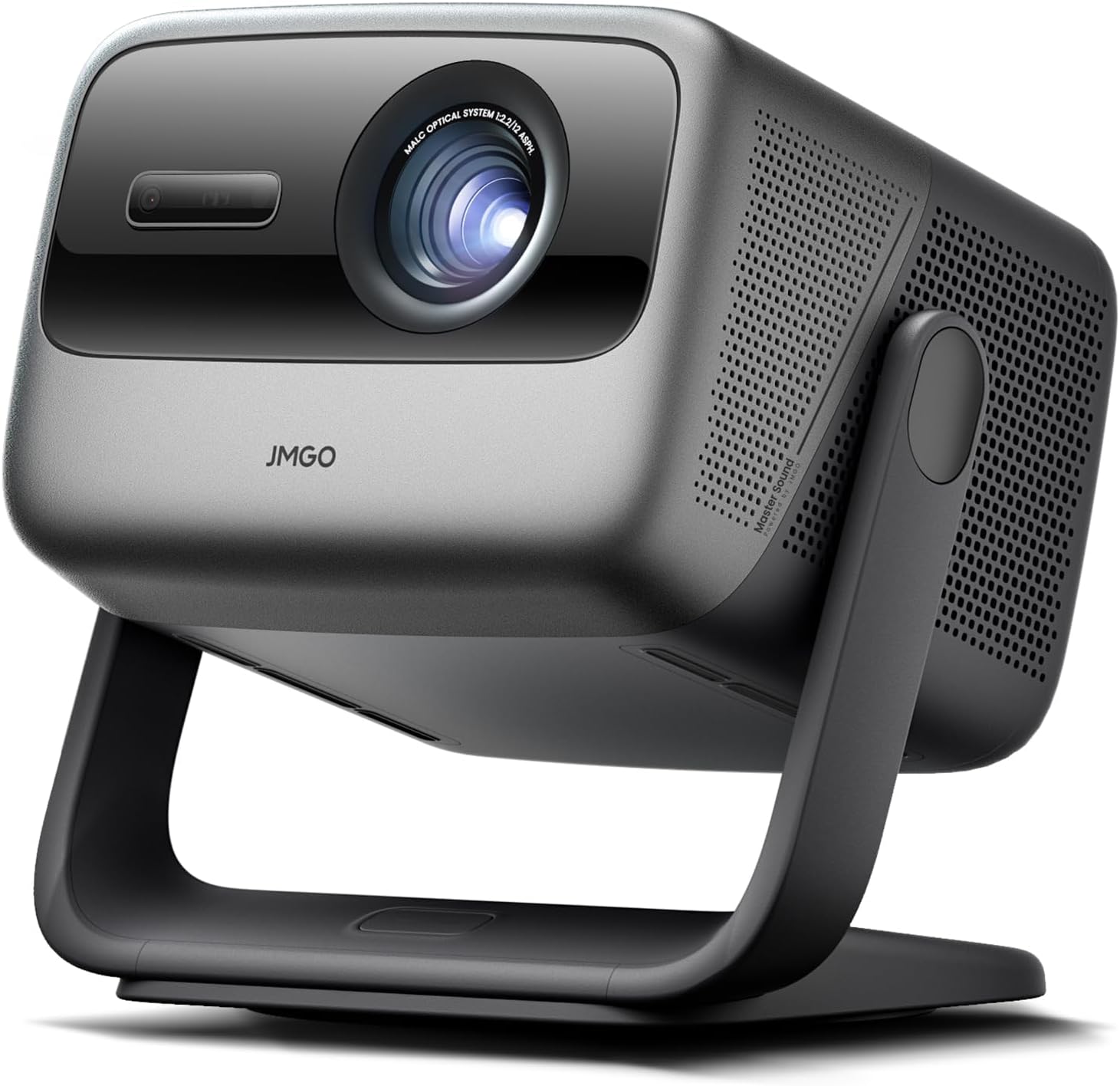
The JMGO N1S Ultra 4K is a triple RGB laser projector built for buyers who want a genuine home theater setup without the hassle of manual calibration. It's a strong fit for home cinema enthusiasts, gamers, and anyone who wants a plug-and-play big screen experience up to 300 inches.
What stands out most is JMGO's smart adaptive system. Using a 3D TOF sensor and CMOS camera, the projector handles auto-focus, keystone correction, screen alignment, and obstacle avoidance in real time, so the image stays sharp and properly framed even if you move the unit or the surface changes. Paired with 2800 ISO lumens and a 110% BT.2020 color gamut, everyday viewing looks vivid even with some ambient light present.
Build quality reflects JMGO's portable-projector design language, compact at under 10 inches per side and just under 10 pounds, with a built-in gimbal for flexible placement. The inclusion of dual HDMI 2.1 ports, WiFi 6, Bluetooth 5.2, and Google TV baked in means fewer external boxes cluttering the entertainment setup.
The main tradeoff is contrast and brightness headroom. At 1600:1 contrast and 2800 lumens, it sits below JMGO's own N3 Ultimate, which offers 20000:1 contrast and over double the brightness, so very large screens in bright rooms may not look as punchy. It's also a premium-priced unit, so buyers should weigh it against similarly specced competitors.
Overall, the N1S Ultra 4K is a well-rounded, convenience-focused 4K laser projector that removes most of the friction typically associated with home projection setups. It's an easy recommendation for anyone prioritizing automated picture accuracy and smart features over chasing the highest brightness or contrast numbers.
The N1S Ultra 4K features native 3840 x 2160 resolution with HDR10 support and a triple-laser RGB light engine rated at 2800 ISO lumens and 35,000 hours of operating life.
Contrast ratio is 1600:1 FOFO with a 110% BT.2020 color gamut and ΔE<1 color accuracy. Projection size ranges from 60 to 300 inches, with a throw distance between 5.2 and 25.1 feet.
Connectivity includes dual HDMI 2.1 ports, one USB 2.0 port, WiFi 6, and Bluetooth 5.2, plus a 3.5mm audio output. Audio is handled by 20W dual speakers with Dolby Digital Plus and bass response down to 45Hz.
The unit runs Google TV out of the box, weighs 9.9 pounds, and measures roughly 9.57 x 8.27 x 9.37 inches, backed by a 1-year manufacturer warranty.
How to Choose Your 4K Laser TV Screen
Screen Material and Gain
The screen’s surface material directly impacts brightness and color. A 1.0 gain screen, like that on the AWOL Valerion 150″ PureVision Fixed Frame, preserves your projector’s native brightness accurately. For rooms with some ambient light, screens with higher gain or specialized materials like Fresnel or ALR (Ambient Light Rejecting) can boost perceived brightness and improve contrast. Always match the gain to your room’s lighting conditions for the best results.
Ambient Light Rejection (ALR) Technology
If your viewing space isn’t completely dark, ALR technology is a game-changer. It selectively reflects projector light toward the viewer while rejecting light from other angles, such as lamps or windows. This capability is central to screens like the NothingProjector ALR models, allowing for watchable images even during daytime. Consider an ALR screen if you desire a versatile, living-room-friendly setup without needing blackout curtains for every viewing session.
Viewing Angle and Size Compatibility
A wide viewing angle ensures everyone on the couch enjoys a consistent picture. Look for angles of 170 degrees or more for true flexibility in seating arrangements. Equally important is ensuring the screen’s size and format match both your room’s dimensions and your projector’s throw capabilities. Fixed-frame screens offer a perfectly flat surface for optimal focus, which is essential for 4K clarity. Proper planning here prevents installation headaches later.
Compatibility with Your Projector
Not all screens work optimally with all projectors. Ultra-short-throw (UST) projectors often require specific screens to avoid hotspots or distortion. Confirm that your chosen screen is validated for use with UST models if that’s your projector type. Screens designed for laser projectors may also include speckle-reduction features to create a smoother image texture. Checking compatibility ensures you get the visual performance you paid for. For more on integrating your entire system, see our expert guide to the best 4K laser TV stands.
Final Thoughts
Selecting the right screen fundamentally transforms your 4K laser TV experience, elevating it from a simple projection to a captivating home theater. For viewers prioritizing a pristine, theater-like image in a controlled light environment, the fixed-frame design and speckle-reduction of the AWOL Valerion 150″ PureVision Fixed Frame is an outstanding choice. Conversely, if your setup faces ambient light challenges and you value a massive, seamless display, the innovative NothingProjector ALR Screen for Ultra Short Throw provides a compelling solution. Each product we reviewed brings distinct strengths, ensuring you can find the perfect visual canvas for your entertainment.
Frequently Asked Questions
Can I use a regular projector screen with a 4K laser TV?
While you can, you likely won’t achieve optimal performance. Standard screens may not resolve the full detail of 4K content or properly handle the unique light characteristics of laser projectors. Screens designed for 4K and laser sources, like those in our guide, are engineered to reduce speckle and enhance contrast, delivering the clarity and color fidelity you expect.
Is an ALR screen necessary for a dedicated home theater room?
In a dedicated, light-controlled theater, a high-quality matte white or grey screen (non-ALR) often provides the most accurate color and widest viewing angle. ALR screens excel in rooms with ambient light. For a pure, dark-room experience, a fixed-frame screen like those discussed in our definitive guide to fixed frame screens is typically the preferred choice among enthusiasts.
What is the main advantage of a fixed-frame screen over a pull-down model?
The primary advantage is a perfectly flat, permanently tensioned surface. This eliminates waves or curls, which can distort the image and compromise sharpness, a critical factor for 4K resolution. A fixed frame provides a permanent, professional installation that consistently delivers the best possible picture quality.
How do I know what screen size is right for my room?
A common guideline is that the ideal viewing distance is 1.5 to 2.5 times the screen’s diagonal width. Measure the distance from your primary seating to the wall, then calculate the compatible screen size. Also, verify your projector’s throw ratio to ensure it can fill your desired screen size from its mounting position. Proper planning ensures an immersive yet comfortable viewing experience.


Write Your Review
No reviews yet. Be the first to share your experience!